
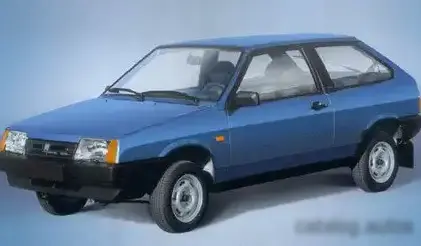
The Lada 21081 1.1, producing 54 horsepower, represents an entry-level variant of the Lada 2108 series, manufactured between 1984 and 1997. This model was a significant step forward for AvtoVAZ, the Soviet automotive manufacturer, as it was the first front-wheel-drive Lada and a departure from the rear-wheel-drive designs that had characterized the brand for decades. The 21081, specifically with the 1.1-liter engine, served as the base model, aimed at providing affordable transportation to a broad segment of the Soviet and, later, Russian market. It was built on the 2108 platform, internally designated as the 21081, and played a crucial role in modernizing the Lada lineup.
Technical Specifications
| Brand | Lada |
| Model | 2108 |
| Generation | 21081 |
| Type (Engine) | 1.1 (54 Hp) |
| Start of production | 1984 |
| End of production | 1997 |
| Powertrain Architecture | Internal Combustion engine |
| Body type | Hatchback |
| Seats | 5 |
| Doors | 3 |
| Fuel consumption (urban) | 8.2 l/100 km (28.7 US mpg) |
| Fuel Type | Petrol (Gasoline) |
| Acceleration 0 – 100 km/h | 18 sec |
| Acceleration 0 – 62 mph | 18 sec |
| Acceleration 0 – 60 mph | 17.1 sec |
| Maximum speed | 140 km/h (86.99 mph) |
| Weight-to-power ratio | 16.7 kg/Hp |
| Weight-to-torque ratio | 11.4 kg/Nm |
| Power | 54 Hp @ 5600 rpm |
| Power per litre | 49.1 Hp/l |
| Torque | 79 Nm @ 3600 rpm (58.27 lb.-ft. @ 3600 rpm) |
| Engine layout | Front, Transverse |
| Engine displacement | 1100 cm3 (67.13 cu. in.) |
| Number of cylinders | 4 |
| Engine configuration | Inline |
| Cylinder Bore | 76 mm (2.99 in.) |
| Piston Stroke | 60.6 mm (2.39 in.) |
| Compression ratio | 9:1 |
| Number of valves per cylinder | 2 |
| Fuel injection system | Carburettor |
| Engine aspiration | Naturally aspirated engine |
| Valvetrain | OHC |
| Kerb Weight | 900 kg (1984.16 lbs.) |
| Max. weight | 1325 kg (2921.12 lbs.) |
| Max load | 425 kg (936.96 lbs.) |
| Trunk (boot) space – minimum | 270 l (9.53 cu. ft.) |
| Trunk (boot) space – maximum | 1000 l (35.31 cu. ft.) |
| Fuel tank capacity | 43 l (11.36 US gal) |
| Length | 4006 mm (157.72 in.) |
| Width | 1650 mm (64.96 in.) |
| Height | 1402 mm (55.2 in.) |
| Wheelbase | 2460 mm (96.85 in.) |
| Front track | 1400 mm (55.12 in.) |
| Rear (Back) track | 1370 mm (53.94 in.) |
| Drivetrain Architecture | Front wheel drive |
| Number of gears and type of gearbox | 5 gears, manual transmission |
| Front suspension | Spring Strut |
| Rear suspension | Coil spring |
| Front brakes | Disc |
| Rear brakes | Drum |
| Assisting systems | ABS (Anti-lock braking system) |
| Steering type | Steering rack and pinion |
| Tires size | 165/70 SR13 |
Powertrain & Engine Architecture
The heart of the 21081 1.1 was the VAZ-2108 engine, a 1.1-liter (1089 cc) inline-four cylinder engine. This engine utilized a single overhead camshaft (OHC) design with two valves per cylinder. Crucially, this base model was equipped with a carburetor fuel system, a cost-saving measure compared to the fuel injection found on higher-spec versions. The carburetor, typically a K-126G, was relatively simple and easy to maintain, but offered less precise fuel metering and lower performance than fuel injection. The engine produced 54 horsepower at 5600 rpm and 79 Nm (58.27 lb-ft) of torque at 3600 rpm. The engine’s relatively low compression ratio of 9:1 allowed it to run on the lower octane fuel commonly available in the Soviet Union and Eastern Europe. The 21081 was exclusively offered with a five-speed manual transmission, designed to maximize fuel efficiency and provide adequate acceleration given the engine’s modest power output.
Driving Characteristics
The driving experience in the 21081 1.1 was characterized by its simplicity and affordability. Acceleration was slow, with a 0-60 mph time of around 17.1 seconds, and a top speed of 140 km/h (87 mph). The carburetor engine delivered power in a relatively narrow band, requiring frequent gear changes to maintain momentum, especially when climbing hills or overtaking. Compared to the more powerful 1.5-liter and 1.6-liter versions of the 2108, the 1.1 felt noticeably underpowered. However, the lighter weight of the 1.1-liter engine contributed to slightly better handling and fuel economy. The five-speed manual transmission was relatively notchy but functional, and the steering, while not particularly precise, provided adequate feedback.
Equipment & Trim Levels
The 21081 1.1 was the most basic trim level in the 2108 range. Standard equipment was minimal, reflecting its position as an entry-level vehicle. It typically included cloth upholstery, a basic dashboard with analog gauges, and manual windows and door locks. Optional extras were limited, but could include a radio, upgraded seat covers, and sometimes, a sunroof. The interior was functional but spartan, with a focus on durability rather than luxury. The exterior featured steel wheels, black plastic bumpers, and minimal chrome trim.
Chassis & Braking
The 21081 utilized a MacPherson strut front suspension and a coil spring rear suspension. The suspension setup was tuned for comfort rather than sporty handling, providing a relatively smooth ride on uneven roads. The front brakes were disc brakes, while the rear brakes were drum brakes. Later models were sometimes equipped with an ABS system, but this was not standard on the base 1.1-liter version. The steering was a rack and pinion system, providing reasonable maneuverability. The tires were typically 165/70 SR13, chosen for their affordability and durability.
Market Reception & Comparison
The Lada 21081 1.1 was primarily aimed at budget-conscious buyers in the Soviet Union and Eastern Europe. It was praised for its affordability, reliability, and ease of maintenance. However, it was also criticized for its slow performance, basic interior, and relatively crude driving experience. Compared to the 1.5 and 1.6-liter versions of the 2108, the 1.1 offered significantly less performance but better fuel economy. It was often seen as a practical and dependable vehicle for everyday transportation, but not a particularly exciting one.
Legacy
The Lada 21081 1.1, while not a performance icon, played a vital role in modernizing the Lada brand and providing affordable transportation to millions of people. The 1.1-liter engine, while simple, proved to be relatively durable and reliable. Today, the 21081 1.1 is a popular choice among classic Lada enthusiasts and collectors, appreciated for its simplicity, affordability, and historical significance. Parts availability can be a challenge, but the engine’s straightforward design makes it relatively easy to repair and maintain. The 21081 1.1 remains a testament to the Soviet era of automotive engineering, representing a pragmatic approach to transportation in a challenging economic climate.
