
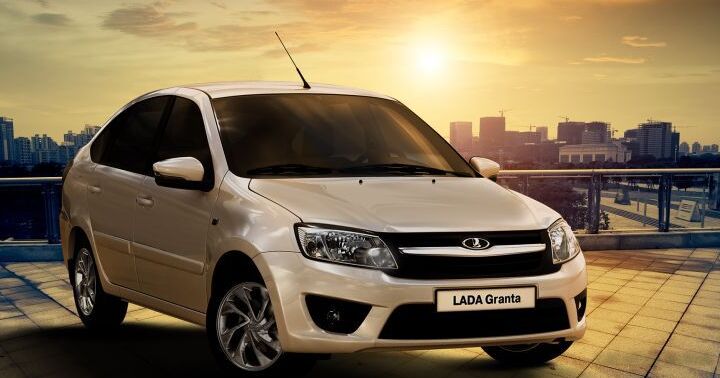
The Lada Granta I Hatchback 1.6 (87 hp) was a mainstay of the Russian automaker’s lineup from 2014 to 2018. Positioned as an entry-level offering within the Granta range, it represented a significant step forward for Lada in terms of modern design and build quality, while remaining focused on affordability. This particular variant, equipped with the 1.6-liter engine and a five-speed manual transmission, was aimed at buyers seeking a practical and economical vehicle for daily commuting and general transportation. The Granta I Hatchback, built on the Lada B/C platform, was intended to replace the aging Lada Samara, offering a more contemporary and reliable alternative in the budget car segment.
Technical Specifications
| Brand | Lada |
| Model | Granta |
| Generation | Granta I Hatchback |
| Type (Engine) | 1.6 (87 Hp) |
| Start of production | 2014 |
| End of production | 2018 |
| Powertrain Architecture | Internal Combustion engine |
| Body type | Hatchback |
| Seats | 5 |
| Doors | 5 |
| Fuel consumption (urban) | 9 l/100 km (26.1 US mpg, 31.4 UK mpg, 11.1 km/l) |
| Fuel consumption (extra urban) | 5.8 l/100 km (40.6 US mpg, 48.7 UK mpg, 17.2 km/l) |
| Fuel consumption (combined) | 7 l/100 km (33.6 US mpg, 40.4 UK mpg, 14.3 km/l) |
| Fuel Type | Petrol (Gasoline) |
| Acceleration 0 – 100 km/h | 12.2 sec |
| Acceleration 0 – 62 mph | 12.2 sec |
| Acceleration 0 – 60 mph | 11.6 sec |
| Maximum speed | 166 km/h (103.15 mph) |
| Weight-to-power ratio | 12.5 kg/Hp, 80.2 Hp/tonne |
| Weight-to-torque ratio | 7.8 kg/Nm, 129 Nm/tonne |
| Power | 87 Hp @ 5100 rpm |
| Power per litre | 54.5 Hp/l |
| Torque | 140 Nm @ 3800 rpm (103.26 lb.-ft. @ 3800 rpm) |
| Engine layout | Front, Transverse |
| Engine Model/Code | 11186 |
| Engine displacement | 1596 cm3 (97.39 cu. in.) |
| Number of cylinders | 4 |
| Engine configuration | Inline |
| Number of valves per cylinder | 2 |
| Fuel injection system | Multi-port manifold injection |
| Engine aspiration | Naturally aspirated engine |
| Engine oil capacity | 3.2 l (3.38 US qt | 2.82 UK qt) |
| Coolant capacity | 6.5 l (6.87 US qt | 5.72 UK qt) |
| Kerb Weight | 1085 kg (2392.02 lbs) |
| Max. weight | 1560 kg (3439.21 lbs) |
| Max load | 475 kg (1047.2 lbs) |
| Trunk (boot) space – minimum | 440 l (15.54 cu. ft.) |
| Trunk (boot) space – maximum | 760 l (26.84 cu. ft.) |
| Fuel tank capacity | 50 l (13.21 US gal | 11 UK gal) |
| Permitted trailer load with brakes (12%) | 900 kg (1984.16 lbs) |
| Permitted trailer load without brakes | 450 kg (992.08 lbs) |
| Length | 4246 mm (167.17 in) |
| Width | 1700 mm (66.93 in) |
| Height | 1500 mm (59.06 in) |
| Wheelbase | 2476 mm (97.48 in) |
| Front track | 1430 mm (56.3 in) |
| Rear (Back) track | 1414 mm (55.67 in) |
| Ride height (ground clearance) | 160 mm (6.3 in) |
| Drivetrain Architecture | Front wheel drive |
| Number of gears and type of gearbox | 5 gears, manual transmission |
| Front suspension | Independent, type McPherson with coil spring and anti-roll bar |
| Rear suspension | Semi-independent, coil spring |
| Assisting systems | ABS (Anti-lock braking system) |
| Steering type | Steering rack and pinion |
| Tires size | 175/65 R14; 185/60 R14 |
| Wheel rims size | 14 |
Powertrain & Engine Architecture
The heart of the Granta 1.6 (87 hp) is the Lada 11186 engine, an 8-valve, 1.6-liter inline-four cylinder petrol engine. This engine, a descendant of the Volga Automotive Plant’s long-running engine family, utilizes a multi-port fuel injection system for improved fuel efficiency and emissions control. The engine’s relatively simple valvetrain – two valves per cylinder – contributes to its robustness and ease of maintenance. The 11186 engine produces 87 horsepower at 5100 rpm and 140 Nm (103 lb-ft) of torque at 3800 rpm. The five-speed manual transmission was the standard offering for this trim level, providing a direct and engaging driving experience. The transmission’s gear ratios were tuned for a balance between acceleration and fuel economy, prioritizing usability over outright performance.
Driving Characteristics
The Granta 1.6 (87 hp) offered a predictable and undemanding driving experience. Acceleration was modest, taking approximately 12.2 seconds to reach 100 km/h (62 mph). While not particularly quick, the engine provided sufficient power for everyday driving situations, including city commuting and highway cruising. The manual transmission allowed for precise control over the engine’s power band, and the relatively light weight of the vehicle (1085 kg / 2392 lbs) helped to mitigate the effects of the modest horsepower output. Compared to higher-spec Granta models with larger engines, this variant prioritized fuel efficiency and affordability over performance. The suspension, tuned for comfort, provided a reasonably smooth ride, although it could feel somewhat soft and wallowy when pushed hard through corners.
Equipment & Trim Levels
The Granta I Hatchback 1.6 (87 hp) typically came equipped with basic but essential features. Standard equipment included power steering, central locking, front power windows, and an audio system with USB connectivity. Interior upholstery was typically cloth, with a simple and functional dashboard layout. Optional extras included air conditioning, heated front seats, and an upgraded audio system. Trim levels varied slightly depending on the market, but generally, this variant represented the entry point into the Granta range, offering a no-frills but practical package.
Chassis & Braking
The Granta I Hatchback featured a front-wheel-drive layout with an independent McPherson strut suspension at the front and a semi-independent coil spring suspension at the rear. The front suspension incorporated an anti-roll bar to reduce body roll during cornering. Braking duties were handled by disc brakes at the front and drum brakes at the rear. ABS (Anti-lock Braking System) was standard equipment, enhancing safety and stability during emergency braking situations. The steering system utilized a rack and pinion setup, providing reasonably precise and responsive steering feel.
Market Reception & Comparison
The Lada Granta 1.6 (87 hp) was generally well-received in its primary markets, particularly in Russia and other Eastern European countries. Critics praised its affordability, practicality, and improved build quality compared to previous Lada models. However, it was also criticized for its relatively basic interior, modest performance, and somewhat dated design. Compared to other trims in the Granta lineup, such as those equipped with the 1.6-liter 98 hp engine or the 1.4-liter engine, the 87 hp variant offered the most economical option, appealing to budget-conscious buyers. Fuel economy was a strong point, with combined fuel consumption figures around 7 l/100 km (33.6 US mpg).
Legacy
The Lada Granta I Hatchback 1.6 (87 hp) proved to be a popular and reliable vehicle, particularly in the used car market. The 11186 engine, while not known for its sophistication, is generally considered to be robust and relatively easy to maintain. Common issues include oil leaks and wear on the timing chain, but these are typically inexpensive to repair. Today, the Granta 1.6 (87 hp) remains a viable option for buyers seeking an affordable and practical vehicle, particularly in regions where Lada has a strong presence. Its simplicity and durability continue to appeal to those looking for a no-nonsense, dependable mode of transportation.

