
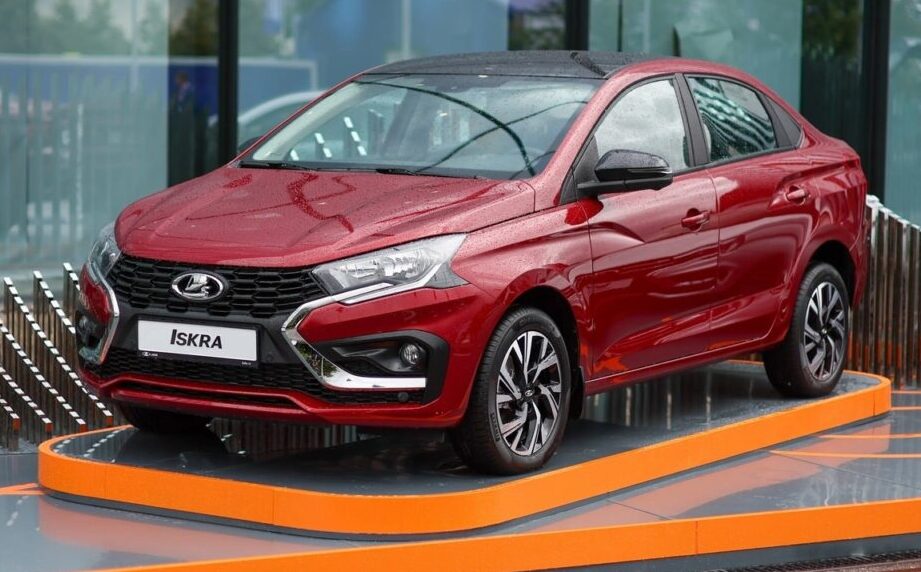
The Lada Iskra 1.6L, producing 106 horsepower, represents a significant entry in the modernization of the Lada lineup, launched in July 2025. Positioned as a mainstream sedan within the range, the Iskra aimed to offer a balance of affordability, practicality, and contemporary features to the Russian domestic market. It builds upon the foundations of previous Lada models but incorporates updated styling, improved safety equipment, and a more refined driving experience. The Iskra is a four-door, five-seater sedan designed to compete in the high-volume compact car segment.
Technical Specifications
| Brand | Lada |
| Model | Iskra |
| Generation | Iskra |
| Type (Engine) | 1.6L (106 Hp) |
| Start of production | July, 2025 |
| Powertrain Architecture | Internal Combustion engine |
| Body type | Sedan |
| Seats | 5 |
| Doors | 4 |
| Fuel consumption (urban) | 10.6 l/100 km (22.2 US mpg, 26.6 UK mpg, 9.4 km/l) |
| Fuel consumption (extra urban) | 6.1 l/100 km (38.6 US mpg, 46.3 UK mpg, 16.4 km/l) |
| Fuel consumption (combined) | 7.8 l/100 km (30.2 US mpg, 36.2 UK mpg, 12.8 km/l) |
| Fuel Type | Petrol (Gasoline) |
| Acceleration 0 – 100 km/h | 12.6 sec |
| Acceleration 0 – 62 mph | 12.6 sec |
| Acceleration 0 – 60 mph | 12 sec |
| Maximum speed | 177 km/h (109.98 mph) |
| Weight-to-power ratio | 11.3 kg/Hp, 88.3 Hp/tonne |
| Weight-to-torque ratio | 8.1 kg/Nm, 123.3 Nm/tonne |
| Power | 106 Hp @ 5800 rpm |
| Power per litre | 66.4 Hp/l |
| Torque | 148 Nm @ 4200 rpm (109.16 lb.-ft. @ 4200 rpm) |
| Engine layout | Front, Transverse |
| Engine Model/Code | 21129 |
| Engine displacement | 1596 cm3 (97.39 cu. in.) |
| Number of cylinders | 4 |
| Engine configuration | Inline |
| Cylinder Bore | 82 mm (3.23 in.) |
| Piston Stroke | 75.6 mm (2.98 in.) |
| Compression ratio | 10.5:1 |
| Number of valves per cylinder | 4 |
| Fuel injection system | Multi-port manifold injection |
| Engine aspiration | Naturally aspirated engine |
| Kerb Weight | 1200-1293 kg (2645.55 – 2850.58 lbs.) |
| Max. weight | 1690 kg (3725.81 lbs.) |
| Max load | 397-490 kg (875.24 – 1080.27 lbs.) |
| Trunk (boot) space – minimum | 500-645 l (17.66 – 22.78 cu. ft.) |
| Fuel tank capacity | 50 l (13.21 US gal | 11 UK gal) |
| Permitted trailer load with brakes (12%) | 800 kg (1763.7 lbs.) |
| Permitted trailer load without brakes | 600 kg (1322.77 lbs.) |
| Length | 4333 mm (170.59 in.) |
| Width | 1777 mm (69.96 in.) |
| Height | 1527 mm (60.12 in.) |
| Wheelbase | 2603 mm (102.48 in.) |
| Front track | 1534 mm (60.39 in.) |
| Rear (Back) track | 1527 mm (60.12 in.) |
| Front overhang | 820 mm (32.28 in.) |
| Rear overhang | 910 mm (35.83 in.) |
| Ride height (ground clearance) | 170 mm (6.69 in.) |
| Drivetrain Architecture | The Internal combustion engine (ICE) drives the front wheels of the vehicle. |
| Drive wheel | Front wheel drive |
| Number of gears and type of gearbox | 6 gears, manual transmission |
| Front suspension | Independent, type McPherson with coil spring and anti-roll bar |
| Rear suspension | Spring Strut, Semi-independent, coil spring |
| Front brakes | Ventilated discs |
| Rear brakes | Drum |
| Assisting systems | ABS (Anti-lock braking system) |
| Steering type | Steering rack and pinion |
| Power steering | Electric Steering |
| Tires size | 185/65 R15; 195/55 R16 |
| Wheel rims size | 15; 16 |
Powertrain & Engine Architecture
The Lada Iskra 1.6L is powered by the 21129 engine, a 1.6-liter inline-four cylinder gasoline engine. This engine is a development of the long-running Lada engine family, featuring a multi-point fuel injection system. The engine produces 106 horsepower at 5800 rpm and 148 Nm (109.16 lb-ft) of torque at 4200 rpm. The engine utilizes a single overhead camshaft (SOHC) design with four valves per cylinder. The 6-speed manual transmission is the sole transmission option, providing a relatively wide range of gear ratios designed for both fuel efficiency and acceptable acceleration. The engine is transversely mounted, driving the front wheels.
Driving Characteristics
The Iskra 1.6L offers a predictable, if not particularly exciting, driving experience. Acceleration from 0-60 mph takes approximately 12 seconds, and the top speed is around 109.98 mph. The 6-speed manual transmission helps to keep the engine within its optimal power band during everyday driving. While not a sporty vehicle, the Iskra provides adequate power for typical commuting and highway cruising. The gear ratios are tuned for fuel economy, meaning the engine can feel somewhat strained when accelerating quickly or climbing hills. Compared to potential future turbocharged variants, the 1.6L naturally aspirated engine delivers a more linear power delivery, making it easy to modulate for new drivers.
Equipment & Trim Levels
The Lada Iskra 1.6L typically comes standard with features such as power windows, central locking, an audio system with USB connectivity, and ABS brakes. Higher trim levels may include air conditioning, alloy wheels, and a more advanced infotainment system. Interior upholstery is generally cloth, with a focus on durability rather than luxury. Optional extras could include a rear parking sensor, heated front seats, and upgraded audio systems. The dashboard layout is functional and straightforward, prioritizing ease of use over aesthetic flair.
Chassis & Braking
The Iskra utilizes a McPherson strut front suspension and a semi-independent spring strut rear suspension. This setup provides a reasonable balance between ride comfort and handling. The front brakes are ventilated discs, while the rear brakes are drums. ABS (Anti-lock Braking System) is standard, enhancing safety during emergency braking situations. The steering is rack and pinion with electric power assistance, offering a light and responsive feel. Tire sizes typically range from 185/65 R15 to 195/55 R16, depending on the trim level.
Market Reception & Comparison
The Lada Iskra 1.6L was generally well-received in the Russian market as a practical and affordable sedan. Critics praised its improved build quality and modern features compared to previous Lada models. However, some reviewers noted that the engine lacked refinement and that the interior materials were somewhat basic. Fuel economy is respectable, averaging around 30.2 US mpg in combined driving. Compared to other trims, the 1.6L version represents the entry point to the Iskra range, offering a balance of affordability and functionality. It is positioned below any potential higher-powered variants, appealing to budget-conscious buyers.
Legacy
The Lada Iskra 1.6L represents a step forward for the Lada brand, demonstrating a commitment to modernization and improved quality. While long-term reliability data is still emerging, the 21129 engine is based on a well-established design with a proven track record. In the used car market, the Iskra 1.6L is expected to be a popular choice for buyers seeking an affordable and reliable sedan. Its relatively simple mechanical design should translate to lower maintenance costs compared to more complex vehicles. The Iskra’s success will likely depend on Lada’s ability to continue improving build quality and offering competitive pricing.

