
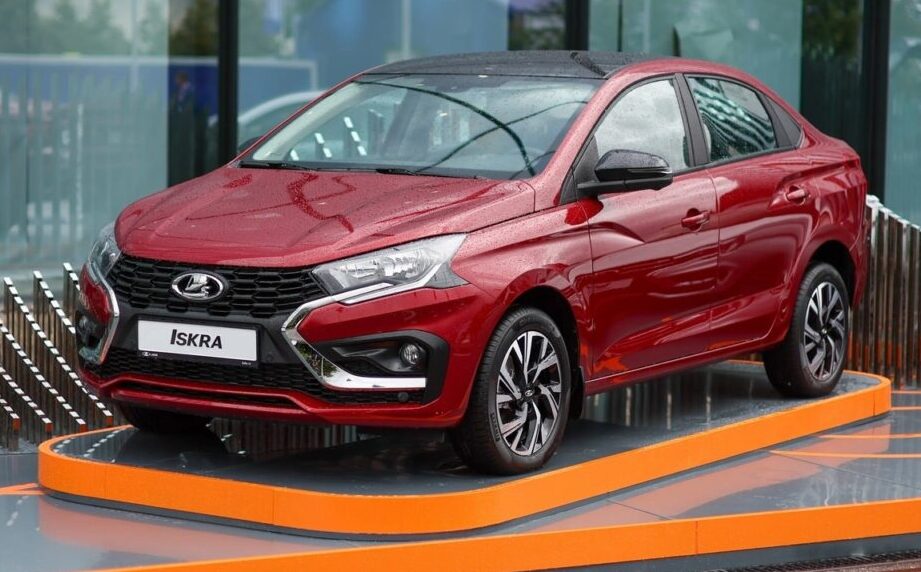
The Lada Iskra 1.6L (90 hp) represents a significant entry point into the revived Lada lineup, launched in July 2025. Positioned as a practical and affordable sedan, the Iskra aims to recapture a segment of the market previously served by older Lada models. This variant, equipped with a 1.6-liter naturally aspirated engine and a 5-speed manual transmission, is intended to appeal to budget-conscious buyers prioritizing fuel efficiency and basic transportation. It forms part of the first generation of the Iskra, built on a modernized platform intended to improve reliability and safety compared to its predecessors. The Iskra is primarily targeted at the Russian domestic market and neighboring countries, offering a domestically produced alternative to imported vehicles.
Technical Specifications
| Brand | Lada |
| Model | Iskra |
| Generation | Iskra |
| Type (Engine) | 1.6L (90 Hp) |
| Start of production | July, 2025 |
| Powertrain Architecture | Internal Combustion engine |
| Body type | Sedan |
| Seats | 5 |
| Doors | 4 |
| Fuel consumption (economy) – urban | 10 l/100 km (23.5 US mpg, 28.2 UK mpg, 10 km/l) |
| Fuel consumption (economy) – extra urban | 5.8 l/100 km (40.6 US mpg, 48.7 UK mpg, 17.2 km/l) |
| Fuel consumption (economy) – combined | 7.4 l/100 km (31.8 US mpg, 38.2 UK mpg, 13.5 km/l) |
| Fuel Type | Petrol (Gasoline) |
| Acceleration 0 – 100 km/h | 13 sec |
| Acceleration 0 – 62 mph | 13 sec |
| Acceleration 0 – 60 mph | 12.4 sec |
| Maximum speed | 173 km/h (107.5 mph) |
| Weight-to-power ratio | 13.3 kg/Hp, 75 Hp/tonne |
| Weight-to-torque ratio | 8.4 kg/Nm, 119.2 Nm/tonne |
| Power | 90 Hp @ 5000 rpm |
| Power per litre | 56.4 Hp/l |
| Torque | 143 Nm @ 3800 rpm (105.47 lb.-ft. @ 3800 rpm) |
| Engine layout | Front, Transverse |
| Engine Model/Code | 11182 |
| Engine displacement | 1596 cm3 (97.39 cu. in.) |
| Number of cylinders | 4 |
| Engine configuration | Inline |
| Cylinder Bore | 82 mm (3.23 in.) |
| Piston Stroke | 75.6 mm (2.98 in.) |
| Compression ratio | 10.5:1 |
| Number of valves per cylinder | 2 |
| Fuel injection system | Multi-port manifold injection |
| Engine aspiration | Naturally aspirated engine |
| Kerb Weight | 1200-1293 kg (2645.55 – 2850.58 lbs.) |
| Max. weight | 1690 kg (3725.81 lbs.) |
| Max load | 397-490 kg (875.24 – 1080.27 lbs.) |
| Trunk (boot) space – minimum | 500-645 l (17.66 – 22.78 cu. ft.) |
| Fuel tank capacity | 50 l (13.21 US gal | 11 UK gal) |
| Permitted trailer load with brakes (12%) | 800 kg (1763.7 lbs.) |
| Permitted trailer load without brakes | 600 kg (1322.77 lbs.) |
| Length | 4333 mm (170.59 in.) |
| Width | 1777 mm (69.96 in.) |
| Height | 1527 mm (60.12 in.) |
| Wheelbase | 2603 mm (102.48 in.) |
| Front track | 1534 mm (60.39 in.) |
| Rear (Back) track | 1527 mm (60.12 in.) |
| Front overhang | 820 mm (32.28 in.) |
| Rear overhang | 910 mm (35.83 in.) |
| Ride height (ground clearance) | 170 mm (6.69 in.) |
| Drivetrain Architecture | The Internal combustion engine (ICE) drives the front wheels of the vehicle. |
| Drive wheel | Front wheel drive |
| Number of gears and type of gearbox | 5 gears, manual transmission |
| Front suspension | Independent, type McPherson with coil spring and anti-roll bar |
| Rear suspension | Spring Strut, Semi-independent, coil spring |
| Front brakes | Ventilated discs |
| Rear brakes | Drum |
| Assisting systems | ABS (Anti-lock braking system) |
| Steering type | Steering rack and pinion |
| Power steering | Electric Steering |
| Tires size | 185/65 R15 |
| Wheel rims size | 15 |
Powertrain & Engine Architecture
The heart of the Iskra 1.6L is the Lada 11182 engine, a 1.6-liter inline-four cylinder gasoline engine. This engine represents an evolution of the long-running Lada engine family, incorporating updated fuel injection and engine management systems. It utilizes a multi-port fuel injection system, delivering fuel directly to the intake ports for improved combustion efficiency. The engine features a single overhead camshaft (SOHC) design with two valves per cylinder. The 5-speed manual transmission is a standard unit, chosen for its simplicity and cost-effectiveness. While not offering the refinement of more modern automatic transmissions, it provides adequate control for everyday driving. The engine is transversely mounted, driving the front wheels.
Driving Characteristics
The 90 hp output of the Iskra 1.6L translates to modest but acceptable performance. Acceleration from 0 to 60 mph takes approximately 12.4 seconds, and the top speed is around 107.5 mph. The engine delivers its peak torque of 105.47 lb.-ft. at 3800 rpm, providing reasonable pulling power for overtaking and hill climbing. The 5-speed manual transmission is geared to prioritize fuel economy, meaning the engine needs to be revved to access its full potential. Compared to potential future higher-output versions or even a hypothetical automatic variant, this setup feels less responsive but offers greater driver control and fuel efficiency. The gear ratios are relatively long, contributing to the relaxed cruising experience but requiring downshifts for quicker acceleration.
Equipment & Trim Levels
The Iskra 1.6L typically comes with a basic level of standard equipment. This generally includes power steering, an anti-lock braking system (ABS), and basic audio system. Interior upholstery is typically cloth, and the dashboard features a functional but utilitarian design. Optional extras, depending on availability, may include air conditioning, power windows, and upgraded audio systems. The trim level is generally considered the base model, focusing on providing essential features at the lowest possible price point.
Chassis & Braking
The Iskra utilizes a McPherson strut independent suspension setup at the front, providing a reasonable level of ride comfort and handling. The rear suspension employs a semi-independent spring strut design, which is a cost-effective solution but less sophisticated than a fully independent setup. The front brakes are ventilated discs, offering adequate stopping power, while the rear brakes are drums, a cost-saving measure. The steering is rack and pinion with electric power assistance, providing a light and easy steering feel.
Market Reception & Comparison
The Lada Iskra 1.6L has been generally well-received in its target market as a practical and affordable sedan. Critics have praised its fuel efficiency and low running costs, but have also noted its basic interior and modest performance. Compared to other trims in the Iskra lineup (should they become available), the 1.6L variant offers the most accessible price point but sacrifices performance and features. It competes directly with other budget-oriented sedans in the Russian market, offering a domestically produced alternative to imported vehicles.
Legacy
The long-term reliability of the 11182 engine remains to be fully established, but Lada has made efforts to improve the durability and reliability of its engines in recent years. The Iskra 1.6L is expected to be a common sight on Russian roads for years to come, offering affordable and reliable transportation. Its status in the used car market will likely be determined by its maintenance history and overall condition. As a foundational model for the revived Lada brand, the Iskra 1.6L represents a step towards modernizing the Russian automotive industry.

