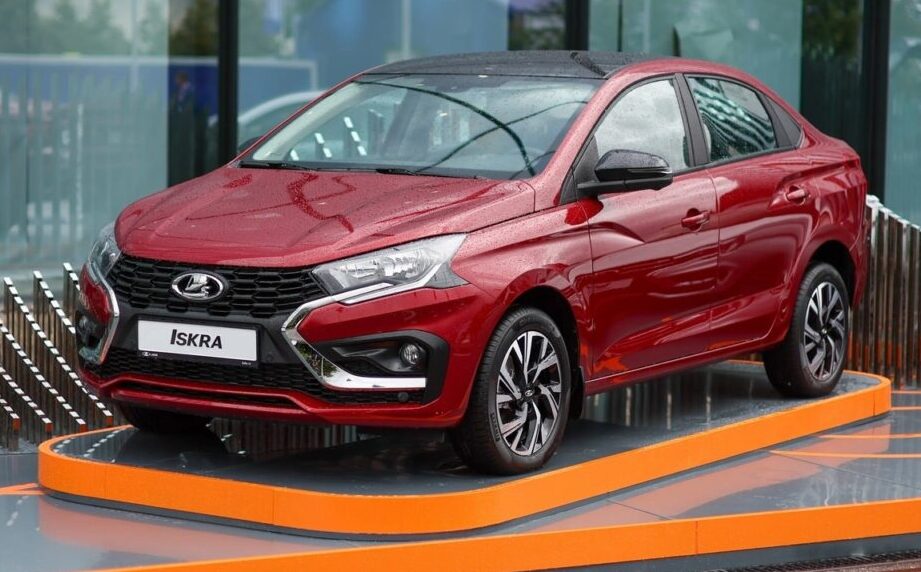
The Lada Iskra SW 1.6L (106 hp) CVT is a station wagon introduced in July 2025 as part of the first generation Iskra lineup. Positioned as a practical and affordable family vehicle, it represents Lada’s attempt to modernize its offerings with continuously variable transmission technology. The Iskra SW, meaning “spark” in Russian, aims to provide a balance of space, fuel efficiency, and reasonable performance within the Russian automotive market. This particular variant, with its 1.6-liter engine and CVT, is intended to appeal to buyers prioritizing ease of driving and lower running costs over outright performance.
Technical Specifications
| Brand | Lada |
| Model | Iskra |
| Generation | Iskra SW |
| Type (Engine) | 1.6L (106 Hp) CVT |
| Start of production | July, 2025 |
| Powertrain Architecture | Internal Combustion engine |
| Body type | Station wagon (estate) |
| Seats | 5 |
| Doors | 5 |
| Fuel consumption (urban) | 9.7 l/100 km (24.2 US mpg, 29.1 UK mpg, 10.3 km/l) |
| Fuel consumption (extra urban) | 5.8 l/100 km (40.6 US mpg, 48.7 UK mpg, 17.2 km/l) |
| Fuel consumption (combined) | 7.2 l/100 km (32.7 US mpg, 39.2 UK mpg, 13.9 km/l) |
| Fuel Type | Petrol (Gasoline) |
| Acceleration 0 – 100 km/h | 13.9 sec |
| Acceleration 0 – 62 mph | 13.9 sec |
| Acceleration 0 – 60 mph | 13.2 sec |
| Maximum speed | 166 km/h (103.15 mph) |
| Weight-to-power ratio | 11.4 kg/Hp, 87.7 Hp/tonne |
| Weight-to-torque ratio | 8.2 kg/Nm, 122.5 Nm/tonne |
| Power | 106 Hp @ 5800 rpm |
| Power per litre | 66.4 Hp/l |
| Torque | 148 Nm @ 4200 rpm (109.16 lb.-ft. @ 4200 rpm) |
| Engine layout | Front, Transverse |
| Engine Model/Code | 21129 |
| Engine displacement | 1596 cm3 (97.39 cu. in.) |
| Number of cylinders | 4 |
| Engine configuration | Inline |
| Cylinder Bore | 82 mm (3.23 in.) |
| Piston Stroke | 75.6 mm (2.98 in.) |
| Compression ratio | 10.5:1 |
| Number of valves per cylinder | 4 |
| Fuel injection system | Multi-port manifold injection |
| Engine aspiration | Naturally aspirated engine |
| Engine systems | Start & Stop System |
| Kerb Weight | 1208-1301 kg (2663.18 – 2868.21 lbs.) |
| Max. weight | 1690 kg (3725.81 lbs.) |
| Max load | 389-482 kg (857.6 – 1062.63 lbs.) |
| Trunk (boot) space – minimum | 480 l (16.95 cu. ft.) |
| Trunk (boot) space – maximum | 1965 l (69.39 cu. ft.) |
| Fuel tank capacity | 50 l (13.21 US gal | 11 UK gal) |
| Permitted trailer load with brakes (12%) | 800 kg (1763.7 lbs.) |
| Permitted trailer load without brakes | 600 kg (1322.77 lbs.) |
| Length | 4333 mm (170.59 in.) |
| Width | 1777 mm (69.96 in.) |
| Height | 1507 mm (59.33 in.) |
| Wheelbase | 2603 mm (102.48 in.) |
| Front track | 1534 mm (60.39 in.) |
| Rear (Back) track | 1527 mm (60.12 in.) |
| Front overhang | 820 mm (32.28 in.) |
| Rear overhang | 910 mm (35.83 in.) |
| Ride height (ground clearance) | 170 mm (6.69 in.) |
| Drivetrain Architecture | The Internal combustion engine (ICE) drives the front wheels of the vehicle. |
| Drive wheel | Front wheel drive |
| Number of gears and type of gearbox | automatic transmission CVT |
| Front suspension | Independent, type McPherson with coil spring and anti-roll bar |
| Rear suspension | Spring Strut, Semi-independent, coil spring |
| Front brakes | Ventilated discs |
| Rear brakes | Drum |
| Assisting systems | ABS (Anti-lock braking system) |
| Steering type | Steering rack and pinion |
| Power steering | Electric Steering |
| Tires size | 185/65 R15 |
| Wheel rims size | 15 |
Powertrain & Engine Architecture
The Lada Iskra SW 1.6L CVT utilizes the 21129 engine, a 1.6-liter inline-four cylinder gasoline engine. This engine is a development of Lada’s long-running series of 1.6-liter engines, featuring a multi-point fuel injection system. The engine produces 106 horsepower at 5800 rpm and 148 Nm (109.16 lb-ft) of torque at 4200 rpm. The engine employs a timing belt and four valves per cylinder. The continuously variable transmission (CVT) is a key feature of this variant, offering stepless gear changes for improved fuel efficiency and smoother acceleration compared to a traditional automatic transmission. While the specific CVT model used isn’t widely publicized, it’s designed to work in conjunction with the engine’s torque curve to optimize performance and economy.
Driving Characteristics
The 1.6L CVT powertrain delivers adequate, but not exhilarating, performance. Acceleration from 0-100 km/h takes approximately 13.9 seconds, and top speed is limited to 166 km/h. The CVT prioritizes fuel efficiency over rapid acceleration, resulting in a more relaxed driving experience. The lack of distinct gear shifts can feel unusual to drivers accustomed to traditional automatics. Compared to a manual transmission version (if offered), the CVT will likely feel slower in acceleration, but easier to drive in congested urban environments. The CVT’s programming is tuned for smooth operation, but may exhibit some “rubber band” effect under hard acceleration, where engine RPMs rise without a corresponding increase in vehicle speed.
Equipment & Trim Levels
The Iskra SW 1.6L CVT typically comes with a base level of equipment, focusing on practicality and affordability. Standard features generally include power windows, central locking, power steering, and an ABS anti-lock braking system. Interior upholstery is typically cloth, and the dashboard features a functional, if somewhat basic, design. Optional extras may include air conditioning, a radio with Bluetooth connectivity, and upgraded interior trim. The specific trim levels and available options vary depending on the market and dealer packages.
Chassis & Braking
The Iskra SW utilizes a McPherson strut independent suspension at the front and a semi-independent spring strut suspension at the rear. This setup provides a reasonable balance of ride comfort and handling. The front brakes are ventilated discs, while the rear brakes are drums. The use of drum brakes on the rear is a cost-saving measure common in this segment. Electric power steering is standard, providing light and easy steering feel. The 185/65 R15 tires offer a good compromise between comfort and grip.
Market Reception & Comparison
The Lada Iskra SW 1.6L CVT is positioned as a budget-friendly station wagon aimed at families and drivers seeking a practical and economical vehicle. Critics generally acknowledge its affordability and spaciousness, but note its relatively modest performance and basic interior. Compared to other trims in the Iskra lineup, the 1.6L CVT offers the lowest price point and the most fuel-efficient powertrain. However, it sacrifices some performance compared to higher-powered engine options. Its fuel economy of 7.2 l/100 km (32.7 US mpg) is competitive within its class.
Legacy
The long-term reliability of the 21129 engine and the CVT transmission remains to be fully assessed, as the Iskra SW is a relatively new model. However, Lada engines have a reputation for being robust and relatively easy to maintain, although build quality can be inconsistent. The CVT, being a more complex transmission than a traditional automatic, may require more specialized maintenance. In the used car market, the Iskra SW 1.6L CVT is expected to appeal to buyers seeking an affordable and practical station wagon, but its resale value will likely be influenced by its perceived reliability and the availability of spare parts.