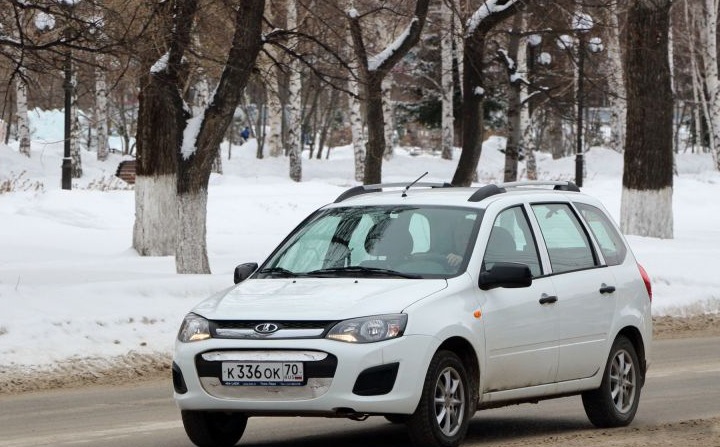
The Lada Kalina II Combi (2194) 1.6, producing 106 horsepower, was a station wagon variant of the second-generation Lada Kalina, manufactured between 2013 and 2018. Positioned as a practical and affordable family vehicle, it represented a significant step forward for AvtoVAZ, the Russian automaker, in terms of design and technology compared to its predecessors. The Kalina II Combi aimed to provide a spacious and versatile option within the budget-conscious Russian automotive market, competing with other domestically produced vehicles and increasingly, lower-priced foreign imports. This specific 1.6-liter engine and five-speed manual transmission combination was a mainstay of the Kalina II Combi lineup, offering a balance between fuel economy and acceptable performance for everyday driving.
Technical Specifications
| Brand | Lada |
| Model | Kalina |
| Generation | Kalina II Combi (2194) |
| Type (Engine) | 1.6 (106 Hp) |
| Start of production | 2013 |
| End of production | 2018 |
| Powertrain Architecture | Internal Combustion engine |
| Body type | Station wagon (estate) |
| Seats | 5 |
| Doors | 5 |
| Fuel consumption (urban) | 8.6 l/100 km (27.4 US mpg, 32.8 UK mpg, 11.6 km/l) |
| Fuel consumption (extra urban) | 5.6 l/100 km (42 US mpg, 50.4 UK mpg, 17.9 km/l) |
| Fuel consumption (combined) | 6.7 l/100 km (35.1 US mpg, 42.2 UK mpg, 14.9 km/l) |
| Fuel Type | Petrol (Gasoline) |
| Acceleration 0 – 100 km/h | 11 sec |
| Acceleration 0 – 62 mph | 11 sec |
| Acceleration 0 – 60 mph | 10.5 sec |
| Maximum speed | 181 km/h (112.47 mph) |
| Weight-to-power ratio | 10.6 kg/Hp, 94.2 Hp/tonne |
| Weight-to-torque ratio | 7.6 kg/Nm, 131.6 Nm/tonne |
| Power | 106 Hp @ 5800 rpm |
| Power per litre | 66.4 Hp/l |
| Torque | 148 Nm @ 4000 rpm (109.16 lb.-ft. @ 4000 rpm) |
| Engine layout | Front, Transverse |
| Engine Model/Code | 21127 |
| Engine displacement | 1596 cm3 (97.39 cu. in.) |
| Number of cylinders | 4 |
| Engine configuration | Inline |
| Number of valves per cylinder | 4 |
| Fuel injection system | Multi-port manifold injection |
| Engine aspiration | Naturally aspirated engine |
| Engine oil capacity | 3.2 l (3.38 US qt | 2.82 UK qt) |
| Coolant capacity | 7.84 l (8.28 US qt | 6.9 UK qt) |
| Kerb Weight | 1125 kg (2480.2 lbs) |
| Max. weight | 1560 kg (3439.21 lbs) |
| Max load | 435 kg (959.01 lbs) |
| Trunk (boot) space – minimum | 355 l (12.54 cu. ft) |
| Trunk (boot) space – maximum | 670 l (23.66 cu. ft) |
| Fuel tank capacity | 50 l (13.21 US gal | 11 UK gal) |
| Permitted trailer load with brakes (12%) | 900 kg (1984.16 lbs) |
| Permitted trailer load without brakes | 450 kg (992.08 lbs) |
| Length | 4084 mm (160.79 in) |
| Width | 1700 mm (66.93 in) |
| Height | 1504 mm (59.21 in) |
| Wheelbase | 2476 mm (97.48 in) |
| Front track | 1430 mm (56.3 in) |
| Rear (Back) track | 1414 mm (55.67 in) |
| Ride height (ground clearance) | 160 mm (6.3 in) |
| Drivetrain Architecture | Front wheel drive |
| Number of gears and type of gearbox | 5 gears, manual transmission |
| Front suspension | Independent, type McPherson with coil spring and anti-roll bar |
| Rear suspension | Semi-independent, coil spring |
| Assisting systems | ABS (Anti-lock braking system) |
| Steering type | Steering rack and pinion |
| Tires size | 175/65 R14; 185/60 R14; 185/55 R15 |
| Wheel rims size | 14; 15 |
Powertrain & Engine Architecture
The Lada Kalina II Combi 1.6 utilized the 21127 engine, a 1.6-liter inline-four cylinder gasoline engine. This engine was a development of the older 2112 series, featuring multi-point fuel injection and a single overhead camshaft (SOHC) valvetrain with four valves per cylinder. The engine’s design prioritized simplicity and durability over outright performance. The 106 horsepower output was achieved at 5800 rpm, while peak torque of 148 Nm (109.16 lb-ft) was delivered at 4000 rpm. The five-speed manual transmission was a standard offering, providing relatively long gear ratios geared towards fuel efficiency rather than rapid acceleration. The transmission was a conventional setup, known for its robustness but lacking in refinement compared to more modern automatic or continuously variable transmissions.
Driving Characteristics
The 1.6-liter engine and five-speed manual transmission combination in the Kalina II Combi provided adequate, but not exhilarating, performance. Acceleration from 0 to 100 km/h (0-62 mph) took approximately 11 seconds. The long gear ratios meant that the engine needed to be revved to extract maximum performance, and overtaking maneuvers required careful planning. Compared to potential higher-output variants (which were not commonly available in the Combi body style), this setup prioritized fuel economy and ease of driving. The suspension, while providing a reasonably comfortable ride on smooth surfaces, could feel somewhat harsh on rough roads. The steering was light and lacked significant feedback, typical of vehicles in this price segment.
Equipment & Trim Levels
The Kalina II Combi 1.6 typically came with a basic level of standard equipment. This included power steering, central locking, front power windows, and an audio system. Higher trim levels, such as the “Standard” or “Lux” variants, added features like air conditioning, heated front seats, electric mirrors, and upgraded interior trim. Interior upholstery was typically cloth, with a simple and functional dashboard layout. Optional extras included alloy wheels, a more advanced audio system, and parking sensors.
Chassis & Braking
The Kalina II Combi featured a front-wheel-drive layout with an independent McPherson strut suspension at the front and a semi-independent coil spring suspension at the rear. The braking system consisted of disc brakes on the front wheels and drum brakes on the rear wheels. ABS (Anti-lock Braking System) was standard equipment, enhancing safety. The chassis was relatively simple, designed for durability and affordability rather than sporty handling. Stabilizer bars were included to reduce body roll during cornering, but the overall handling characteristics were geared towards comfort and stability.
Market Reception & Comparison
The Lada Kalina II Combi 1.6 was generally well-received in the Russian market as a practical and affordable family vehicle. Critics praised its spacious interior, large trunk capacity, and relatively low running costs. However, it was also criticized for its basic interior, lack of refinement, and somewhat underwhelming performance. Compared to other trims in the Kalina II lineup, the 1.6-liter version offered the best balance of fuel economy and affordability. It was a popular choice for buyers who prioritized practicality and value over performance and luxury.
Legacy
The Lada Kalina II Combi 1.6, while not a groundbreaking vehicle, played an important role in modernizing AvtoVAZ’s product lineup. The 21127 engine proved to be relatively reliable, although maintenance costs could be higher than some foreign competitors due to the availability of parts and the quality of service. In the used car market, the Kalina II Combi 1.6 remains an affordable and practical option for buyers seeking a spacious and reliable station wagon. Its simplicity and robust construction contribute to its continued usability, although potential buyers should be aware of the vehicle’s age and the potential for wear and tear on components.