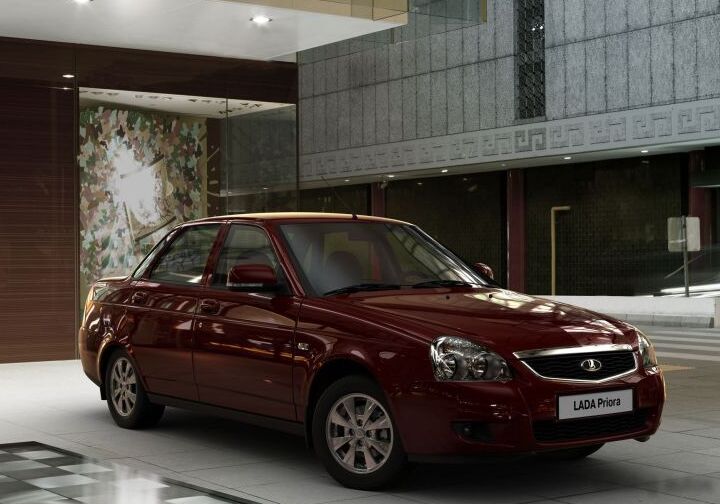
The Lada Priora I Combi (facelift 2013) 1.6, a station wagon variant of the popular Priora model, was produced from 2013 until July 2018. Representing a significant update to the original Priora, the facelifted Combi aimed to offer a practical and affordable family vehicle within the Russian automotive market. Positioned as a mid-range offering within the Priora lineup, the 1.6-liter, 106 horsepower engine paired with a five-speed manual transmission provided a balance between fuel economy and acceptable performance for everyday driving. The Priora Combi, in all its trims, was designed to appeal to buyers needing a spacious and versatile vehicle for both urban commutes and longer journeys.
Technical Specifications
| Brand | Lada |
| Model | Priora |
| Generation | Priora I Combi (facelift 2013) |
| Type (Engine) | 1.6 (106 Hp) |
| Start of production | 2013 |
| End of production | July, 2018 |
| Powertrain Architecture | Internal Combustion engine |
| Body type | Station wagon (estate) |
| Seats | 5 |
| Doors | 5 |
| Fuel consumption (urban) | 8.9 l/100 km (26.4 US mpg, 31.7 UK mpg, 11.2 km/l) |
| Fuel consumption (extra urban) | 5.6 l/100 km (42 US mpg, 50.4 UK mpg, 17.9 km/l) |
| Fuel consumption (combined) | 6.8 l/100 km (34.6 US mpg, 41.5 UK mpg, 14.7 km/l) |
| Fuel Type | Petrol (Gasoline) |
| Acceleration 0 – 100 km/h | 11.5 sec |
| Acceleration 0 – 62 mph | 11.5 sec |
| Acceleration 0 – 60 mph | 10.9 sec |
| Maximum speed | 183 km/h (113.71 mph) |
| Weight-to-power ratio | 11 kg/Hp, 91.1 Hp/tonne |
| Weight-to-torque ratio | 7.9 kg/Nm, 127.3 Nm/tonne |
| Power | 106 Hp @ 5800 rpm |
| Power per litre | 66.4 Hp/l |
| Torque | 148 Nm @ 4200 rpm (109.16 lb.-ft. @ 4200 rpm) |
| Engine layout | Front, Transverse |
| Engine displacement | 1596 cm3 (97.39 cu. in.) |
| Number of cylinders | 4 |
| Engine configuration | Inline |
| Number of valves per cylinder | 4 |
| Fuel injection system | Multi-port manifold injection |
| Engine aspiration | Naturally aspirated engine |
| Engine oil capacity | 3.2 l (3.38 US qt | 2.82 UK qt) |
| Coolant capacity | 6.3 l (6.66 US qt | 5.54 UK qt) |
| Kerb Weight | 1163 kg (2563.98 lbs) |
| Max. weight | 1593 kg (3511.96 lbs) |
| Max load | 430 kg (947.99 lbs) |
| Trunk (boot) space – minimum | 444 l (15.68 cu. ft.) |
| Trunk (boot) space – maximum | 777 l (27.44 cu. ft.) |
| Fuel tank capacity | 43 l (11.36 US gal | 9.46 UK gal) |
| Permitted trailer load with brakes (12%) | 800 kg (1763.7 lbs) |
| Permitted trailer load without brakes | 500 kg (1102.31 lbs) |
| Length | 4340 mm (170.87 in) |
| Width | 1680 mm (66.14 in) |
| Height | 1508 mm (59.37 in) |
| Wheelbase | 2492 mm (98.11 in) |
| Front track | 1410 mm (55.51 in) |
| Rear (Back) track | 1380 mm (54.33 in) |
| Ride height (ground clearance) | 165 mm (6.5 in) |
| Drivetrain Architecture | Front wheel drive |
| Number of gears and type of gearbox | 5 gears, manual transmission |
| Front suspension | Independent, type McPherson with coil spring and anti-roll bar |
| Rear suspension | Semi-independent, coil spring |
| Front brakes | Ventilated discs |
| Rear brakes | Drum |
| Assisting systems | ABS (Anti-lock braking system) |
| Steering type | Steering rack and pinion |
| Tires size | 175/65 R14; 185/60 R14; 185/65 R14 |
| Wheel rims size | 14 |
Powertrain & Engine Architecture
The 2013 Lada Priora 1.6 Combi utilized the VAZ-2110 engine family, specifically the 1.6-liter (1596 cc) inline-four cylinder engine. This engine, often referred to by its engine codes (such as VAZ-21106), was a relatively simple design featuring a single overhead camshaft (SOHC) and four valves per cylinder. The engine employed a multi-point fuel injection system, a significant improvement over the earlier carburetor-equipped Lada models. While not particularly powerful by modern standards, the engine was known for its robustness and relative ease of maintenance. The five-speed manual transmission was a standard offering, providing a fairly conventional gear ratio spread. The transmission was designed for durability rather than sporty performance, with a focus on smooth operation and reliability.
Driving Characteristics
The 106 horsepower and 148 Nm (109 lb-ft) of torque delivered by the 1.6-liter engine provided adequate, but not exhilarating, performance. Acceleration from 0 to 60 mph took around 10.9 seconds, and the top speed was approximately 113.7 mph. The car felt most comfortable at moderate speeds, making it well-suited for everyday commuting and highway driving. The manual transmission offered precise shifts, but the gear ratios were geared towards fuel efficiency rather than rapid acceleration. Compared to higher-output versions of the Priora, such as those equipped with the 1.8-liter engine, the 1.6-liter model felt noticeably less responsive, particularly when fully loaded or climbing hills. However, the 1.6L offered a better fuel economy than its larger displacement siblings.
Equipment & Trim Levels
The 2013 Lada Priora 1.6 Combi, in its base trim, typically included features such as power steering, central locking, electric front windows, and an audio system. Higher trim levels offered additional features like air conditioning, alloy wheels, fog lights, and a more comprehensive audio system. Interior upholstery was generally cloth, with a simple and functional dashboard layout. Optional extras included a sunroof, upgraded audio systems, and various cosmetic enhancements. The Combi body style itself offered a significant advantage in terms of cargo space, making it a practical choice for families or those needing to transport larger items.
Chassis & Braking
The Priora Combi utilized a McPherson strut front suspension and a semi-independent coil spring rear suspension. This setup provided a reasonable balance between ride comfort and handling. The front brakes were ventilated discs, while the rear brakes were drums. ABS (Anti-lock Braking System) was a standard safety feature. The chassis was relatively simple, prioritizing affordability and durability over sophisticated handling characteristics. Stabilizer bars were included to reduce body roll during cornering, but the overall handling was considered adequate rather than sporty.
Market Reception & Comparison
The Lada Priora Combi 1.6 was generally well-received in the Russian market as an affordable and practical family vehicle. Critics praised its spacious interior, large trunk capacity, and relatively low running costs. However, the engine was often criticized for its lack of power, and the overall build quality was not on par with Western European or Japanese competitors. Compared to other trims in the Priora lineup, the 1.6-liter model offered the best fuel economy but the lowest performance. It was positioned as an entry-level option, appealing to budget-conscious buyers who prioritized practicality over performance.
Legacy
The Lada Priora, including the 1.6 Combi variant, remains a common sight on Russian roads today. The powertrain, while not technologically advanced, proved to be remarkably durable and relatively easy to repair, contributing to its longevity. In the used car market, the Priora 1.6 Combi is often sought after for its affordability and practicality. While it may not offer the refinement or performance of more modern vehicles, it remains a viable option for those seeking a reliable and inexpensive station wagon. Parts availability is generally good, and the simple mechanical design makes it accessible to amateur mechanics.