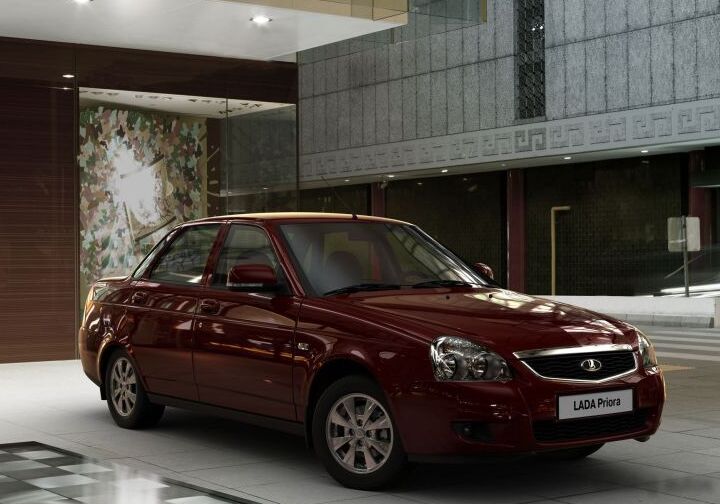
The Lada Priora I Hatchback, specifically the facelifted version introduced in 2013 with the 1.6-liter 106 horsepower engine, represented a significant step forward for the Russian automaker. Produced from 2013 until July 2018, this variant occupied a central position within the Priora range, aiming to provide a balance of affordability, practicality, and reasonable performance for the Russian and Eastern European markets. The Priora, built on the 1HX0/A3 platform, was intended as a modern replacement for the aging Lada 110 series, offering improved safety, comfort, and a more contemporary design. This particular 1.6L engine and five-speed manual transmission combination was a popular choice, targeting buyers seeking a reliable and economical daily driver.
Technical Specifications
| Brand | Lada |
| Model | Priora |
| Generation | Priora I Hatchback (facelift 2013) |
| Type (Engine) | 1.6 (106 Hp) |
| Start of production | 2013 |
| End of production | July, 2018 |
| Powertrain Architecture | Internal Combustion engine |
| Body type | Hatchback |
| Seats | 5 |
| Doors | 5 |
| Fuel consumption (urban) | 8.9 l/100 km (26.4 US mpg, 31.7 UK mpg, 11.2 km/l) |
| Fuel consumption (extra urban) | 5.6 l/100 km (42 US mpg, 50.4 UK mpg, 17.9 km/l) |
| Fuel consumption (combined) | 6.8 l/100 km (34.6 US mpg, 41.5 UK mpg, 14.7 km/l) |
| Fuel Type | Petrol (Gasoline) |
| Acceleration 0 – 100 km/h | 11.5 sec |
| Acceleration 0 – 62 mph | 11.5 sec |
| Acceleration 0 – 60 mph | 10.9 sec |
| Maximum speed | 183 km/h (113.71 mph) |
| Weight-to-power ratio | 11 kg/Hp, 91.1 Hp/tonne |
| Weight-to-torque ratio | 7.9 kg/Nm, 127.3 Nm/tonne |
| Power | 106 Hp @ 5800 rpm |
| Power per litre | 66.4 Hp/l |
| Torque | 148 Nm @ 4200 rpm (109.16 lb.-ft. @ 4200 rpm) |
| Engine layout | Front, Transverse |
| Engine displacement | 1596 cm3 (97.39 cu. in.) |
| Number of cylinders | 4 |
| Engine configuration | Inline |
| Number of valves per cylinder | 4 |
| Fuel injection system | Multi-port manifold injection |
| Engine aspiration | Naturally aspirated engine |
| Engine oil capacity | 3.2 l (3.38 US qt | 2.82 UK qt) |
| Coolant capacity | 6.3 l (6.66 US qt | 5.54 UK qt) |
| Kerb Weight | 1163 kg (2563.98 lbs) |
| Max. weight | 1578 kg (3478.89 lbs) |
| Max load | 415 kg (914.92 lbs) |
| Trunk (boot) space – minimum | 360 l (12.71 cu. ft.) |
| Trunk (boot) space – maximum | 705 l (24.9 cu. ft.) |
| Fuel tank capacity | 43 l (11.36 US gal | 9.46 UK gal) |
| Permitted trailer load with brakes (12%) | 800 kg (1763.7 lbs) |
| Permitted trailer load without brakes | 500 kg (1102.31 lbs) |
| Length | 4210 mm (165.75 in) |
| Width | 1680 mm (66.14 in) |
| Height | 1435 mm (56.5 in) |
| Wheelbase | 2492 mm (98.11 in) |
| Front track | 1410 mm (55.51 in) |
| Rear (Back) track | 1380 mm (54.33 in) |
| Ride height (ground clearance) | 165 mm (6.5 in) |
| Drivetrain Architecture | The Internal combustion engine (ICE) drives the front wheels of the vehicle. |
| Drive wheel | Front wheel drive |
| Number of gears and type of gearbox | 5 gears, manual transmission |
| Front suspension | Independent, type McPherson with coil spring and anti-roll bar |
| Rear suspension | Semi-independent, coil spring |
| Front brakes | Ventilated discs |
| Rear brakes | Drum |
| Assisting systems | ABS (Anti-lock braking system) |
| Steering type | Steering rack and pinion |
| Tires size | 175/65 R14; 185/60 R14; 185/65 R14 |
| Wheel rims size | 14 |
Powertrain & Engine Architecture
The heart of this Priora variant is the Lada 1.6-liter (1596 cc) inline-four cylinder engine, typically identified by engine codes such as VAZ-21174. This engine is a naturally aspirated unit featuring a multi-point fuel injection system. The engine utilizes a single overhead camshaft (SOHC) design with four valves per cylinder, contributing to reasonable efficiency and power output for its displacement. The 106 horsepower peak is achieved at 5800 rpm, while the 148 Nm (109.16 lb-ft) of torque is delivered at 4200 rpm. The engine’s relatively simple design prioritized reliability and ease of maintenance over outright performance. The five-speed manual transmission was the standard offering, providing a fairly conventional gear ratio spread designed for everyday driving.
Driving Characteristics
The 1.6-liter, 106 hp Priora Hatchback offered adequate, but not exhilarating, performance. Acceleration from 0 to 60 mph took around 10.9 seconds, and the top speed was approximately 113.71 mph. The engine felt somewhat strained at higher speeds, and overtaking maneuvers required careful planning. Compared to the more powerful 1.8-liter versions, this variant felt noticeably slower, particularly when fully loaded. However, the five-speed manual transmission allowed drivers to keep the engine in its optimal power band, maximizing efficiency and responsiveness. The gear ratios were well-suited for city driving and highway cruising, although the shift quality wasn’t particularly refined.
Equipment & Trim Levels
The 1.6-liter Priora Hatchback typically came with a fairly basic level of equipment, reflecting its position as a value-oriented model. Standard features generally included power steering, central locking, electric front windows, and an audio system. Interior upholstery was typically cloth, and the dashboard featured a functional, if somewhat dated, design. Optional extras included air conditioning, alloy wheels, and upgraded audio systems. Higher trim levels offered additional features such as fog lights, heated front seats, and a more comprehensive instrument cluster.
Chassis & Braking
The Priora Hatchback utilized a McPherson strut front suspension and a semi-independent coil spring rear suspension. This setup provided a reasonable balance of ride comfort and handling, although it wasn’t particularly sporty. The front brakes were ventilated discs, while the rear brakes were drums. ABS (Anti-lock Braking System) was standard, enhancing safety. The steering was a rack and pinion system, offering acceptable precision and feedback. The relatively lightweight construction of the Priora helped to mitigate the effects of the modest engine power, resulting in a reasonably agile driving experience.
Market Reception & Comparison
The Lada Priora 1.6 Hatchback was generally well-received in its target markets, particularly for its affordability and practicality. Critics praised its improved build quality and safety features compared to previous Lada models. However, the engine was often criticized for its lack of refinement and relatively low power output. Compared to the 1.8-liter versions, the 1.6-liter offered better fuel economy but significantly less performance. The 1.6L was often seen as the sensible choice for budget-conscious buyers who prioritized fuel efficiency and reliability over outright speed.
Legacy
The Lada Priora 1.6 Hatchback remains a common sight on the roads of Russia and Eastern Europe. The engine, while not particularly sophisticated, proved to be relatively durable and easy to maintain. Parts availability is generally good, and repair costs are typically low. In the used car market, these Prioras are often sought after by buyers looking for an affordable and reliable vehicle. While not a performance icon, the 1.6-liter Priora Hatchback played a significant role in modernizing the Lada brand and providing a practical transportation solution for a wide range of drivers.