
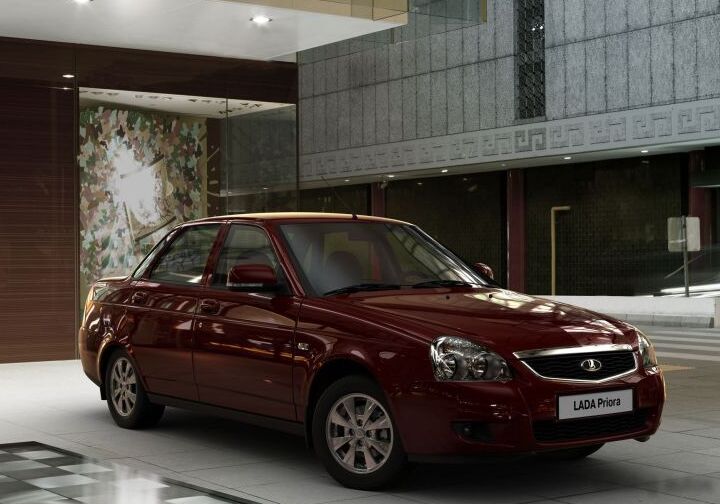
The Lada Priora I Sedan (facelift 2013) 1.6 (106 hp) Automatic represents a significant step in the modernization of the Russian automotive industry. Produced from 2013 until July 2018, this variant occupied a middle-ground position within the Priora lineup, offering a more accessible entry point to automatic transmission ownership compared to the more powerful, and often more expensive, 1.8-liter options. The Priora itself was a direct successor to the Lada 110, built upon the aging but continually refined 1HX0/A3 platform. This facelifted version, introduced in 2013, featured revised styling, improved interior materials, and a focus on enhancing perceived quality, aiming to appeal to a broader customer base both within Russia and in export markets.
Technical Specifications
| Brand | Lada |
| Model | Priora |
| Generation | Priora I Sedan (facelift 2013) |
| Type (Engine) | 1.6 (106 Hp) Automatic |
| Start of production | 2013 |
| End of production | July, 2018 |
| Powertrain Architecture | Internal Combustion engine |
| Body type | Sedan |
| Seats | 5 |
| Doors | 4 |
| Fuel consumption (urban) | 8.5 l/100 km (27.7 US mpg, 33.2 UK mpg, 11.8 km/l) |
| Fuel consumption (extra urban) | 5.5 l/100 km (42.8 US mpg, 51.4 UK mpg, 18.2 km/l) |
| Fuel consumption (combined) | 6.6 l/100 km (35.6 US mpg, 42.8 UK mpg, 15.2 km/l) |
| Fuel Type | Petrol (Gasoline) |
| Acceleration 0 – 100 km/h | 12.6 sec |
| Acceleration 0 – 62 mph | 12.6 sec |
| Acceleration 0 – 60 mph | 12 sec |
| Maximum speed | 183 km/h (113.71 mph) |
| Weight-to-power ratio | 11 kg/Hp, 91.1 Hp/tonne |
| Weight-to-torque ratio | 7.9 kg/Nm, 127.3 Nm/tonne |
| Power | 106 Hp @ 5800 rpm |
| Power per litre | 66.4 Hp/l |
| Torque | 148 Nm @ 4200 rpm (109.16 lb.-ft. @ 4200 rpm) |
| Engine layout | Front, Transverse |
| Engine displacement | 1596 cm3 (97.39 cu. in.) |
| Number of cylinders | 4 |
| Engine configuration | Inline |
| Number of valves per cylinder | 4 |
| Fuel injection system | Multi-port manifold injection |
| Engine aspiration | Naturally aspirated engine |
| Engine oil capacity | 3.2 l (3.38 US qt | 2.82 UK qt) |
| Coolant capacity | 6.3 l (6.66 US qt | 5.54 UK qt) |
| Kerb Weight | 1163 kg (2563.98 lbs.) |
| Max. weight | 1578 kg (3478.89 lbs.) |
| Max load | 415 kg (914.92 lbs.) |
| Trunk (boot) space – minimum | 430 l (15.19 cu. ft.) |
| Fuel tank capacity | 43 l (11.36 US gal | 9.46 UK gal) |
| Permitted trailer load with brakes (12%) | 800 kg (1763.7 lbs.) |
| Permitted trailer load without brakes | 500 kg (1102.31 lbs.) |
| Length | 4350 mm (171.26 in.) |
| Width | 1680 mm (66.14 in.) |
| Height | 1420 mm (55.91 in.) |
| Wheelbase | 2492 mm (98.11 in.) |
| Front track | 1410 mm (55.51 in.) |
| Rear (Back) track | 1380 mm (54.33 in.) |
| Ride height (ground clearance) | 165 mm (6.5 in.) |
| Drivetrain Architecture | The Internal combustion engine (ICE) drives the front wheels of the vehicle. |
| Drive wheel | Front wheel drive |
| Number of gears and type of gearbox | 5 gears, automatic transmission |
| Front suspension | Independent, type McPherson with coil spring and anti-roll bar |
| Rear suspension | Semi-independent, coil spring |
| Front brakes | Ventilated discs |
| Rear brakes | Drum |
| Assisting systems | ABS (Anti-lock braking system) |
| Steering type | Steering rack and pinion |
| Tires size | 175/65 R14; 185/60 R14; 185/65 R14 |
| Wheel rims size | 14 |
Powertrain & Engine Architecture
The heart of the Priora 1.6 Automatic is the Vaz-21114 engine, a 1.6-liter inline-four cylinder gasoline engine. This engine, often referred to by its engine codes (like those found in earlier iterations), utilizes a multi-point fuel injection system. The engine’s valvetrain consists of a single overhead camshaft (SOHC) operating four valves per cylinder. This configuration, while not particularly advanced, proved to be relatively reliable and easy to maintain. The automatic transmission paired with this engine is a Jatco-sourced 5-speed unit. This transmission was chosen for its relative affordability and suitability for the engine’s torque output. It’s important to note that this transmission wasn’t known for its particularly quick or smooth shifts, but it provided the convenience of automatic operation that many buyers desired.
Driving Characteristics
The 106 hp and 148 Nm (109 lb-ft) of torque delivered by the 1.6-liter engine, when coupled with the 5-speed automatic, resulted in a driving experience best described as adequate. Acceleration from 0-60 mph took around 12 seconds, and top speed was around 114 mph. Compared to the manual transmission version of the same engine, the automatic suffered a noticeable performance penalty due to the transmission’s inherent efficiency losses. The gear ratios were tuned for fuel economy and drivability rather than outright performance. The automatic transmission tended to hold onto gears for longer, prioritizing fuel efficiency over responsiveness. Compared to the more powerful 1.8-liter versions, the 1.6 Automatic felt noticeably slower, particularly when overtaking or climbing hills.
Equipment & Trim Levels
The 1.6 Automatic trim typically included features such as power front windows, central locking, power steering, and an audio system. Interior upholstery was generally cloth, with a relatively basic dashboard layout. Optional extras included air conditioning, alloy wheels, and a more advanced audio system. The trim level sat in the middle of the Priora range, offering a step up from the base models but lacking the premium features found in the higher-spec 1.8-liter variants. Safety features were relatively basic, typically including ABS and driver/passenger airbags.
Chassis & Braking
The Priora utilized a McPherson strut front suspension and a semi-independent coil spring rear suspension. This setup provided a reasonable ride quality, although it wasn’t particularly sporty. Front brakes were ventilated discs, while rear brakes were drums. This configuration was typical for vehicles in this price segment at the time. The steering was a rack and pinion system, providing adequate precision. Stabilizer bars were fitted to the front suspension to reduce body roll during cornering.
Market Reception & Comparison
The Lada Priora 1.6 Automatic was generally viewed as a practical and affordable option for buyers seeking an automatic transmission sedan. Critics noted its relatively basic interior and lackluster performance compared to Western European or Japanese competitors. However, its low price point and relatively good reliability made it a popular choice in Russia and other markets where Lada had a strong presence. Compared to the 1.8-liter versions, the 1.6 Automatic offered better fuel economy but significantly less performance. The 1.8-liter manual transmission models were often preferred by drivers who prioritized performance and driving engagement.
Legacy
The Lada Priora, and specifically the 1.6 Automatic variant, represents a transitional period for the Russian automotive industry. While not a groundbreaking vehicle, it demonstrated Lada’s efforts to modernize its product line and improve quality. The Vaz-21114 engine and Jatco automatic transmission proved to be reasonably durable, and many examples are still on the road today. In the used car market, the Priora 1.6 Automatic remains an affordable and practical option, particularly for those seeking a budget-friendly sedan with the convenience of an automatic transmission. However, potential buyers should be aware of the vehicle’s age and the potential for maintenance issues associated with older vehicles.

