
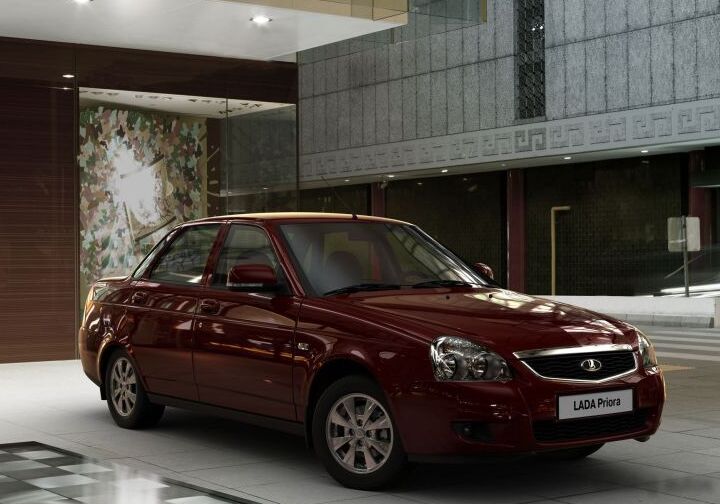
The Lada Priora I Sedan (facelift 2013) 1.6, producing 87 horsepower, represented a significant step forward for AvtoVAZ, the Russian automaker. Introduced in 2013 as part of a broader facelift for the Priora range, this variant aimed to provide affordable and relatively modern transportation to the Russian market and export destinations. The Priora, built on the 1HX0/A3 platform, was intended to replace the aging Lada 110 series, offering improved safety, comfort, and styling. The 1.6-liter 87 hp version served as a core model within the lineup, positioned as an entry-level option appealing to budget-conscious buyers. Production continued until July 2018, when it was superseded by the Lada Vesta.
Technical Specifications
| Brand | Lada |
| Model | Priora |
| Generation | Priora I Sedan (facelift 2013) |
| Type (Engine) | 1.6 (87 Hp) |
| Start of production | 2013 |
| End of production | July, 2018 |
| Powertrain Architecture | Internal Combustion engine |
| Body type | Sedan |
| Seats | 5 |
| Doors | 4 |
| Fuel consumption (combined) | 7.3 l/100 km (32.2 US mpg, 38.7 UK mpg, 13.7 km/l) |
| Fuel Type | Petrol (Gasoline) |
| Acceleration 0 – 100 km/h | 12.5 sec |
| Acceleration 0 – 62 mph | 12.5 sec |
| Acceleration 0 – 60 mph | 11.9 sec |
| Maximum speed | 176 km/h (109.36 mph) |
| Weight-to-power ratio | 13.4 kg/Hp, 74.8 Hp/tonne |
| Weight-to-torque ratio | 8.3 kg/Nm, 120.4 Nm/tonne |
| Power | 87 Hp @ 5100 rpm |
| Power per litre | 54.5 Hp/l |
| Torque | 140 Nm @ 3800 rpm (103.26 lb.-ft. @ 3800 rpm) |
| Engine layout | Front, Transverse |
| Engine displacement | 1596 cm3 (97.39 cu. in.) |
| Number of cylinders | 4 |
| Engine configuration | Inline |
| Number of valves per cylinder | 2 |
| Fuel injection system | Multi-port manifold injection |
| Engine aspiration | Naturally aspirated engine |
| Engine oil capacity | 3.2 l (3.38 US qt | 2.82 UK qt) |
| Coolant | 6.3 l (6.66 US qt | 5.54 UK qt) |
| Kerb Weight | 1163-1185 kg (2563.98 – 2612.48 lbs.) |
| Max. weight | 1578 kg (3478.89 lbs.) |
| Max load | 393-415 kg (866.42 – 914.92 lbs.) |
| Trunk (boot) space – minimum | 430 l (15.19 cu. ft.) |
| Fuel tank capacity | 43 l (11.36 US gal | 9.46 UK gal) |
| Permitted trailer load with brakes (12%) | 800 kg (1763.7 lbs.) |
| Permitted trailer load without brakes | 500 kg (1102.31 lbs.) |
| Length | 4350 mm (171.26 in.) |
| Width | 1680 mm (66.14 in.) |
| Height | 1420 mm (55.91 in.) |
| Wheelbase | 2492 mm (98.11 in.) |
| Front track | 1410 mm (55.51 in.) |
| Rear (Back) track | 1380 mm (54.33 in.) |
| Ride height (ground clearance) | 165 mm (6.5 in.) |
| Drivetrain Architecture | The Internal combustion engine (ICE) drives the front wheels of the vehicle. |
| Drive wheel | Front wheel drive |
| Number of gears and type of gearbox | 5 gears, manual transmission |
| Front suspension | Independent, type McPherson with coil spring and anti-roll bar |
| Rear suspension | Semi-independent, coil spring |
| Front brakes | Ventilated discs |
| Rear brakes | Drum |
| Assisting systems | ABS (Anti-lock braking system) |
| Steering type | Steering rack and pinion |
| Tires size | 175/70 R13 |
| Wheel rims size | 13 |
Powertrain & Engine Architecture
The heart of the Priora 1.6 was the VAZ-21114 engine, a 1.6-liter inline-four cylinder unit. This engine was a development of the older VAZ-2108 engine, featuring a slightly increased displacement and revised engine management. It utilized a multi-point fuel injection system, a significant improvement over the carburetor systems found in earlier Lada models. The engine employed a single overhead camshaft (SOHC) design with two valves per cylinder. While not a particularly sophisticated engine by modern standards, it was known for its relative simplicity and robustness. The 87 horsepower output was achieved at 5100 rpm, with peak torque of 140 Nm (103 lb-ft) delivered at 3800 rpm. The engine was transversely mounted, driving the front wheels. The standard transmission was a five-speed manual gearbox, designed for durability rather than sporty performance.
Driving Characteristics
The Priora 1.6 87 hp offered modest performance. Acceleration from 0 to 100 km/h (0-62 mph) took around 12.5 seconds, and top speed was limited to 176 km/h (109 mph). Compared to the more powerful 1.8-liter versions or the diesel options, the 1.6 felt noticeably slower, particularly when fully loaded or climbing hills. The five-speed manual transmission had relatively long gearing, prioritizing fuel economy over rapid acceleration. The power delivery was linear but lacked the punch of higher-output engines. Handling was adequate for everyday driving, but the suspension was tuned for comfort rather than sporty handling. The steering was light and lacked significant feedback.
Equipment & Trim Levels
The 1.6-liter Priora typically came with a basic level of equipment. Standard features included power steering, central locking, electric front windows, and an audio system. Interior upholstery was typically cloth, and the dashboard featured a functional but somewhat dated design. Optional extras included air conditioning, alloy wheels, and upgraded audio systems. Higher trim levels, such as the “Comfort” and “Luxe” variants, added features like rear electric windows, heated seats, and more sophisticated interior trim. The base 1.6 model was aimed at buyers prioritizing affordability and practicality.
Chassis & Braking
The Priora utilized a McPherson strut front suspension and a semi-independent coil spring rear suspension. This setup provided a reasonable ride quality, although it wasn’t particularly refined. The front brakes were ventilated discs, while the rear brakes were drums. ABS (Anti-lock Braking System) was standard equipment, enhancing safety. The chassis was a relatively simple body-on-frame construction, which contributed to the car’s affordability but also limited its torsional rigidity compared to more modern unibody designs. The 13-inch wheels were fitted with 175/70 R13 tires.
Market Reception & Comparison
The Lada Priora 1.6 was generally well-received in its target market, particularly in Russia and other Eastern European countries. It offered a compelling combination of affordability, practicality, and relative reliability. Critics noted the car’s dated design and lack of refinement compared to Western European competitors, but acknowledged its value for money. Compared to the 1.8-liter Priora, the 1.6 offered better fuel economy but significantly less performance. The diesel versions provided even better fuel economy but were more expensive to purchase and maintain. The 1.6 was often seen as a sensible choice for urban commuters and families on a budget.
Legacy
The Lada Priora 1.6, while not a groundbreaking vehicle, played an important role in modernizing the Russian automotive industry. It provided a more reliable and safer alternative to older Lada models and helped to establish AvtoVAZ as a competitive player in the regional market. In the used car market, the Priora 1.6 remains a popular choice due to its affordability and readily available spare parts. The VAZ-21114 engine is known for its durability, although regular maintenance is essential to prevent issues. While not a collector’s item, the Priora 1.6 represents a significant chapter in the history of Russian automotive manufacturing.

