
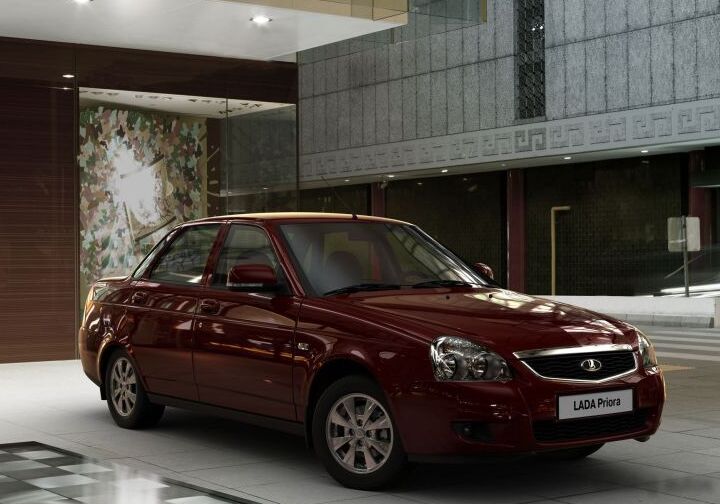
The Lada Priora I Sedan (facelift 2013) 1.6, producing 98 horsepower, represented a significant step in the modernization of the Russian automotive industry. Introduced in 2013 and continuing in production through October 2014, this variant occupied a crucial position within the Priora range, serving as a relatively affordable and practical option for Russian motorists. The Priora itself was built upon the 1HX0/A3 platform, a derivative of the aging but robust Fiat Albea/Logan underpinnings, and aimed to offer a more contemporary alternative to the aging Lada 110 series it replaced. This 1.6-liter, 98 hp version was primarily targeted at buyers seeking a balance between fuel efficiency and acceptable performance for everyday driving.
Technical Specifications
| Brand | Lada |
| Model | Priora |
| Generation | Priora I Sedan (facelift 2013) |
| Type (Engine) | 1.6 (98 Hp) |
| Start of production | 2013 |
| End of production | October, 2014 |
| Powertrain Architecture | Internal Combustion engine |
| Body type | Sedan |
| Seats | 5 |
| Doors | 4 |
| Fuel consumption (urban) | 9.1 l/100 km (25.8 US mpg, 31 UK mpg, 11 km/l) |
| Fuel consumption (extra urban) | 5.5 l/100 km (42.8 US mpg, 51.4 UK mpg, 18.2 km/l) |
| Fuel consumption (combined) | 6.9 l/100 km (34.1 US mpg, 40.9 UK mpg, 14.5 km/l) |
| Fuel Type | Petrol (Gasoline) |
| Acceleration 0 – 100 km/h | 11.5 sec |
| Acceleration 0 – 62 mph | 11.5 sec |
| Acceleration 0 – 60 mph | 10.9 sec |
| Maximum speed | 183 km/h (113.71 mph) |
| Weight-to-power ratio | 11.9 kg/Hp, 84.3 Hp/tonne |
| Weight-to-torque ratio | 8 kg/Nm, 124.7 Nm/tonne |
| Power | 98 Hp @ 5600 rpm |
| Power per litre | 61.4 Hp/l |
| Torque | 145 Nm @ 4000 rpm (106.95 lb.-ft. @ 4000 rpm) |
| Engine layout | Front, Transverse |
| Engine displacement | 1596 cm3 (97.39 cu. in.) |
| Number of cylinders | 4 |
| Engine configuration | Inline |
| Number of valves per cylinder | 4 |
| Fuel injection system | Multi-port manifold injection |
| Engine aspiration | Naturally aspirated engine |
| Engine oil capacity | 3.2 l (3.38 US qt | 2.82 UK qt) |
| Coolant capacity | 6.3 l (6.66 US qt | 5.54 UK qt) |
| Kerb Weight | 1163 kg (2563.98 lbs) |
| Max. weight | 1578 kg (3478.89 lbs) |
| Max load | 415 kg (914.92 lbs) |
| Trunk (boot) space – minimum | 430 l (15.19 cu. ft.) |
| Fuel tank capacity | 43 l (11.36 US gal | 9.46 UK gal) |
| Permitted trailer load with brakes (12%) | 800 kg (1763.7 lbs) |
| Permitted trailer load without brakes | 500 kg (1102.31 lbs) |
| Length | 4350 mm (171.26 in) |
| Width | 1680 mm (66.14 in) |
| Height | 1420 mm (55.91 in) |
| Wheelbase | 2492 mm (98.11 in) |
| Front track | 1410 mm (55.51 in) |
| Rear (Back) track | 1380 mm (54.33 in) |
| Ride height (ground clearance) | 165 mm (6.5 in) |
| Drivetrain Architecture | The Internal combustion engine (ICE) drives the front wheels of the vehicle. |
| Drive wheel | Front wheel drive |
| Number of gears and type of gearbox | 5 gears, manual transmission |
| Front suspension | Independent, type McPherson with coil spring and anti-roll bar |
| Rear suspension | Semi-independent, coil spring |
| Front brakes | Ventilated discs |
| Rear brakes | Drum |
| Assisting systems | ABS (Anti-lock braking system) |
| Steering type | Steering rack and pinion |
| Tires size | 175/65 R14; 185/60 R14; 185/65 R14 |
| Wheel rims size | 14 |
Powertrain & Engine Architecture
The heart of the Priora 1.6 was the VAZ-2110 engine, a four-cylinder, inline engine displacing 1.6 liters (1596 cm³). This engine, while a development of earlier Lada designs, featured multi-point fuel injection, a significant upgrade over the carburetor systems found in older models. The engine utilized a single overhead camshaft (SOHC) operating four valves per cylinder. The 98 horsepower output was achieved at 5600 rpm, with peak torque of 145 Nm (106.95 lb-ft) delivered at 4000 rpm. The engine was transversely mounted, driving the front wheels. The transmission was a standard five-speed manual gearbox, chosen for its affordability and simplicity. While an automatic transmission was offered on some Priora models, it wasn’t typically paired with the base 1.6-liter engine due to the limited power output.
Driving Characteristics
The 1.6-liter, 98 hp Priora Sedan offered modest performance. Acceleration from 0 to 100 km/h (0-62 mph) took around 11.5 seconds, making it adequate for city driving and highway cruising, but not particularly sporty. The five-speed manual transmission was geared to prioritize fuel economy, resulting in a somewhat sluggish feel at lower speeds. Compared to the more powerful 1.8-liter versions or the diesel options, the 1.6 felt noticeably underpowered, especially when fully loaded or tackling steep inclines. However, the lighter weight of the 1.6 compared to some other variants helped to mitigate this somewhat. The steering was light and easy, making it maneuverable in urban environments, but lacked the precision and feedback desired by more enthusiastic drivers.
Equipment & Trim Levels
The Priora 1.6 typically came with a fairly basic level of equipment, reflecting its position as an entry-level model. Standard features generally included power steering, central locking, electric front windows, and an audio system. Air conditioning was often an optional extra. Interior upholstery was typically cloth, with a simple dashboard layout. Higher trim levels offered upgrades such as alloy wheels, fog lights, and more sophisticated audio systems. Safety features were limited, typically consisting of ABS and driver/passenger airbags. The focus was on providing a functional and affordable vehicle rather than luxury or advanced technology.
Chassis & Braking
The Priora utilized a McPherson strut independent suspension at the front and a semi-independent coil spring suspension at the rear. This setup provided a reasonable ride quality, although it wasn’t particularly refined. The front brakes were ventilated discs, offering adequate stopping power, while the rear brakes were drums, a cost-saving measure. The chassis was relatively simple, prioritizing durability and ease of maintenance over sophisticated handling characteristics. The ride height was relatively high, providing good ground clearance for navigating rough roads, a common consideration in Russia.
Market Reception & Comparison
The Lada Priora 1.6 was well-received in the Russian market as an affordable and practical sedan. It offered a significant improvement over previous Lada models in terms of build quality, reliability, and features. However, it faced competition from increasingly affordable foreign imports, particularly from Asian manufacturers. Compared to the 1.8-liter Priora, the 1.6 offered better fuel economy but significantly less performance. The diesel versions provided even better fuel efficiency but came with a higher initial cost. Critics generally praised the Priora’s value for money but noted its lack of refinement and its somewhat dated design.
Legacy
The Lada Priora 1.6, while not a groundbreaking vehicle, played an important role in the modernization of the Russian automotive industry. It provided a relatively affordable and reliable option for Russian motorists, helping to bridge the gap between older Lada models and more modern foreign imports. Today, the Priora 1.6 is a common sight on Russian roads, and its simple, robust design makes it relatively easy and inexpensive to maintain. While not a collector’s item, it remains a practical and affordable used car option, particularly for those seeking a no-frills, dependable vehicle.

