
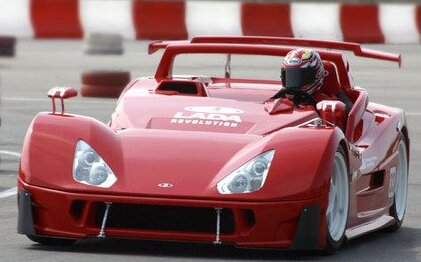
The Lada Revolution I 1.6i, produced between 2005 and 2008, represented a bold departure for the Russian automaker. This rear-wheel-drive roadster was a limited-production vehicle intended to showcase Lada’s engineering capabilities and appeal to a more performance-oriented buyer. It was positioned as a halo car, a departure from the typically utilitarian vehicles associated with the Lada brand. The Revolution I was built on a bespoke platform, differing significantly from the standard Lada offerings of the time, and aimed to compete with entry-level sports cars available in the European market.
Technical Specifications
| Brand | Lada |
| Model | Revolution |
| Generation | Revolution I |
| Type (Engine) | 1.6i (215 Hp) |
| Start of production | 2005 |
| End of production | 2008 |
| Powertrain Architecture | Internal Combustion engine |
| Body type | Roadster |
| Fuel Type | Petrol (Gasoline) |
| Acceleration 0 – 100 km/h | 6.5 sec |
| Acceleration 0 – 62 mph | 6.5 sec |
| Acceleration 0 – 60 mph | 6.2 sec |
| Maximum speed | 260 km/h / 161.56 mph |
| Weight-to-power ratio | 3 kg/Hp, 330.8 Hp/tonne |
| Power | 215 Hp @ 8500 rpm |
| Power per litre | 134.7 Hp/l |
| Engine layout | Rear, Transverse |
| Engine displacement | 1596 cm3 / 97.39 cu. in. |
| Number of cylinders | 4 |
| Engine configuration | Inline |
| Number of valves per cylinder | 4 |
| Fuel injection system | Multi-port manifold injection |
| Engine aspiration | Naturally aspirated engine |
| Kerb Weight | 650 kg / 1433 lbs |
| Length | 3650 mm / 143.7 in |
| Width | 1750 mm / 68.9 in |
| Height | 1200 mm / 47.24 in |
| Wheelbase | 2400 mm / 94.49 in |
| Front track | 1545 mm / 60.83 in |
| Rear (Back) track | 1502 mm / 59.13 in |
| Drivetrain Architecture | The Internal combustion engine (ICE) drives the rear wheels of the vehicle. |
| Drive wheel | Rear wheel drive |
| Number of gears and type of gearbox | 6 gears, manual transmission |
| Front brakes | Ventilated discs |
| Rear brakes | Ventilated discs |
| Steering type | Steering rack and pinion |
| Tires size | 255/40 R18 |
| Wheel rims size | 9J x 18 |
Powertrain & Engine Architecture
The heart of the Lada Revolution I was its 1.6-liter inline four-cylinder engine. While sharing some basic architecture with other Lada engines of the period, this unit was significantly modified to produce 215 horsepower at a high 8500 rpm. This impressive output for its displacement was achieved through a combination of optimized cylinder head design, high-flow fuel injectors, and a tuned exhaust system. The engine utilized a multi-port fuel injection system, a common setup for performance engines of the era. The engine was transversely mounted at the rear of the vehicle, contributing to a balanced weight distribution. The Revolution I was exclusively equipped with a six-speed manual transmission, designed to handle the engine’s power and provide a sporty driving experience. The transmission’s gear ratios were tailored for acceleration, prioritizing responsiveness over top-end cruising efficiency.
Driving Characteristics
The rear-wheel-drive configuration and relatively lightweight construction (650 kg / 1433 lbs) gave the Revolution I lively handling characteristics. Acceleration from 0 to 60 mph was quoted at around 6.2 seconds, and it could reach a top speed of 161.56 mph (260 km/h). The six-speed manual transmission allowed drivers to keep the engine in its optimal power band. However, the car’s limited production run and the relatively unsophisticated chassis compared to established sports car manufacturers meant that its handling wasn’t as refined. Early reviews noted a tendency for oversteer, requiring skilled drivers to manage the car’s balance. The steering, while responsive, lacked the precision found in more expensive sports cars.
Equipment & Trim Levels
Given its positioning as a limited-production model, the Lada Revolution I was relatively well-equipped for its time, though not lavishly so. Standard features included sports seats, leather-wrapped steering wheel, alloy wheels (9J x 18 with 255/40 R18 tires), and power windows. Air conditioning and a more sophisticated audio system were often optional extras. The interior design was minimalist, focusing on functionality rather than luxury. The dashboard layout was straightforward, with clearly visible gauges. The car’s interior materials were of reasonable quality, but lacked the premium feel of more established European sports cars.
Chassis & Braking
The Revolution I featured a fully independent suspension system, with MacPherson struts at the front and a multi-link setup at the rear. This suspension configuration was designed to provide a balance between handling performance and ride comfort. Ventilated disc brakes were fitted to all four wheels, providing adequate stopping power for the car’s performance capabilities. The steering system utilized a rack and pinion setup, offering direct and responsive steering feel. The chassis itself was a tubular space frame, providing a rigid and lightweight platform for the bodywork.
Market Reception & Comparison
The Lada Revolution I received mixed reviews upon its release. Critics praised its performance and handling, particularly considering its price point. However, they also noted its rough edges, including a somewhat unrefined interior and a tendency for oversteer. Compared to other vehicles in its price range, such as the Mazda MX-5 or Toyota MR2, the Revolution I offered more raw power but lacked the same level of refinement. Its limited production run and the Lada brand’s reputation for reliability also hindered its market success. Fuel economy was not a primary focus, with the engine prioritizing performance over efficiency.
Legacy
The Lada Revolution I remains a relatively rare and unusual vehicle. Its limited production run and unique design have made it a sought-after collectible among Lada enthusiasts and those interested in unusual sports cars. The 1.6-liter engine, while potent, is known to require regular maintenance, and parts availability can be challenging. The car’s rear-wheel-drive layout and relatively simple mechanicals make it appealing to those who enjoy hands-on maintenance and modification. Today, the Revolution I represents a fascinating chapter in Lada’s history, a bold attempt to break away from its traditional image and compete in the sports car market. Its long-term reliability is dependent on proper maintenance and care, but well-maintained examples continue to provide an engaging and unique driving experience.
