
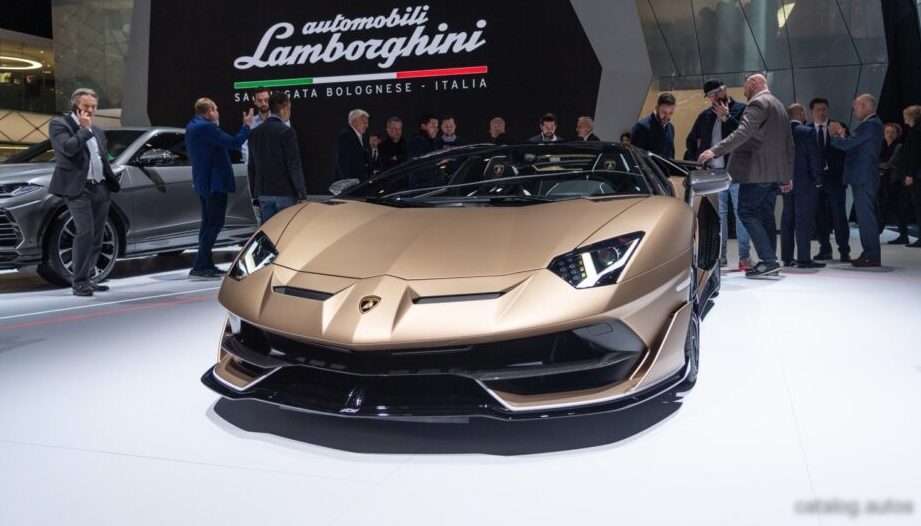
The Lamborghini Aventador SVJ Roadster, introduced in 2018, represents the pinnacle of open-top performance within the Aventador lineage. Building upon the already extreme SVJ (Superveloce Jota) coupe, the Roadster variant offers an uncompromised driving experience with the added thrill of open-air motoring. It’s positioned as the most powerful version of the Aventador Roadster, and a limited-production model aimed at discerning enthusiasts. The SVJ Roadster is part of the Aventador’s second generation (LP750-4 SVJ), which itself is based on Lamborghini’s extensive use of carbon fiber construction to minimize weight and maximize rigidity. It utilizes a naturally aspirated 6.5-liter V12 engine, paired with a 7-speed ISR (Independent Shifting Rod) automated manual transmission and a sophisticated all-wheel-drive system.
Technical Specifications
| Brand | Lamborghini |
| Model | Aventador |
| Generation | Aventador SVJ Roadster |
| Type (Engine) | 6.5 V12 (770 Hp) 4WD ISR |
| Start of production | 2018 |
| Powertrain Architecture | Internal Combustion engine |
| Body type | Roadster |
| Seats | 2 |
| Doors | 2 |
| Combined fuel consumption (WLTP) | 17.9 l/100 km |
| Combined fuel consumption (US mpg) | 13.1 US mpg |
| Combined fuel consumption (UK mpg) | 15.8 UK mpg |
| Combined fuel consumption (km/l) | 5.6 km/l |
| CO2 emissions (WLTP) | 486 g/km |
| Fuel Type | Petrol (Gasoline) |
| Acceleration 0 – 100 km/h | 2.9 sec |
| Acceleration 0 – 62 mph | 2.9 sec |
| Acceleration 0 – 60 mph | 3 sec |
| Acceleration 0 – 200 km/h | 8.8 sec |
| Maximum speed | 351 km/h (218.1 mph) |
| Weight-to-power ratio | 2 kg/Hp, 488.9 Hp/tonne |
| Weight-to-torque ratio | 2.2 kg/Nm, 457.1 Nm/tonne |
| Power | 770 Hp @ 8500 rpm |
| Power per litre | 118.5 Hp/l |
| Torque | 720 Nm @ 6750 rpm (531.04 lb.-ft. @ 6750 rpm) |
| Maximum engine speed | 8700 rpm |
| Engine layout | Middle, Longitudinal |
| Engine Model/Code | L539 |
| Engine displacement | 6498 cm3 (396.53 cu. in.) |
| Number of cylinders | 12 |
| Engine configuration | V-engine |
| Cylinder Bore | 95 mm (3.74 in.) |
| Piston Stroke | 76.4 mm (3.01 in.) |
| Compression ratio | 11.8:1 |
| Number of valves per cylinder | 4 |
| Fuel injection system | Multi-port manifold injection |
| Engine aspiration | Naturally aspirated engine |
| Engine oil capacity | 12 l (12.68 US qt | 10.56 UK qt) |
| Coolant capacity | 25 l (26.42 US qt | 22 UK qt) |
| Kerb Weight | 1575 kg (3472.28 lbs.) |
| Fuel tank capacity | 85 l (22.45 US gal | 18.7 UK gal) |
| Length | 4943 mm (194.61 in.) |
| Width | 2098 mm (82.6 in.) |
| Width including mirrors | 2273 mm (89.49 in.) |
| Height | 1136 mm (44.72 in.) |
| Wheelbase | 2700 mm (106.3 in.) |
| Front track | 1720 mm (67.72 in.) |
| Rear track | 1680 mm (66.14 in.) |
| Front overhang | 1226 mm (48.27 in.) |
| Rear overhang | 1017 mm (40.04 in.) |
| Ride height (ground clearance) | 115 mm (4.53 in.) |
| Minimum turning circle | 12.5 m (41.01 ft.) |
| Drivetrain Architecture | All wheel drive (4×4) |
| Number of gears | 7 |
| Gearbox type | Automatic transmission ISR |
| Front suspension | Double wishbone |
| Rear suspension | Double wishbone |
| Front brakes | Ventilated discs, 400 mm |
| Rear brakes | Ventilated discs, 380 mm |
| Tires size | 255/30 ZR20 92Y; 355/25 ZR21 107Y |
| Wheel rims size | 9J x 20; 13J x 21 |
Powertrain & Engine Architecture
The heart of the Aventador SVJ Roadster is Lamborghini’s naturally aspirated 6.5-liter V12 engine, designated L539. This engine produces a staggering 770 horsepower at 8,500 rpm and 531 lb-ft of torque at 6,750 rpm. It features a 60-degree V-angle, four valves per cylinder, and a high 11.8:1 compression ratio. The engine utilizes multi-point fuel injection and benefits from extensive use of lightweight materials, including titanium intake valves. The engine’s architecture is a key element of Lamborghini’s commitment to a visceral driving experience, eschewing turbocharging in favor of immediate throttle response and a distinctive exhaust note. Power is transmitted to all four wheels via a 7-speed ISR (Independent Shifting Rod) automated manual transmission. This transmission, while offering incredibly fast shifts, is known for its somewhat jerky low-speed operation compared to traditional automatic or dual-clutch transmissions. The ISR system uses actuators to mechanically shift gears, rather than relying on a torque converter.
Driving Characteristics
The SVJ Roadster delivers an exceptionally aggressive and engaging driving experience. The combination of the high-output V12 engine, all-wheel drive, and relatively lightweight construction (for a V12 supercar) results in blistering acceleration. The 0-60 mph sprint is dispatched in around 3 seconds, and the car can reach a top speed of 218 mph. The ISR transmission, while quick, requires a skilled driver to master smooth launches and low-speed maneuvers. The all-wheel-drive system provides immense traction, allowing the driver to confidently exploit the engine’s power. Compared to the standard Aventador Roadster, the SVJ offers significantly sharper handling due to its revised suspension tuning, increased downforce, and lighter weight. The SVJ’s steering is direct and communicative, providing a strong connection to the road. However, the firm suspension and aggressive tires mean that ride comfort is sacrificed in the pursuit of performance.
Equipment & Trim Levels
The Aventador SVJ Roadster is a highly focused performance car, and as such, it comes standard with a comprehensive array of performance-enhancing features. These include carbon-ceramic brakes, a lightweight exhaust system, and a sophisticated aerodynamics package with active aero elements. The interior is trimmed in Alcantara and leather, with carbon fiber accents throughout. Standard features include power-adjustable seats, a navigation system, and a premium audio system. Optional extras include a variety of customization options, allowing owners to personalize their cars to their exact specifications. These options include different interior color schemes, exterior paint finishes, and carbon fiber trim packages.
Chassis & Braking
The Aventador SVJ Roadster utilizes a lightweight monocoque chassis constructed primarily from carbon fiber. This chassis provides exceptional rigidity and contributes to the car’s low weight. The suspension features double wishbones at all four corners, with magnetorheological dampers that adjust to changing road conditions. The braking system consists of ventilated carbon-ceramic discs with six-piston calipers at the front and four-piston calipers at the rear. The car also features Lamborghini’s dynamic steering system, which provides variable steering ratios for improved agility.
Market Reception & Comparison
The Aventador SVJ Roadster was widely praised by automotive critics for its exceptional performance, handling, and dramatic styling. It was often compared favorably to other high-performance supercars, such as the Ferrari 812 Superfast and the McLaren 720S. While the SVJ Roadster offered superior track performance, some critics noted that its ride comfort was compromised compared to its rivals. The SVJ Roadster’s fuel economy is predictably poor, with a combined fuel consumption of 13.1 US mpg. However, this is typical for a high-performance supercar of this caliber. Compared to the standard Aventador Roadster, the SVJ offers a significantly more focused and engaging driving experience, but at a higher price point.
Legacy
The Aventador SVJ Roadster represents a high point in Lamborghini’s naturally aspirated V12 engine development. While the Aventador has since been replaced by the Revuelto, the SVJ Roadster remains a highly sought-after collector’s item. The L539 engine, while complex, has proven to be relatively reliable when properly maintained. However, maintenance costs are substantial, and the ISR transmission can require occasional servicing. On the used car market, SVJ Roadsters command a premium price, reflecting their limited production numbers and exceptional performance capabilities. The SVJ Roadster is remembered as a thrilling and uncompromising supercar that embodies Lamborghini’s commitment to pushing the boundaries of automotive performance.


