
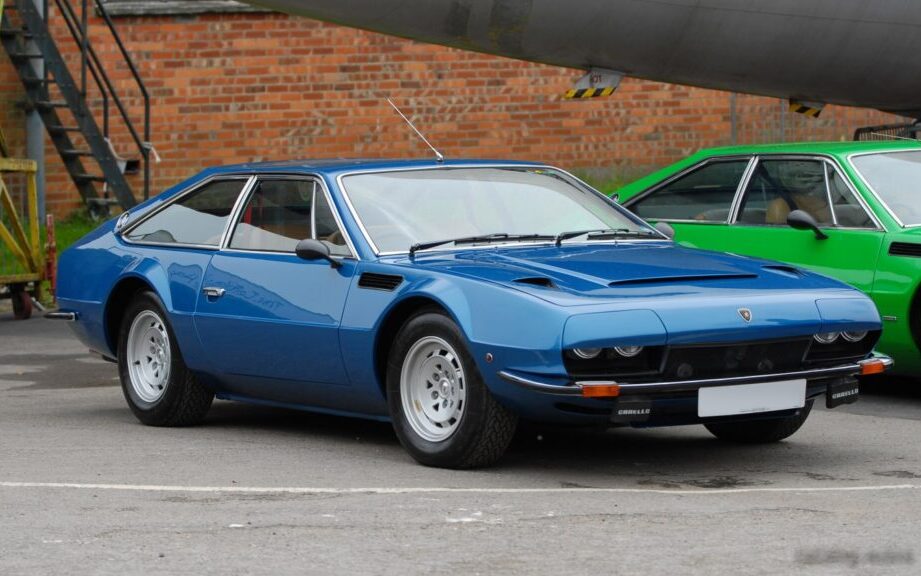
The Lamborghini Jarama 400 GT, produced between 1970 and 1976, represents a pivotal moment in the Italian automaker’s history. Designed as a more compact and accessible grand tourer compared to the larger Espada, the Jarama aimed to blend Lamborghini’s signature performance with a more manageable size and a slightly lower price point. It was positioned as a direct competitor to the Ferrari Daytona and other high-performance coupes of the era. The Jarama’s design, penned by Bertone’s Marcello Gandini, is characterized by its wedge shape and distinctive glass hatchback, a departure from the more traditional styling of earlier Lamborghinis. The 400 GT variant, equipped with a 3.9-liter V12 engine producing 350 horsepower, was the primary model offered throughout the Jarama’s production run.
Technical Specifications
| Brand | Lamborghini |
| Model | Jarama |
| Generation | Jarama |
| Type (Engine) | 400 GT (350 Hp) |
| Start of production | 1970 year |
| End of production | 1976 year |
| Powertrain Architecture | Internal Combustion engine |
| Body type | Coupe |
| Seats | 4 |
| Doors | 2 |
| Fuel Type | Petrol (Gasoline) |
| Maximum speed | 261 km/h (162.18 mph) |
| Weight-to-power ratio | 4.1 kg/Hp, 241.4 Hp/tonne |
| Weight-to-torque ratio | 3.7 kg/Nm, 271 Nm/tonne |
| Power | 350 Hp @ 7500 rpm |
| Power per litre | 89.1 Hp/l |
| Torque | 393 Nm @ 5500 rpm (289.86 lb.-ft. @ 5500 rpm) |
| Engine Model/Code | L 403 |
| Engine displacement | 3929 cm3 (239.76 cu. in.) |
| Number of cylinders | 12 |
| Engine configuration | V-engine |
| Cylinder Bore | 82 mm (3.23 in.) |
| Piston Stroke | 62 mm (2.44 in.) |
| Compression ratio | 10.5:1 |
| Number of valves per cylinder | 2 |
| Fuel injection system | Carburettor |
| Engine aspiration | Naturally aspirated engine |
| Kerb Weight | 1450 kg (3196.7 lbs.) |
| Trunk (boot) space – maximum | 430 l (15.19 cu. ft.) |
| Length | 4485 mm (176.57 in.) |
| Width | 1820 mm (71.65 in.) |
| Height | 1190 mm (46.85 in.) |
| Wheelbase | 2380 mm (93.7 in.) |
| Front track | 1490 mm (58.66 in.) |
| Rear (Back) track | 1490 mm (58.66 in.) |
| Drivetrain Architecture | The Internal combustion engine (ICE) drives the rear wheels of the vehicle. |
| Drive wheel | Rear wheel drive |
| Number of gears and type of gearbox | 5 gears, manual transmission |
| Front suspension | Double wishbone, Independent coil spring |
| Rear suspension | Double wishbone, Independent coil spring |
| Front brakes | Ventilated discs |
| Rear brakes | Ventilated discs |
| Steering type | Steering rack and pinion |
| Wheel rims size | 7J x 15 |
Powertrain & Engine Architecture
The heart of the Jarama 400 GT is the Lamborghini L403 engine, a 3.9-liter (3929 cc) naturally aspirated V12. This engine is a derivative of the earlier 3.5-liter V12 found in the Miura, but with an increased bore size to achieve the larger displacement. It features a 60-degree V-angle and utilizes a single overhead camshaft per cylinder bank, operating two valves per cylinder. Unlike later Lamborghini engines which adopted fuel injection, the L403 relied on six Weber 46 IDA3C1 carburetors for fuel delivery. This carburetor setup, while providing a raw and responsive feel, also contributed to slightly lower fuel economy and required more frequent maintenance. The engine produced 350 horsepower at 7,500 rpm and 393 Nm (289.86 lb-ft) of torque at 5,500 rpm. The engine’s robust construction and relatively conservative tuning (compared to the Miura’s) aimed for greater reliability and longevity. The engine is mated to a five-speed manual transmission, driving the rear wheels.
Driving Characteristics
The Jarama 400 GT offered a distinctly different driving experience compared to its contemporaries. Its relatively compact size and shorter wheelbase contributed to a more agile and responsive feel than the larger Espada. The 350 horsepower V12 provided ample power for spirited driving, with a noticeable surge in acceleration as the engine climbed towards its 7,500 rpm redline. The five-speed manual transmission offered precise shifts, although the clutch could be heavy for extended city driving. The car’s handling was generally well-balanced, thanks to its independent double-wishbone suspension at all four corners. However, the Jarama’s relatively high weight (1450 kg / 3196.7 lbs) and rear-wheel drive configuration meant that it could be challenging to control at the limit, particularly in wet conditions. Compared to the Miura, the Jarama felt more stable and predictable, but lacked the ultimate level of raw excitement.
Equipment & Trim Levels
The Jarama 400 GT was relatively well-equipped for a sports car of its era, though luxury wasn’t its primary focus. Standard features included leather upholstery, power windows, and a wood-rimmed steering wheel. Air conditioning was often an optional extra, as were features like a radio and power-assisted steering. The interior design was functional and driver-focused, with a prominent dashboard featuring a full array of gauges, including a speedometer, tachometer, oil pressure gauge, and water temperature gauge. Trim levels were fairly limited; most variations came down to individual customer preferences regarding interior colors and optional equipment. The overall ambiance was one of understated elegance, reflecting Lamborghini’s attempt to broaden its appeal beyond the purely exotic.
Chassis & Braking
The Jarama utilized a tubular steel chassis, providing a strong and rigid foundation for the bodywork. The suspension system consisted of independent double-wishbone setups at both the front and rear, with coil springs and hydraulic shock absorbers. This configuration provided a good balance of ride comfort and handling performance. Braking duties were handled by ventilated disc brakes at all four corners, offering adequate stopping power for the car’s weight and performance. Steering was via a rack-and-pinion system, providing precise and responsive control. The car rode on 7J x 15 inch wheels, typically fitted with Pirelli Cinturato tires.
Market Reception & Comparison
The Lamborghini Jarama received mixed reviews upon its introduction. Critics praised its stylish design and improved practicality compared to the Miura, but some found it lacked the ultimate level of performance and excitement. Compared to the Ferrari Daytona, the Jarama was often seen as slightly less refined and powerful, but also more approachable and easier to drive. The Jarama’s carburetor-fed engine also suffered in comparison to the Daytona’s fuel-injected powerplant, particularly in terms of fuel economy and emissions. However, the Jarama’s lower price point and more manageable size appealed to a wider range of buyers. Reliability was generally good, although maintenance costs remained high due to the complexity of the V12 engine.
Legacy
Today, the Lamborghini Jarama 400 GT is a highly sought-after classic car, appreciated for its unique design, powerful V12 engine, and relative rarity. While not as iconic as the Miura or Countach, the Jarama represents an important chapter in Lamborghini’s history, demonstrating the company’s ability to adapt to changing market demands. The L403 engine, while requiring regular maintenance, has proven to be remarkably durable when properly cared for. Values for well-maintained Jarama 400 GTs have steadily increased in recent years, reflecting their growing desirability among collectors. The Jarama stands as a testament to the enduring appeal of Italian sports car design and engineering.
