
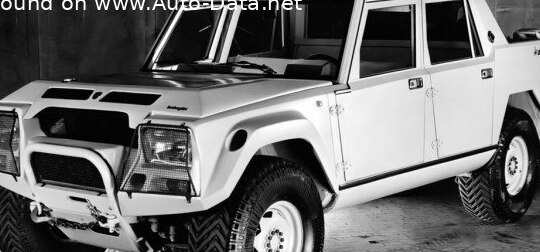
The Lamborghini LMA002, a prototype vehicle produced in 1982, represents a pivotal, though ultimately limited, foray by the Italian manufacturer into the realm of high-performance, all-terrain vehicles. Born from a military contract attempt (the “LM” designation stood for Lamborghini Militare), the LMA002 was intended to be a rugged, capable off-roader. While the military contract ultimately fell through, Lamborghini recognized the potential for a civilian version, leading to the development of the LMA002 that would eventually see limited production. This particular prototype showcased a 4.8-liter V12 engine producing 332 horsepower, setting the stage for the iconic, and somewhat outlandish, vehicle that followed. It was a bold statement from Lamborghini, demonstrating their engineering prowess and willingness to explore beyond the traditional supercar market.
Technical Specifications
| Brand | Lamborghini |
| Model | LMA002 (Prototype) |
| Generation | LMA002 (Prototype) |
| Type (Engine) | 4.8 (332 Hp) |
| Start of production | 1982 |
| End of production | 1982 |
| Powertrain Architecture | Internal Combustion engine |
| Body type | Off-road vehicle |
| Seats | 4 |
| Doors | 4 |
| Fuel Type | Petrol (Gasoline) |
| Maximum speed | 188 km/h (116.82 mph) |
| Weight-to-power ratio | 7.8 kg/Hp, 127.7 Hp/tonne |
| Weight-to-torque ratio | 6.1 kg/Nm, 163.8 Nm/tonne |
| Power | 332 Hp @ 6000 rpm |
| Power per litre | 69.8 Hp/l |
| Torque | 426 Nm @ 4500 rpm (314.2 lb.-ft. @ 4500 rpm) |
| Engine layout | Front, Longitudinal |
| Engine displacement | 4754 cm3 (290.11 cu. in.) |
| Number of cylinders | 12 |
| Engine configuration | V-engine |
| Cylinder Bore | 85.5 mm (3.37 in.) |
| Piston Stroke | 69 mm (2.72 in.) |
| Fuel injection system | Carburettor |
| Engine aspiration | Naturally aspirated engine |
| Valvetrain | DOHC |
| Engine oil capacity | 17 l (17.96 US qt | 14.96 UK qt) |
| Coolant | 17 l (17.96 US qt | 14.96 UK qt) |
| Kerb Weight | 2600 kg (5732.02 lbs) |
| Fuel tank capacity | 280 l (73.97 US gal | 61.59 UK gal) |
| Length | 4790 mm (188.58 in.) |
| Width including mirrors | 2000 mm (78.74 in.) |
| Height | 1850 mm (72.83 in.) |
| Wheelbase | 2950 mm (116.14 in.) |
| Front track | 1615 mm (63.58 in.) |
| Rear (Back) track | 1615 mm (63.58 in.) |
| Ride height (ground clearance) | 300 mm (11.81 in.) |
| Drive wheel | All wheel drive (4×4) |
| Number of gears and type of gearbox | 5 gears, manual transmission |
| Front suspension | Independent coil spring |
| Rear suspension | Independent coil spring |
| Front brakes | Ventilated discs |
| Rear brakes | Ventilated discs |
| Wheel rims size | 9J x 16 |
Powertrain & Engine Architecture
The heart of the LMA002 prototype was Lamborghini’s 4.8-liter V12 engine, a naturally aspirated powerplant derived from the legendary 3.5-liter V8 initially designed for the Espada and Islero. Bored and stroked to 4.8 liters, the engine retained the 60-degree V-angle and utilized a single overhead camshaft (SOHC) design per cylinder bank, a somewhat archaic setup for the time, but one that contributed to the engine’s robust character. The prototype employed carburetion for fuel delivery, a deliberate choice for simplicity and reliability, particularly given the intended off-road application. This engine produced 332 horsepower at 6000 rpm and 314.2 lb-ft of torque at 4500 rpm. The engine was mounted longitudinally in the front of the chassis. The prototype was equipped with a five-speed manual transmission, delivering power to all four wheels.
Driving Characteristics
While the LMA002 prototype wasn’t extensively tested by the automotive press, it’s reasonable to assume its driving characteristics were…unique. The combination of a large, heavy chassis (approximately 5732 lbs) and a powerful V12 engine resulted in a vehicle that was likely both exhilarating and challenging to control. The manual transmission offered a direct connection to the engine, but the sheer weight and high center of gravity would have demanded careful throttle and steering inputs, especially on uneven terrain. Compared to the later production models which offered a three-speed automatic transmission, the prototype’s manual gearbox would have provided more driver engagement and control, but potentially at the expense of ease of use in demanding off-road situations. The all-wheel-drive system was crucial for traction, but the LMA002 was not designed for delicate handling; it was built for brute force and capability.
Equipment & Trim Levels
As a prototype, the LMA002 lacked the refined interior appointments of the later production models. The focus was squarely on functionality and durability. The interior featured basic instrumentation, rugged seating, and minimal trim. Given its military origins, the interior was spartan, prioritizing practicality over luxury. It’s likely the prototype featured reinforced seats and a robust dashboard designed to withstand the rigors of off-road use. Optional extras were not a consideration at this stage of development.
Chassis & Braking
The LMA002 prototype utilized a robust, box-section steel chassis, designed to withstand significant torsional stress. Independent coil spring suspension was employed at all four corners, providing a degree of wheel travel necessary for off-road performance. Ventilated disc brakes were fitted front and rear, providing adequate stopping power, though likely requiring considerable pedal effort given the vehicle’s weight. The high ground clearance of 11.81 inches was a key feature, enabling the LMA002 to navigate challenging terrain. The track width of 63.58 inches front and rear contributed to stability, but also to the vehicle’s considerable size.
Market Reception & Comparison
The LMA002 prototype did not receive significant market reception, as it was never intended for public sale. However, the concept generated considerable interest within automotive circles, demonstrating Lamborghini’s willingness to explore new market segments. Compared to the later production models, the prototype represented a more raw and unrefined approach to the off-road supercar concept. The production LMA002, with its automatic transmission and more luxurious interior, was aimed at a different clientele – those seeking a unique and ostentatious vehicle rather than a purely utilitarian off-roader.
Legacy
The Lamborghini LMA002 prototype, while a short-lived experiment, played a crucial role in the development of the production LMA002. It proved the feasibility of a high-performance, all-terrain vehicle bearing the Lamborghini badge. Although production numbers were limited, the LMA002 has become a highly sought-after collector’s item, representing a unique chapter in Lamborghini’s history. The prototype itself remains a testament to the company’s engineering ambition and willingness to push boundaries. Today, the LMA002 is remembered as a fascinating and somewhat eccentric vehicle, a bold departure from Lamborghini’s traditional supercar focus.
