
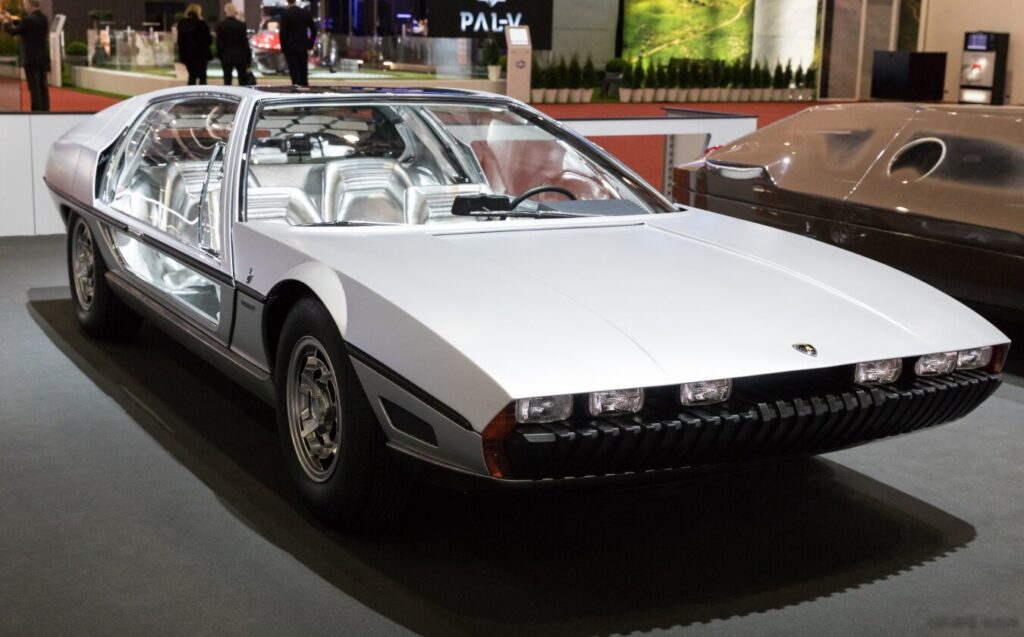
The Lamborghini Marzal, produced in a very limited run during 1967, represents a pivotal moment in the Italian automaker’s history. It wasn’t merely a showcase of Lamborghini’s engineering prowess, but a bold design study exploring the potential of a four-seater grand tourer. The 2.0-liter (175 hp) variant, while the sole configuration offered, was a significant departure from the company’s established focus on two-seater sports cars. The Marzal was conceived as a more practical, family-oriented Lamborghini, and its radical styling, penned by Marcello Gandini at Bertone, foreshadowed many design elements found in later Lamborghini models. Only six examples were ever built, with five being displayed at the 1967 Geneva Motor Show and one retained by Ferruccio Lamborghini himself.
Technical Specifications
| Brand | Lamborghini |
| Model | Marzal |
| Generation | Marzal |
| Type (Engine) | 2.0 (175 Hp) |
| Start of production | 1967 |
| End of production | 1967 |
| Powertrain Architecture | Internal Combustion engine |
| Body type | Coupe |
| Seats | 4 |
| Doors | 2 |
| Fuel Type | Petrol (Gasoline) |
| Maximum speed | 225 km/h (139.81 mph) |
| Weight-to-power ratio | 7.5 kg/Hp, 133.6 Hp/tonne |
| Weight-to-torque ratio | 7.3 kg/Nm, 136.6 Nm/tonne |
| Power | 175 Hp @ 6800 rpm |
| Power per litre | 87.6 Hp/l |
| Torque | 179 Nm @ 4600 rpm (132.02 lb.-ft. @ 4600 rpm) |
| Engine layout | Rear, Transverse |
| Engine displacement | 1997 cm3 (121.86 cu. in.) |
| Number of cylinders | 6 |
| Engine configuration | Inline |
| Cylinder Bore | 82 mm (3.23 in.) |
| Piston Stroke | 62 mm (2.44 in.) |
| Compression ratio | 9.2:1 |
| Number of valves per cylinder | 2 |
| Fuel injection system | Carburettor |
| Engine aspiration | Naturally aspirated engine |
| Valvetrain | DOHC |
| Kerb Weight | 1310 kg (2888.06 lbs.) |
| Trunk (boot) space – minimum | 310 l (10.95 cu. ft.) |
| Fuel tank capacity | 75 l (19.81 US gal | 16.5 UK gal) |
| Length | 4450 mm (175.2 in.) |
| Width | 1709 mm (67.28 in.) |
| Height | 1110 mm (43.7 in.) |
| Wheelbase | 2620 mm (103.15 in.) |
| Front track | 1480 mm (58.27 in.) |
| Rear (Back) track | 1480 mm (58.27 in.) |
| Drivetrain Architecture | The Internal combustion engine (ICE) drives the rear wheels of the vehicle. |
| Drive wheel | Rear wheel drive |
| Number of gears and type of gearbox | 5 gears, manual transmission |
| Front suspension | Double wishbone |
| Rear suspension | Double wishbone |
| Front brakes | Disc |
| Rear brakes | Ventilated discs |
| Steering type | Steering rack and pinion |
| Tires size | 205/75 R14 |
| Wheel rims size | 6.5J x 14 |
Powertrain & Engine Architecture
The heart of the Marzal is its 1997cc inline-six cylinder engine, designated as a naturally aspirated unit. This engine, while sharing some lineage with Lamborghini’s earlier V12 designs, was a unique creation. It featured a dual overhead camshaft (DOHC) valvetrain operating two valves per cylinder. Fuel delivery was managed by a carburetor system, a common practice for the era, rather than the fuel injection systems that would become prevalent later. The engine produced 175 horsepower at 6800 rpm and 179 Nm (132.02 lb.-ft.) of torque at 4600 rpm. Notably, the engine was mounted transversely at the rear of the vehicle, a configuration that contributed to the Marzal’s unique handling characteristics. Power was transmitted to the rear wheels via a five-speed manual transmission. The transverse engine layout, while unusual for a Lamborghini, was intended to maximize interior space and improve weight distribution.
Driving Characteristics
The Marzal’s driving experience was undoubtedly unique. The rear-mounted, transversely-oriented engine and the relatively modest 175 hp output resulted in a distinct character. While not possessing the blistering acceleration of later Lamborghini models, the Marzal offered a surprisingly capable and engaging driving experience. The five-speed manual transmission allowed drivers to effectively manage the engine’s powerband. The rear-wheel-drive configuration, combined with the double wishbone suspension on both axles, provided a reasonably balanced handling feel, although the rear-engine layout did introduce a degree of oversteer. The Marzal’s top speed was approximately 225 km/h (139.81 mph). Compared to a potential V12-powered Lamborghini of the time, the 2.0-liter Marzal prioritized usability and grand touring comfort over outright performance.
Equipment & Trim Levels
Given the limited production run and the Marzal’s role as a design exercise, trim levels were essentially non-existent. All six examples were equipped with a high level of standard features for the time. The interior was lavishly appointed with leather upholstery, and the cabin was designed to accommodate four passengers comfortably. The Marzal’s most striking interior feature was its extensive use of glass, including a large panoramic roof and expansive windows, creating a bright and airy cabin. Optional extras were largely dictated by individual customer requests, as the cars were essentially bespoke creations. Power steering and air conditioning were available, but not standard.
Chassis & Braking
The Marzal’s chassis was a steel monocoque construction, providing a rigid and lightweight platform. The suspension system employed double wishbones on both the front and rear axles, offering a good balance of ride comfort and handling precision. Braking duties were handled by disc brakes on all four wheels, with ventilated discs at the rear to improve heat dissipation. The steering system was a rack and pinion setup, providing precise and responsive steering feel. The car rode on 205/75 R14 tires mounted on 6.5J x 14 inch wheels.
Market Reception & Comparison
The Lamborghini Marzal received a largely positive reception from automotive critics, who praised its innovative design and luxurious interior. However, some critics questioned the practicality of a rear-engined, four-seater Lamborghini. The car was seen as a bold statement of intent from Lamborghini, demonstrating the company’s willingness to explore new design directions. Compared to other grand tourers of the era, such as the Ferrari 275 GTB/4, the Marzal offered a more unconventional and futuristic design. Its fuel economy, while not a primary concern for potential buyers, was comparable to other high-performance cars of the time. Reliability was not extensively documented due to the limited production run, but the engine was generally considered to be robust and well-engineered.
Legacy
The Lamborghini Marzal, despite its limited production, left a lasting legacy on the automotive world. Its radical design influenced subsequent Lamborghini models, including the Espada and Jarama. The Marzal’s emphasis on spaciousness and comfort paved the way for Lamborghini’s later foray into the luxury SUV market with the Urus. Today, the Marzal is a highly sought-after collector’s item, with surviving examples commanding significant prices. The powertrain, while not as iconic as Lamborghini’s V12s, is considered a reliable and well-engineered unit. The Marzal stands as a testament to Lamborghini’s innovative spirit and its willingness to challenge conventional automotive norms.
