
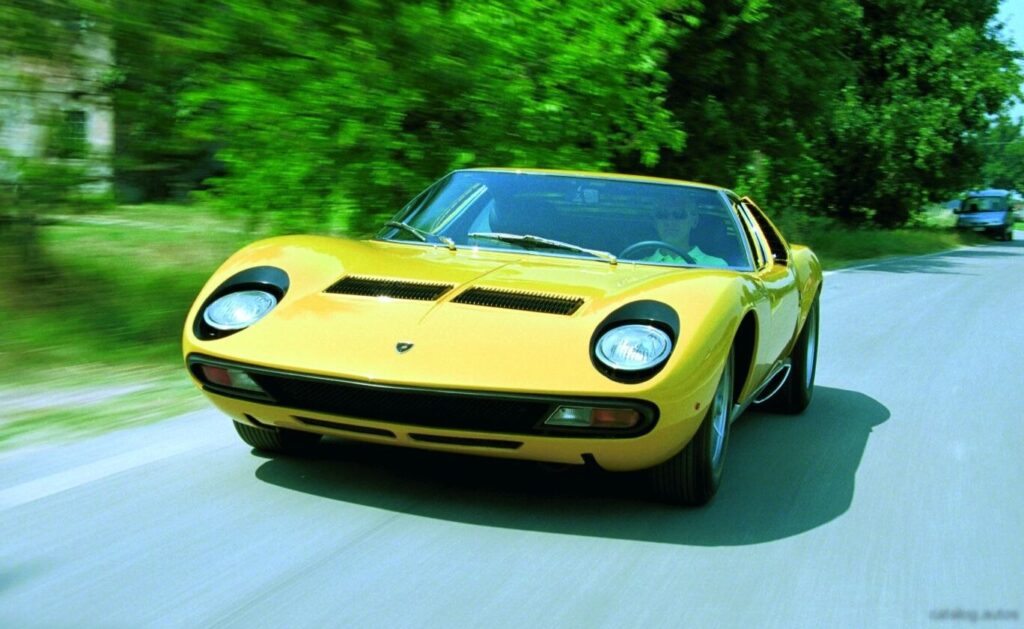
The Lamborghini Miura P400, produced from August 1966 to August 1969, represents a pivotal moment in automotive history. Often credited with establishing the modern supercar archetype, the Miura was a radical departure from the grand touring cars that preceded it. It was the first Lamborghini to utilize a rear-mid engine, rear-wheel drive layout, a configuration that would become standard for high-performance sports cars. The P400 designation refers to the initial 3.9-liter V12 engine producing approximately 350 horsepower. The Miura was built on a bespoke chassis, designed by Giotto Bizzarrini, and clothed in stunning bodywork penned by Marcello Gandini at Bertone. It quickly became an icon, celebrated for its breathtaking aesthetics and groundbreaking performance.
Technical Specifications
| Brand | Lamborghini |
| Model | Miura |
| Generation | Miura |
| Type (Engine) | P400 3.9 V12 (350 Hp) |
| Start of production | August, 1966 |
| End of production | August, 1969 |
| Powertrain Architecture | Internal Combustion engine |
| Body type | Coupe |
| Seats | 2 |
| Doors | 2 |
| Fuel consumption (economy) – combined | 17-19 l/100 km (13.8 – 12.4 US mpg, 16.6 – 14.9 UK mpg, 5.9 – 5.3 km/l) |
| Fuel Type | Petrol (Gasoline) |
| Acceleration 0 – 100 km/h | 6.7 sec |
| Acceleration 0 – 62 mph | 6.7 sec |
| Acceleration 0 – 60 mph | 6.4 sec |
| Maximum speed | 300 km/h (186.41 mph) |
| Weight-to-power ratio | 2.8 kg/Hp, 357.1 Hp/tonne |
| Weight-to-torque ratio | 2.8 kg/Nm, 362.2 Nm/tonne |
| Power | 350 Hp @ 7000 rpm |
| Power per litre | 89.1 Hp/l |
| Torque | 355 Nm @ 5000 rpm (261.83 lb.-ft. @ 5000 rpm) |
| Engine layout | Rear axle, Longitudinal |
| Engine displacement | 3929 cm3 (239.76 cu. in.) |
| Number of cylinders | 12 |
| Engine configuration | V-engine |
| Cylinder Bore | 82 mm (3.23 in.) |
| Piston Stroke | 62 mm (2.44 in.) |
| Compression ratio | 9.8:1 |
| Number of valves per cylinder | 2 |
| Fuel injection system | Carburettor |
| Engine aspiration | Naturally aspirated engine |
| Valvetrain | DOHC |
| Kerb Weight | 980 kg (2160.53 lbs.) |
| Trunk (boot) space – minimum | 140 l (4.94 cu. ft.) |
| Fuel tank capacity | 90 l (23.78 US gal | 19.8 UK gal) |
| Length | 4360 mm (171.65 in.) |
| Width | 1760 mm (69.29 in.) |
| Height | 1055 mm (41.54 in.) |
| Wheelbase | 2500 mm (98.43 in.) |
| Front track | 1412 mm (55.59 in.) |
| Rear (Back) track | 1412 mm (55.59 in.) |
| Minimum turning circle | 11.5 m (37.73 ft.) |
| Drivetrain Architecture | The Internal combustion engine (ICE) drives the rear wheels of the vehicle. |
| Drive wheel | Rear wheel drive |
| Number of gears and type of gearbox | 5 gears, manual transmission |
| Front suspension | Double wishbone, Transverse stabilizer |
| Rear suspension | Double wishbone, Transverse stabilizer |
| Front brakes | Disc |
| Rear brakes | Disc |
| Steering type | Steering rack and pinion |
| Wheel rims size | 7J x 15 |
Powertrain & Engine Architecture
The heart of the Miura P400 is its 3.9-liter, 60-degree V12 engine, designated the Lamborghini Tipo 350. This engine, a masterpiece of engineering, was derived from the earlier 3.5-liter V12 found in the 350 GT. It featured a lightweight alloy block and heads, and utilized four triple-choke Weber 46 IDA carburetors to deliver fuel. The engine employed a dual overhead camshaft (DOHC) design with two valves per cylinder. Crucially, the engine was mounted transversely behind the driver, a revolutionary design for the time. This layout contributed to the car’s exceptional balance and handling. The P400 was paired with a five-speed manual transmission, driving the rear wheels. The transmission was known for its robust construction but also for its somewhat heavy and notchy shift feel.
Driving Characteristics
The Miura P400 offered a driving experience unlike anything else available in the late 1960s. The 350 horsepower engine, while seemingly modest by modern standards, propelled the lightweight car (approximately 2,160 lbs) to a top speed of 186 mph. Acceleration to 60 mph took around 6.4 seconds. The transverse engine placement and rear-wheel drive configuration resulted in a car that was remarkably neutral and balanced, though it could be challenging to control at the limit. The steering was direct and communicative, providing the driver with a strong sense of connection to the road. The car’s relatively short wheelbase contributed to its agility, but also meant it could be prone to snap oversteer if pushed too hard. The five-speed gearbox, while not the most refined, allowed the driver to fully exploit the engine’s powerband.
Equipment & Trim Levels
The Miura P400 was not a car focused on lavish luxury. It was a driver’s machine, and its interior reflected that. Standard features included leather bucket seats, a wood-rimmed steering wheel, and basic instrumentation. Air conditioning was a rare option, as was a radio. The interior was relatively spartan, emphasizing functionality over comfort. The dashboard was elegantly simple, with a focus on providing essential information to the driver. Exterior trim was minimal, with brightwork limited to the window surrounds and exhaust outlets. The Miura was available in a range of vibrant colors, reflecting the flamboyant spirit of the era.
Chassis & Braking
The Miura’s chassis was a tubular steel space frame, designed by Giotto Bizzarrini. This structure provided exceptional rigidity and strength while keeping weight to a minimum. The suspension consisted of double wishbones with transverse stabilizers at both the front and rear. This setup provided a good balance between ride comfort and handling performance. The Miura P400 was equipped with disc brakes on all four wheels, a relatively advanced feature for the time. However, the braking system lacked power assistance, requiring significant pedal effort. The car rode on 7J x 15 inch wheels, typically fitted with Pirelli Cinturato tires.
Market Reception & Comparison
The Lamborghini Miura P400 was an instant success with both critics and enthusiasts. It was lauded for its stunning design, exhilarating performance, and groundbreaking engineering. Compared to its contemporaries, such as the Ferrari Daytona, the Miura offered a more visceral and engaging driving experience. While the Daytona was arguably more refined and comfortable, the Miura was more raw and exciting. The Miura’s fuel economy was predictably poor, averaging around 13.8-12.4 mpg. Reliability could be an issue, particularly with the carburetors and electrical system, but these were often minor concerns for owners who were willing to accept the compromises inherent in owning such an exotic machine.
Legacy
The Lamborghini Miura P400 remains one of the most iconic and influential sports cars ever created. It established the template for the modern supercar and continues to inspire automotive designers today. Original Miura P400s are highly sought after by collectors, commanding prices well into the millions of dollars. The engine, while requiring regular maintenance, has proven to be remarkably durable when properly cared for. The Miura’s legacy extends beyond its technical achievements; it represents a golden age of automotive design and engineering, a time when passion and innovation were paramount. It’s a testament to the vision of Ferruccio Lamborghini and the brilliance of his engineering team.
