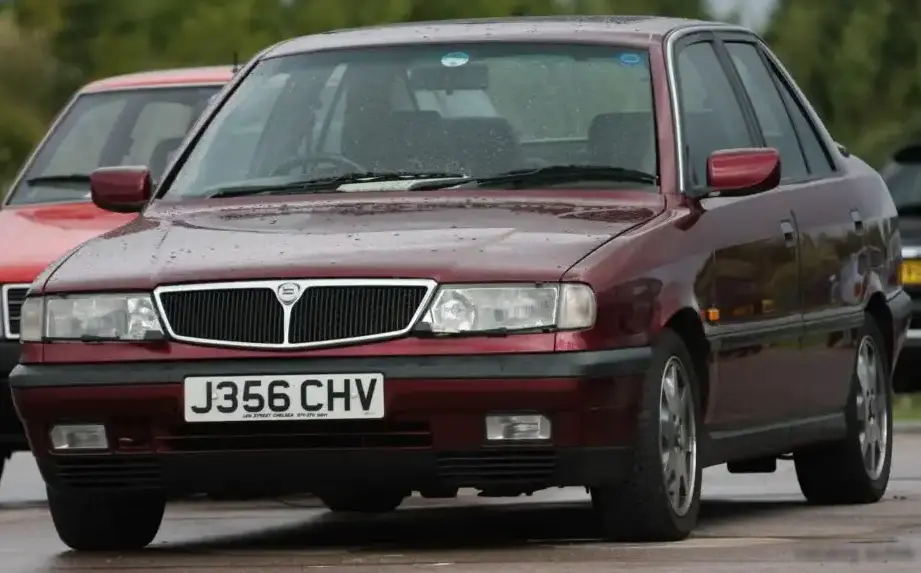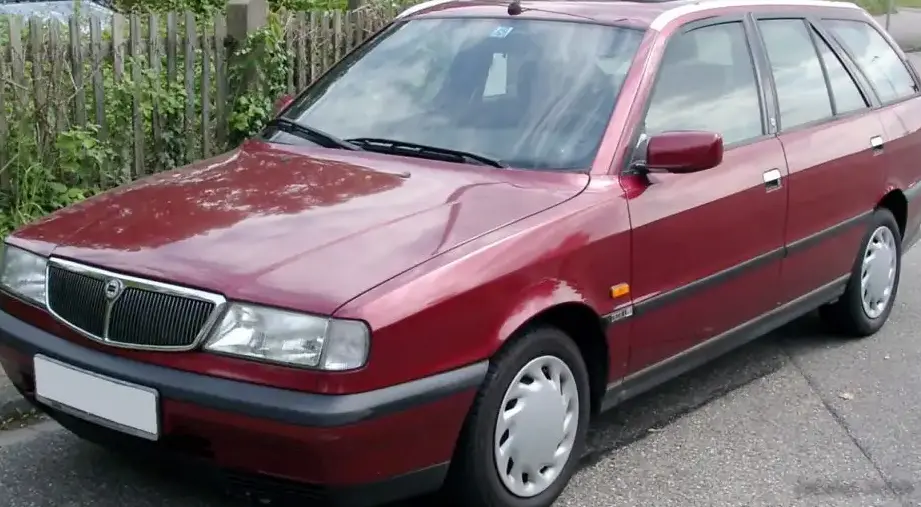
The Lancia Dedra Station Wagon (835) 2.0 16V 4×4, produced between 1994 and 1999, represented a sophisticated and relatively uncommon offering in the European market. Positioned as a premium compact executive estate, the Dedra aimed to blend Italian styling with practicality and performance. This particular variant, equipped with the 1995cc 16-valve engine and a permanent all-wheel-drive system, was a higher-specification model within the Dedra range, appealing to buyers seeking enhanced grip and stability, particularly in inclement weather. It was built on the Tipo-derived 835 platform, shared with the Fiat Croma and Alfa Romeo 164, offering a spacious interior and generous cargo capacity.
Technical Specifications
| Brand | Lancia |
| Model | Dedra |
| Generation | Dedra Station Wagon (835) |
| Type (Engine) | 2.0 16V 4×4 (139 Hp) |
| Start of production | 1994 |
| End of production | 1999 |
| Powertrain Architecture | Internal Combustion engine |
| Body type | Station wagon (estate) |
| Seats | 5 |
| Doors | 5 |
| Fuel consumption (combined) | 10 l/100 km (23.5 US mpg, 28.2 UK mpg, 10 km/l) |
| Fuel Type | Petrol (Gasoline) |
| Acceleration 0 – 100 km/h | 10.3 sec |
| Acceleration 0 – 62 mph | 10.3 sec |
| Acceleration 0 – 60 mph | 9.8 sec |
| Maximum speed | 195 km/h (121.17 mph) |
| Weight-to-power ratio | 10 kg/Hp, 99.6 Hp/tonne |
| Weight-to-torque ratio | 7.8 kg/Nm, 129 Nm/tonne |
| Power | 139 Hp @ 6000 rpm |
| Power per litre | 69.7 Hp/l |
| Torque | 180 Nm @ 4500 rpm (132.76 lb.-ft. @ 4500 rpm) |
| Engine layout | Front, Transverse |
| Engine Model/Code | 836 A3.000 |
| Engine displacement | 1995 cm3 (121.74 cu. in.) |
| Number of cylinders | 4 |
| Engine configuration | Inline |
| Cylinder Bore | 84 mm (3.31 in.) |
| Piston Stroke | 90 mm (3.54 in.) |
| Compression ratio | 9.5:1 |
| Number of valves per cylinder | 4 |
| Fuel injection system | Multi-port manifold injection |
| Engine aspiration | Naturally aspirated engine |
| Valvetrain | DOHC |
| Engine oil capacity | 5.2 l (5.49 US qt | 4.58 UK qt) |
| Coolant | 8.2 l (8.66 US qt | 7.21 UK qt) |
| Kerb Weight | 1395 kg (3075.45 lbs.) |
| Trunk (boot) space – minimum | 420 l (14.83 cu. ft.) |
| Trunk (boot) space – maximum | 1310 l (46.26 cu. ft.) |
| Fuel tank capacity | 60 l (15.85 US gal | 13.2 UK gal) |
| Length | 4343 mm (170.98 in.) |
| Width | 1703 mm (67.05 in.) |
| Height | 1449 mm (57.05 in.) |
| Wheelbase | 2540 mm (100 in.) |
| Front track | 1446 mm (56.93 in.) |
| Rear (Back) track | 1411 mm (55.55 in.) |
| Drive wheel | All wheel drive (4×4) |
| Number of gears and type of gearbox | 5 gears, manual transmission |
| Front suspension | Spring Strut |
| Rear suspension | Trailing arm |
| Front brakes | Ventilated discs |
| Rear brakes | Disc |
| Assisting systems | ABS (Anti-lock braking system) |
| Steering type | Steering rack and pinion |
| Power steering | Hydraulic Steering |
| Tires size | 195/50 R15 |
Powertrain & Engine Architecture
The heart of the Dedra 2.0 16V 4×4 is the 836 A3.000 engine, a 1995cc inline-four cylinder unit. This engine featured a dual overhead camshaft (DOHC) valvetrain operating four valves per cylinder, contributing to its relatively high specific output. Fuel delivery was handled by a multi-port fuel injection system, providing precise control over the air-fuel mixture. The engine’s 9.5:1 compression ratio was a compromise between performance and the fuel quality available in European markets. The all-wheel-drive system was a permanent setup, utilizing a viscous coupling to distribute torque between the front and rear axles. This system didn’t offer selectable modes; instead, it continuously adjusted torque distribution based on wheel slip. The five-speed manual transmission was the only gearbox option for this variant, providing a direct connection to the engine and allowing for driver control.
Driving Characteristics
The 139 horsepower and 180 Nm (132.76 lb-ft) of torque provided by the 2.0 16V engine delivered respectable, though not blistering, performance. Acceleration to 60 mph took around 9.8 seconds, and the car could reach a top speed of 195 km/h (121.17 mph). The all-wheel-drive system significantly enhanced traction, particularly on slippery surfaces, making the Dedra 4×4 a confident handler in adverse conditions. Compared to the lower-powered 1.8L versions, the 2.0 16V offered a noticeable improvement in responsiveness and overall driving enjoyment. However, it didn’t possess the outright performance of the more sporting Alfa Romeo 164 2.0 Twin Spark, which shared similar mechanical components but was tuned for a more aggressive driving experience. The gear ratios in the five-speed manual were well-spaced, providing adequate acceleration in each gear, but the engine did require to be revved to extract its full potential.
Equipment & Trim Levels
The Dedra 2.0 16V 4×4 typically came well-equipped, reflecting its position as a premium model. Standard features included central locking, electric windows, power steering, and an anti-lock braking system (ABS). Interior upholstery was typically cloth, though leather options were available. The dashboard layout was functional and ergonomically designed, with clear instrumentation. Optional extras included a sunroof, air conditioning, and upgraded audio systems. The trim level often included body-colored bumpers and side moldings, adding to the car’s refined appearance.
Chassis & Braking
The Dedra’s chassis featured a MacPherson strut front suspension and a trailing arm rear suspension. This setup provided a good balance between ride comfort and handling. The all-wheel-drive system added weight, but the suspension was tuned to compensate, maintaining a relatively stable and controlled ride. Braking was handled by ventilated discs at the front and solid discs at the rear, providing adequate stopping power for the car’s weight and performance. The ABS system further enhanced braking safety, preventing wheel lockup during hard braking.
Market Reception & Comparison
The Lancia Dedra 2.0 16V 4×4 was generally well-received by automotive critics, who praised its comfortable ride, spacious interior, and all-weather capability. However, it was often criticized for its relatively high price compared to competitors like the Ford Mondeo and Opel Vectra. Fuel economy, at around 10 l/100 km (23.5 US mpg), was typical for a 2.0-liter engine of that era. Compared to the 1.8L versions, the 2.0 16V 4×4 offered a significant performance upgrade, but at the cost of slightly higher fuel consumption and a higher purchase price. The 1.9 TDI diesel version offered superior fuel economy but lacked the 2.0’s outright performance.
Legacy
The Lancia Dedra, while not a massive sales success, remains a fondly remembered car among enthusiasts. The 2.0 16V 4×4 variant, in particular, is appreciated for its rarity and its blend of performance, practicality, and all-weather capability. The engine itself is generally considered reliable, though regular maintenance is essential. Finding parts can be challenging due to the car’s age and limited production numbers. Today, well-maintained examples are becoming increasingly collectible, appealing to those seeking a unique and stylish alternative to more mainstream executive estates. The all-wheel drive system, while robust, requires periodic inspection and maintenance to ensure optimal performance.