
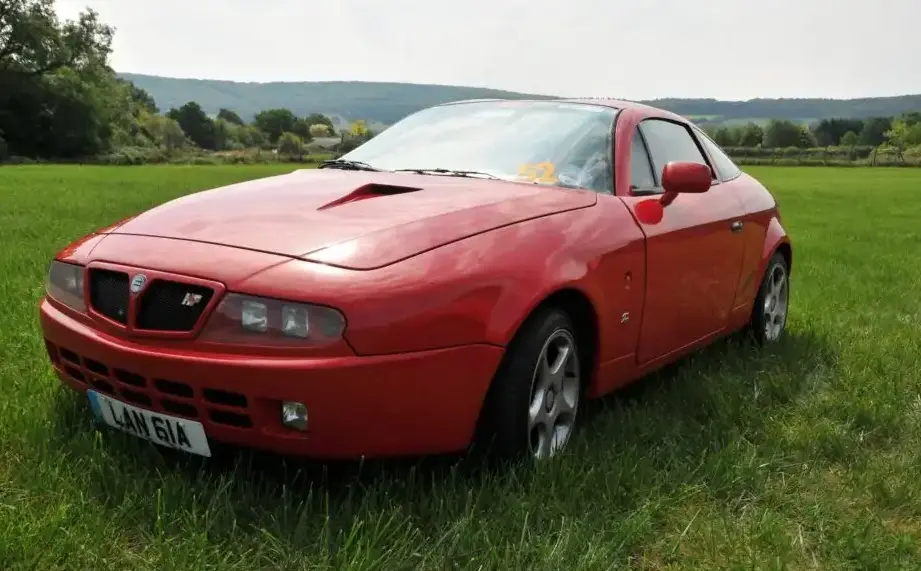
The Lancia Hyena 2.0 i 16V, produced between 1992 and 1996, represents a fascinating and relatively rare chapter in Lancia’s history. Developed as a homologation special for rallying, the Hyena was born from a collaboration between Lancia and the British engineering firm Rally Preparation Limited (RPL). It aimed to bridge the gap between the Delta Integrale and a potential new rally car, utilizing a shortened Delta Integrale chassis and a turbocharged engine. The Hyena was primarily intended for the European market, offering a unique blend of performance and Italian styling. It occupies a niche position as a limited-production, high-performance coupe, distinct from the more mainstream Delta models.
Technical Specifications
| Brand | Lancia |
| Model | Hyena |
| Generation | Hyena |
| Type (Engine) | 2.0 i 16V (210 Hp) |
| Start of production | 1992 |
| End of production | 1996 |
| Powertrain Architecture | Internal Combustion engine |
| Body type | Coupe |
| Seats | 2 |
| Doors | 2 |
| Fuel consumption (urban) | 11.2 l/100 km (21 US mpg, 25.2 UK mpg, 8.9 km/l) |
| Fuel consumption (extra urban) | 7.9 l/100 km (29.8 US mpg, 35.8 UK mpg, 12.7 km/l) |
| Fuel consumption (combined) | 10.5 l/100 km (22.4 US mpg, 26.9 UK mpg, 9.5 km/l) |
| Fuel Type | Petrol (Gasoline) |
| Maximum speed | 220 km/h (136.7 mph) |
| Weight-to-power ratio | 5.5 kg/Hp, 182.6 Hp/tonne |
| Weight-to-torque ratio | 3.8 kg/Nm, 264.3 Nm/tonne |
| Power | 210 Hp @ 5750 rpm |
| Power per litre | 105.3 Hp/l |
| Torque | 304 Nm @ 3500 rpm (224.22 lb.-ft. @ 3500 rpm) |
| Engine layout | Front, Transverse |
| Engine displacement | 1995 cm3 (121.74 cu. in.) |
| Number of cylinders | 4 |
| Engine configuration | Inline |
| Cylinder Bore | 84 mm (3.31 in.) |
| Piston Stroke | 90 mm (3.54 in.) |
| Compression ratio | 8:1 |
| Number of valves per cylinder | 4 |
| Fuel injection system | Multi-port manifold injection |
| Engine aspiration | Turbocharger |
| Valvetrain | DOHC |
| Kerb Weight | 1150 kg (2535.32 lbs.) |
| Fuel tank capacity | 57 l (15.06 US gal, 12.54 UK gal) |
| Length | 3985 mm (156.89 in.) |
| Width | 1740 mm (68.5 in.) |
| Height | 1240 mm (48.82 in.) |
| Wheelbase | 2480 mm (97.64 in.) |
| Front track | 1500 mm (59.06 in.) |
| Rear track | 1500 mm (59.06 in.) |
| Drive wheel | All wheel drive (4×4) |
| Number of gears and type of gearbox | 5 gears, manual transmission |
| Front suspension | Coil spring |
| Rear suspension | Coil spring |
| Front brakes | Ventilated discs |
| Rear brakes | Disc |
| Assisting systems | ABS (Anti-lock braking system) |
| Steering type | Steering rack and pinion |
| Power steering | Hydraulic Steering |
| Tires size | 205/50 ZR 15 |
Powertrain & Engine Architecture
The heart of the Hyena is a 1,995 cc inline-four cylinder engine, derived from the Lancia Delta Integrale’s powerplant but significantly modified by RPL. The engine features a Garrett T25 turbocharger, intercooler, and a revised engine management system. The 16-valve cylinder head, coupled with multi-port fuel injection, contributes to the engine’s 210 horsepower output at 5,750 rpm and 304 Nm (224 lb-ft) of torque at 3,500 rpm. The engine utilizes a relatively low 8:1 compression ratio, typical for turbocharged engines. The Hyena exclusively came with a five-speed manual transmission, delivering power to all four wheels via Lancia’s sophisticated all-wheel-drive system. This system, a hallmark of Lancia’s rally heritage, employs a viscous coupling to distribute torque between the front and rear axles, providing excellent traction in various conditions.
Driving Characteristics
The Hyena’s driving experience is characterized by its responsive turbocharged engine and surefooted all-wheel-drive grip. While not as raw or visceral as some contemporary sports cars, the Hyena offers a refined and capable driving experience. The turbocharger provides a noticeable boost in power, delivering strong acceleration once spooled up. The five-speed manual transmission is well-matched to the engine’s powerband, allowing for precise gear changes. The all-wheel-drive system inspires confidence, particularly on slippery surfaces. Compared to the standard Delta Integrale, the Hyena’s shorter wheelbase contributes to a more agile and responsive feel. However, the Hyena’s increased weight compared to some rivals impacts its overall agility.
Equipment & Trim Levels
The Hyena was offered with a relatively high level of standard equipment, reflecting its positioning as a premium coupe. The interior featured supportive bucket seats upholstered in Alcantara and leather, a leather-wrapped steering wheel, and electric windows. Air conditioning and a basic stereo system were also standard. Optional extras included a sunroof, upgraded audio system, and various cosmetic enhancements. The dashboard layout is similar to that of the Delta Integrale, but with unique trim details and a more focused, sporty aesthetic. The Hyena’s interior, while well-equipped, is not overly luxurious, prioritizing functionality and a driver-focused environment.
Chassis & Braking
The Hyena’s chassis is based on a shortened version of the Delta Integrale’s platform, resulting in a more compact and agile vehicle. The suspension utilizes coil springs and dampers all around, providing a comfortable yet controlled ride. The Hyena is equipped with ventilated disc brakes at the front and solid discs at the rear, providing adequate stopping power. An anti-lock braking system (ABS) is standard, enhancing safety and stability. The steering is a rack-and-pinion system with hydraulic power assistance, offering precise and responsive steering feel. The Hyena’s suspension setup is tuned for a balance between performance and comfort, making it suitable for both spirited driving and everyday use.
Market Reception & Comparison
The Lancia Hyena received generally positive reviews from automotive journalists, who praised its performance, handling, and unique styling. However, its relatively high price and limited production run restricted its market appeal. Compared to other coupes of the era, such as the Porsche 944 or the BMW 8 Series, the Hyena offered a different proposition – a blend of Italian flair, rally-bred performance, and all-wheel-drive capability. Against the Delta Integrale, the Hyena offered a more refined and exclusive experience, albeit at a higher cost. Fuel economy was reasonable for a turbocharged performance car, averaging around 22.4 US mpg in combined driving. Reliability was generally good, although the turbocharged engine and complex all-wheel-drive system required regular maintenance.
Legacy
The Lancia Hyena remains a highly sought-after collector’s car today, appreciated for its rarity, unique design, and connection to Lancia’s rally heritage. The Hyena’s turbocharged engine and all-wheel-drive system have proven to be relatively durable, although regular maintenance is essential to ensure long-term reliability. Finding parts can be challenging due to the Hyena’s limited production run, but a dedicated community of enthusiasts helps to support the preservation of these unique vehicles. The Hyena represents a fascinating footnote in Lancia’s history, showcasing the brand’s engineering prowess and commitment to performance.
