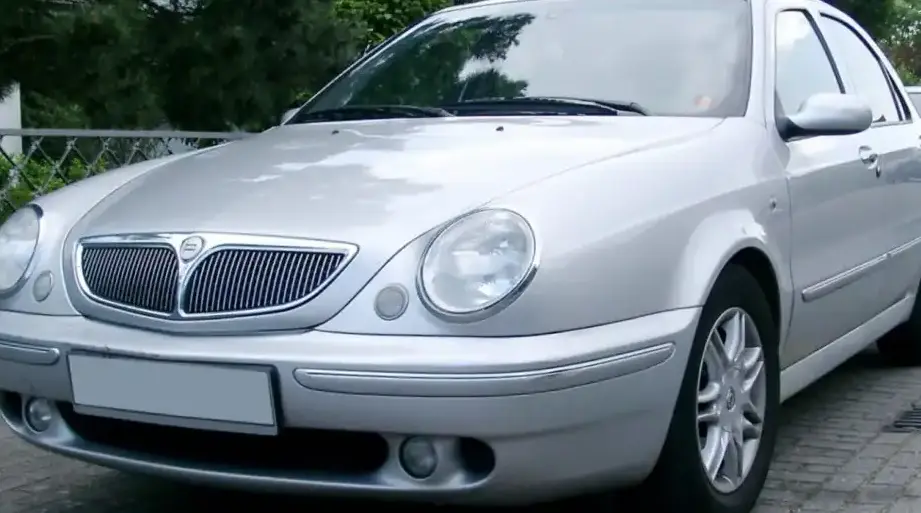
Technical Specifications
| Brand | Lancia |
| Model | Lybra |
| Generation | Lybra SW (839) |
| Type (Engine) | 2.4 JTD (140 Hp) |
| Start of production | 2000 year |
| End of production | 2002 year |
| Powertrain Architecture | Internal Combustion engine |
| Body type | Station wagon (estate) |
| Seats | 5 |
| Doors | 5 |
| Fuel consumption (economy) – urban (NEDC) | 9.2 l/100 km (25.6 US mpg, 30.7 UK mpg, 10.9 km/l) |
| Fuel consumption (economy) – extra urban (NEDC) | 5.5 l/100 km (42.8 US mpg, 51.4 UK mpg, 18.2 km/l) |
| Fuel consumption (economy) – combined (NEDC) | 6.9 l/100 km (34.1 US mpg, 40.9 UK mpg, 14.5 km/l) |
| CO2 emissions (NEDC) | 182 g/km |
| Fuel Type | Diesel |
| Acceleration 0 – 100 km/h | 9.7 sec |
| Acceleration 0 – 62 mph | 9.7 sec |
| Acceleration 0 – 60 mph | 9.2 sec |
| Maximum speed | 205 km/h (127.38 mph) |
| Emission standard | Euro 3 |
| Weight-to-power ratio | 9.5 kg/Hp, 104.9 Hp/tonne |
| Weight-to-torque ratio | 4.4 kg/Nm, 227.7 Nm/tonne |
| Power | 140 Hp @ 4000 rpm |
| Power per litre | 58.7 Hp/l |
| Torque | 304 Nm @ 1800 rpm (224.22 lb.-ft. @ 1800 rpm) |
| Engine layout | Front, Transverse |
| Engine Model/Code | 839A6000 |
| Engine displacement | 2387 cm3 (145.66 cu. in.) |
| Number of cylinders | 5 |
| Engine configuration | Inline |
| Cylinder Bore | 82 mm (3.23 in.) |
| Piston Stroke | 90.4 mm (3.56 in.) |
| Number of valves per cylinder | 2 |
| Fuel injection system | Diesel Commonrail |
| Engine aspiration | Turbocharger, Intercooler |
| Valvetrain | SOHC |
| Engine oil capacity | 5.5 l (5.81 US qt | 4.84 UK qt) |
| Coolant | 7.4 l (7.82 US qt | 6.51 UK qt) |
| Kerb Weight | 1335 kg (2943.17 lbs.) |
| Max. weight | 1935 kg (4265.94 lbs.) |
| Max load | 600 kg (1322.77 lbs.) |
| Trunk (boot) space – minimum | 420 l (14.83 cu. ft.) |
| Trunk (boot) space – maximum | 1300 l (45.91 cu. ft.) |
| Fuel tank capacity | 60 l (15.85 US gal | 13.2 UK gal) |
| Permitted trailer load with brakes (8%) | 1500 kg (3306.93 lbs.) |
| Permitted trailer load with brakes (12%) | 1400 kg (3086.47 lbs.) |
| Permitted trailer load without brakes | 400 kg (881.85 lbs.) |
| Permitted towbar download | 75 kg (165.35 lbs.) |
| Length | 4466 mm (175.83 in.) |
| Width | 1743 mm (68.62 in.) |
| Height | 1470 mm (57.87 in.) |
| Wheelbase | 2593 mm (102.09 in.) |
| Front track | 1517 mm (59.72 in.) |
| Rear (Back) track | 1476 mm (58.11 in.) |
| Front overhang | 926 mm (36.46 in.) |
| Rear overhang | 947 mm (37.28 in.) |
| Minimum turning circle (turning diameter) | 10.9 m (35.76 ft.) |
| Drivetrain Architecture | The Internal combustion engine (ICE) drives the front wheels of the vehicle. |
| Drive wheel | Front wheel drive |
| Number of gears and type of gearbox | 5 gears, manual transmission |
| Front suspension | Independent type McPherson, Transverse stabilizer |
| Rear suspension | Wishbone, Transverse stabilizer, Trailing arm |
| Front brakes | Ventilated discs, 284 mm |
| Rear brakes | Disc, 251 mm |
| Assisting systems | ABS (Anti-lock braking system) |
| Steering type | Steering rack and pinion |
| Power steering | Hydraulic Steering |
| Tires size | 195/65 R15 |
| Wheel rims size | 6J x 15 |
The Lancia Lybra SW 2.4 JTD, produced from 2000 to 2002, represents a compelling blend of Italian styling and diesel practicality within the mid-size station wagon segment. Part of the 839 series, the Lybra SW (Station Wagon) aimed to offer a more versatile alternative to the sedan, appealing to families and those requiring increased cargo capacity. This particular variant, equipped with the 2.4-liter JTD diesel engine producing 140 horsepower, occupied a mid-range position in the Lybra SW lineup, offering a balance between performance, fuel economy, and cost. It was positioned above the lower-powered 1.9 JTD models and below the more expensive petrol-powered versions.
Powertrain & Engine Architecture
The heart of the Lybra SW 2.4 JTD is the 839A6000 engine, a 2.4-liter inline-five cylinder diesel. This engine utilizes a common rail direct injection system, a significant advancement over earlier diesel technologies. Common rail injection allows for multiple injection events per combustion cycle, resulting in smoother operation, reduced noise, and improved fuel efficiency. The engine is turbocharged and intercooled, boosting power output to 140 horsepower and 304 Nm (224 lb-ft) of torque. The five-cylinder configuration, while less common than four-cylinder diesels, contributes to a unique engine note and inherently better balance. The engine features a single overhead camshaft (SOHC) valvetrain operating two valves per cylinder. The engine’s transverse mounting within the front-wheel-drive chassis contributes to a compact engine bay layout.
Driving Characteristics
The 2.4 JTD engine in the Lybra SW provides a respectable level of performance for a diesel station wagon of its era. Acceleration to 60 mph takes approximately 9.2 seconds, and it achieves a top speed of 127 mph. The engine’s torque peak at 1800 rpm delivers strong pulling power, making it well-suited for carrying passengers and cargo. Compared to the lower-powered 1.9 JTD variants, the 2.4 JTD offers noticeably more responsiveness and effortless cruising ability. While not as sporty as the petrol-powered Lybras, the 2.4 JTD provides a comfortable and relaxed driving experience. The five-speed manual transmission offers precise shifts, although the gear ratios are geared towards fuel efficiency rather than outright acceleration.
Equipment & Trim Levels
The Lybra SW 2.4 JTD typically came equipped with a reasonable level of standard features. These included power windows, central locking, air conditioning, and an RDS radio. Interior upholstery was generally cloth, although leather options were available. Higher trim levels added features such as alloy wheels, a sunroof, and upgraded audio systems. The Lybra SW prioritized comfort and practicality, offering a spacious interior and a large cargo area. Optional extras included automatic climate control, heated seats, and a navigation system.
Chassis & Braking
The Lybra SW utilizes an independent McPherson strut suspension at the front and a trailing arm/wishbone setup at the rear. This suspension configuration provides a comfortable ride quality, absorbing bumps and imperfections in the road surface effectively. The 2.4 JTD models typically featured ventilated disc brakes at the front and solid discs at the rear. Anti-lock Braking System (ABS) was standard, enhancing braking performance and stability. Stabilizer bars were fitted to both the front and rear axles to reduce body roll during cornering.
Market Reception & Comparison
The Lancia Lybra SW 2.4 JTD was generally well-received by automotive critics for its blend of practicality, comfort, and fuel efficiency. The diesel engine was praised for its refinement and strong torque output. However, some critics noted that the Lybra SW lacked the dynamic flair of some of its competitors. Compared to other station wagons in its class, such as the Ford Mondeo Estate or the Volkswagen Passat Variant, the Lybra SW offered a more distinctive Italian style and a more comfortable ride. Fuel economy was a strong point, with combined figures around 34 mpg. Reliability was generally considered average for a European car of this era.
Legacy
The Lancia Lybra SW 2.4 JTD, while not a high-volume seller, has developed a following among enthusiasts who appreciate its unique character and practicality. The 2.4 JTD engine is known for its durability, and well-maintained examples can still provide reliable service today. However, as with any older vehicle, potential buyers should be aware of potential maintenance issues, such as turbocharger wear and common rail injector problems. In the used car market, the Lybra SW 2.4 JTD represents a relatively affordable and spacious station wagon option, offering a distinctive alternative to more mainstream choices.