
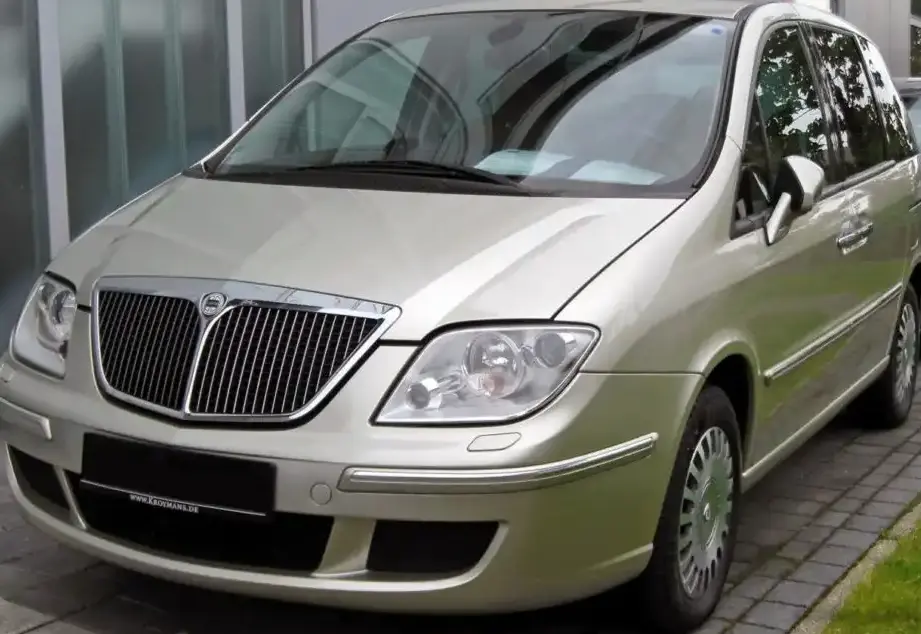
The Lancia Phedra 2.0 JTD 16v, produced between September 2002 and April 2006, was a large, eight-seat minivan positioned as a premium offering within the European MPV (Multi-Purpose Vehicle) segment. It was a result of a collaborative effort between Fiat, Peugeot, and Citroën, sharing its underpinnings with the Peugeot 807 and Citroën C8, all built on the shared 1HX0 platform. The 2.0 JTD 16v variant represented a mid-range engine option, offering a balance between fuel economy and acceptable performance for family transport. It aimed to provide a more refined and luxurious experience compared to more basic MPV offerings.
Technical Specifications
| Brand | Lancia |
| Model | Phedra |
| Generation | Phedra |
| Type (Engine) | 2.0 JTD 16v (109 Hp) |
| Start of production | September, 2002 |
| End of production | April, 2006 |
| Powertrain Architecture | Internal Combustion engine |
| Body type | Minivan |
| Seats | 8 |
| Doors | 5 |
| Fuel consumption (urban) | 9.2 l/100 km (25.6 US mpg) |
| Fuel consumption (extra urban) | 5.9 l/100 km (39.9 US mpg) |
| Fuel consumption (combined) | 7 l/100 km (33.6 US mpg) |
| CO2 emissions | 186 g/km |
| Fuel Type | Diesel |
| Acceleration 0 – 100 km/h | 13.4 sec |
| Acceleration 0 – 62 mph | 13.4 sec |
| Acceleration 0 – 60 mph | 12.7 sec |
| Maximum speed | 174 km/h (108.12 mph) |
| Emission standard | Euro 4 |
| Weight-to-power ratio | 15.2 kg/Hp |
| Weight-to-torque ratio | 6.2 kg/Nm |
| Power | 109 Hp @ 4000 rpm |
| Torque | 270 Nm @ 1750 rpm (199.14 lb.-ft. @ 1750 rpm) |
| Engine layout | Front, Transverse |
| Engine Model/Code | RHW |
| Engine displacement | 1997 cm3 (121.86 cu. in.) |
| Number of cylinders | 4 |
| Engine configuration | Inline |
| Compression ratio | 17.3:1 |
| Number of valves per cylinder | 4 |
| Fuel injection system | Diesel Commonrail |
| Engine aspiration | Turbocharger, Intercooler |
| Valvetrain | DOHC |
| Engine oil capacity | 4.75 l (5.02 US qt | 4.18 UK qt) |
| Coolant capacity | 9.5 l (10.04 US qt | 8.36 UK qt) |
| Kerb Weight | 1661 kg (3661.88 lbs) |
| Max. weight | 1909 kg (4208.62 lbs) |
| Max load | 248 kg (546.75 lbs) |
| Trunk (boot) space – minimum | 324 l (11.44 cu. ft.) |
| Trunk (boot) space – maximum | 2948 l (104.11 cu. ft.) |
| Fuel tank capacity | 80 l (21.13 US gal | 17.6 UK gal) |
| Permitted trailer load with brakes (12%) | 1850 kg (4078.55 lbs) |
| Length | 4750 mm (187.01 in) |
| Width | 1863 mm (73.35 in) |
| Height | 1752 mm (68.98 in) |
| Wheelbase | 2823 mm (111.14 in) |
| Front track | 1570 mm (61.81 in) |
| Rear track | 1548 mm (60.94 in) |
| Minimum turning circle | 11.2 m (36.75 ft) |
| Drivetrain Architecture | Front wheel drive |
| Number of gears | 5 |
| Gearbox type | Manual transmission |
| Front suspension | Independent, McPherson with coil spring and anti-roll bar |
| Rear suspension | Threaded twist beam |
| Front brakes | Ventilated discs, 310 mm |
| Rear brakes | Disc, 272 mm |
| Assisting systems | ABS (Anti-lock braking system) |
| Steering type | Steering rack and pinion |
| Power steering | Hydraulic |
| Tires size | 215/65 R15 |
Powertrain & Engine Architecture
The Lancia Phedra 2.0 JTD 16v utilized the RHW engine code, a 1997cc inline-four cylinder diesel engine. This engine was a product of Fiat’s JTD (Jet Diesel Technology) series, known for its direct injection and turbocharging. The 16-valve configuration (four valves per cylinder) contributed to improved breathing and higher power output compared to older two-valve designs. The engine employed a common rail direct injection system, delivering fuel at extremely high pressure for finer atomization and more complete combustion. This resulted in improved efficiency and reduced emissions. The turbocharger, coupled with an intercooler, boosted power and torque, providing a more responsive driving experience. The five-speed manual transmission was the standard offering for this variant, chosen for its balance of cost and efficiency. The engine’s DOHC (Double Overhead Camshaft) valvetrain further optimized valve timing and control.
Driving Characteristics
The 2.0 JTD 16v Phedra, with its 109 horsepower and 199 lb-ft of torque, offered adequate, but not exhilarating, performance. Acceleration from 0-60 mph took around 12.7 seconds, and top speed was approximately 108 mph. The engine’s torque peak at 1750 rpm provided reasonable pulling power for everyday driving and when fully loaded with passengers and luggage. Compared to the more powerful 2.2 JTD variants, the 2.0 JTD felt noticeably slower, particularly when overtaking or climbing hills. The five-speed manual transmission was well-matched to the engine’s characteristics, offering a decent spread of gears. However, it wasn’t particularly sporty, with a focus on smooth operation rather than quick shifts. The Phedra’s weight, exceeding 3600 pounds, contributed to a somewhat ponderous feel, especially in comparison to smaller, lighter vehicles.
Equipment & Trim Levels
The 2.0 JTD 16v Phedra typically came with a respectable level of standard equipment. This included air conditioning, power windows, central locking, and an audio system. Interior upholstery was generally cloth, although leather options were available as upgrades. Dashboard design was functional and modern for its time, with a focus on ergonomics. Optional extras included features like a sunroof, rear parking sensors, and upgraded audio systems. The Phedra aimed for a comfortable and practical interior, prioritizing space and convenience for families. Trim levels varied slightly depending on the market, but generally, the 2.0 JTD sat in the middle of the range, offering a good balance of features and price.
Chassis & Braking
The Phedra’s chassis featured an independent McPherson strut suspension at the front, providing a comfortable ride and reasonable handling. The rear suspension utilized a threaded twist beam, a cost-effective solution that offered adequate stability for a large MPV. Braking consisted of ventilated discs at the front and solid discs at the rear, equipped with an ABS (Anti-lock Braking System) as standard. Steering was rack and pinion with hydraulic power assistance, providing a light and easy driving experience. The Phedra’s tires were typically 215/65 R15, chosen for a balance of comfort and grip.
Market Reception & Comparison
The Lancia Phedra 2.0 JTD 16v received mixed reviews. Critics praised its spacious interior, comfortable ride, and relatively fuel-efficient engine. However, it was often criticized for its somewhat uninspired styling and lack of driving excitement. Compared to the more powerful engine options within the Phedra range, the 2.0 JTD offered better fuel economy but significantly less performance. It was also seen as a more affordable entry point into the Phedra lineup, appealing to buyers who prioritized practicality and value over outright performance. Against competitors like the Renault Espace and Volkswagen Sharan, the Phedra offered a more luxurious interior and a distinctive Italian design, but often lacked the brand recognition and established reputation of its rivals.
Legacy
The Lancia Phedra 2.0 JTD 16v, while not a sales blockbuster, remains a reasonably reliable and practical MPV in the used car market. The 2.0 JTD engine, when properly maintained, is known for its durability and longevity. Common issues include wear and tear on suspension components and potential problems with the electronic systems. However, parts availability is generally good, and maintenance costs are relatively reasonable. Today, the Phedra 2.0 JTD 16v represents a viable option for buyers seeking a spacious, comfortable, and affordable family vehicle, particularly those who appreciate its unique Italian styling and the practicality of a large MPV.
