
Technical Specifications
| Brand | Lancia |
| Model | Phedra |
| Generation | Phedra |
| Type (Engine) | 2.2 Multijet (170 Hp) |
| Start of production | April, 2008 |
| End of production | August, 2010 |
| Powertrain Architecture | Internal Combustion engine |
| Body type | Minivan |
| Seats | 8 |
| Doors | 5 |
| Fuel consumption (urban) | 9.2 l/100 km (25.6 US mpg) |
| Fuel consumption (extra urban) | 6.2 l/100 km (37.9 US mpg) |
| Fuel consumption (combined) | 7.2 l/100 km (32.7 US mpg) |
| CO2 emissions | 191 g/km |
| Fuel Type | Diesel |
| Acceleration 0 – 100 km/h | 10 sec |
| Acceleration 0 – 62 mph | 10 sec |
| Acceleration 0 – 60 mph | 9.5 sec |
| Maximum speed | 200 km/h (124.27 mph) |
| Emission standard | Euro 4 |
| Weight-to-power ratio | 11 kg/Hp |
| Weight-to-torque ratio | 5.1 kg/Nm |
| Power | 170 Hp @ 4000 rpm |
| Power per litre | 78 Hp/l |
| Torque | 370 Nm @ 1500 rpm (272.9 lb.-ft. @ 1500 rpm) |
| Engine layout | Front, Transverse |
| Engine Model/Code | 4HT/4HS |
| Engine displacement | 2179 cm3 (132.97 cu. in.) |
| Number of cylinders | 4 |
| Engine configuration | Inline |
| Compression ratio | 16.5:1 |
| Number of valves per cylinder | 4 |
| Fuel injection system | Diesel Commonrail |
| Engine aspiration | Turbocharger, Intercooler |
| Valvetrain | DOHC |
| Engine oil capacity | 4.75 l (5.02 US qt | 4.18 UK qt) |
| Coolant | 9 l (9.51 US qt | 7.92 UK qt) |
| Kerb Weight | 1875-2017 kg (4133.67 – 4446.72 lbs.) |
| Max. weight | 2570 kg (5665.88 lbs.) |
| Max load | 553-695 kg (1219.16 – 1532.21 lbs.) |
| Trunk (boot) space – minimum | 324 l (11.44 cu. ft.) |
| Trunk (boot) space – maximum | 2948 l (104.11 cu. ft.) |
| Fuel tank capacity | 80 l (21.13 US gal | 17.6 UK gal) |
| Max. roof load | 100 kg (220.46 lbs.) |
| Permitted trailer load with brakes (12%) | 1850 kg (4078.55 lbs.) |
| Permitted trailer load without brakes | 750 kg (1653.47 lbs.) |
| Permitted towbar download | 75 kg (165.35 lbs.) |
| Length | 4750 mm (187.01 in.) |
| Width | 1863 mm (73.35 in.) |
| Height | 1759 mm (69.25 in.) |
| Wheelbase | 2823 mm (111.14 in.) |
| Front track | 1570 mm (61.81 in.) |
| Rear (Back) track | 1548 mm (60.94 in.) |
| Minimum turning circle | 11.6 m (38.06 ft.) |
| Drivetrain | Front wheel drive |
| Number of gears | 6 gears, manual transmission |
| Front suspension | Independent, type McPherson with coil spring and anti-roll bar |
| Rear suspension | Threaded twist beam |
| Front brakes | Ventilated discs, 310 mm |
| Rear brakes | Disc, 272 mm |
| Assisting systems | ABS (Anti-lock braking system) |
| Steering type | Steering rack and pinion |
| Power steering | Hydraulic Steering |
| Tires size | 215/60 R16 |
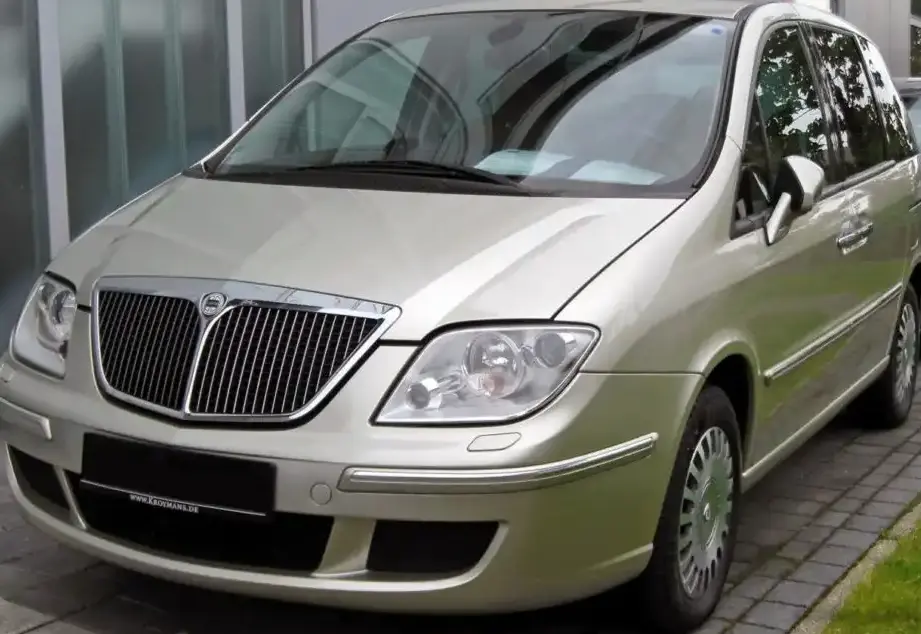
The Lancia Phedra 2.2 Multijet, produced from April 2008 to August 2010, was Lancia’s entry into the large minivan segment. It aimed to provide a premium alternative to established competitors like the Renault Espace and Volkswagen Sharan, leveraging Italian design and a spacious interior. The Phedra shared its underpinnings with the Peugeot 807 and Citroën C8, all built on the PSA Group’s EMP1 platform. This particular variant, equipped with the 2.2-liter Multijet diesel engine and a six-speed manual transmission, represented a balance between performance, fuel efficiency, and practicality, targeting families and those requiring significant passenger and cargo capacity.
Powertrain & Engine Architecture
The Phedra 2.2 Multijet’s engine is the DW12, a 2.2-liter inline-four cylinder diesel. Developed by PSA, it’s identified by the engine codes 4HT and 4HS. This engine utilizes a common rail direct injection system, injecting fuel at extremely high pressure for optimized combustion efficiency. A turbocharger, coupled with an intercooler, forces more air into the cylinders, boosting power output. The engine features a double overhead camshaft (DOHC) valvetrain with four valves per cylinder, enhancing airflow and contributing to overall efficiency. The engine produces 170 horsepower at 4000 rpm and a robust 370 Nm (272.9 lb-ft) of torque from just 1500 rpm, delivering strong low-end pulling power. The standard six-speed manual transmission provides drivers with precise control over gear selection and contributes to efficient highway cruising.
Driving Characteristics
The Phedra 2.2 Multijet offered a comfortable and capable driving experience, particularly well-suited for long-distance travel. The engine’s high torque output made overtaking easy, even when the vehicle was fully loaded. While not designed for sporty driving, the engine provided adequate acceleration, reaching 60 mph in approximately 9.5 seconds. The six-speed manual transmission allowed for efficient cruising at highway speeds. Compared to the lower-powered 2.0-liter diesel versions, the 2.2 Multijet offered a noticeable performance improvement. However, it didn’t quite match the responsiveness of the petrol engines offered in some markets. The gear ratios were optimized for fuel economy and smooth shifts, prioritizing comfort and practicality over outright performance.
Equipment & Trim Levels
The Phedra 2.2 Multijet was generally well-equipped, reflecting its premium positioning. Standard features typically included air conditioning, power windows, central locking, and an audio system. Higher trim levels added features like leather upholstery, automatic climate control, a navigation system, and parking sensors. Interior upholstery was typically cloth on base models, with leather options available. The dashboard layout was functional and modern for its time, prioritizing ergonomics. Optional extras included a panoramic sunroof, a rear entertainment system, and upgraded audio systems.
Chassis & Braking
The Phedra’s chassis featured an independent McPherson strut suspension at the front, providing a comfortable ride and good handling characteristics. The rear suspension utilized a threaded twist beam, a cost-effective solution that offered a reasonable balance between comfort and stability. The braking system consisted of ventilated discs at the front and solid discs at the rear. Anti-lock Braking System (ABS) was standard, enhancing safety during emergency braking. The steering was rack and pinion with hydraulic power assistance, providing a responsive and precise feel.
Market Reception & Comparison
The Lancia Phedra 2.2 Multijet received mixed reviews from automotive critics. It was praised for its spacious interior, comfortable ride, and strong diesel engine, but sometimes criticized for its somewhat unremarkable styling and the Lancia brand’s perceived lack of prestige compared to German competitors. Fuel economy was considered good for a vehicle of its size, averaging around 32.7 US mpg in combined driving. Reliability was generally acceptable, although some owners reported issues with the electronic systems. Compared to the Peugeot 807 and Citroën C8, the Phedra offered a more refined interior and a slightly more upscale image.
Legacy
The Lancia Phedra 2.2 Multijet, while not a huge commercial success, remains a viable option in the used car market for those seeking a spacious and comfortable minivan. The DW12 engine is known for its durability and relatively low maintenance costs, provided it receives regular servicing. Parts availability can be a concern, as Lancia has withdrawn from many markets. However, many components are shared with Peugeot and Citroën models, simplifying parts sourcing. Today, these vehicles are appreciated by families and those needing a versatile vehicle for both passenger and cargo transport, offering a unique combination of Italian style and French engineering.
