
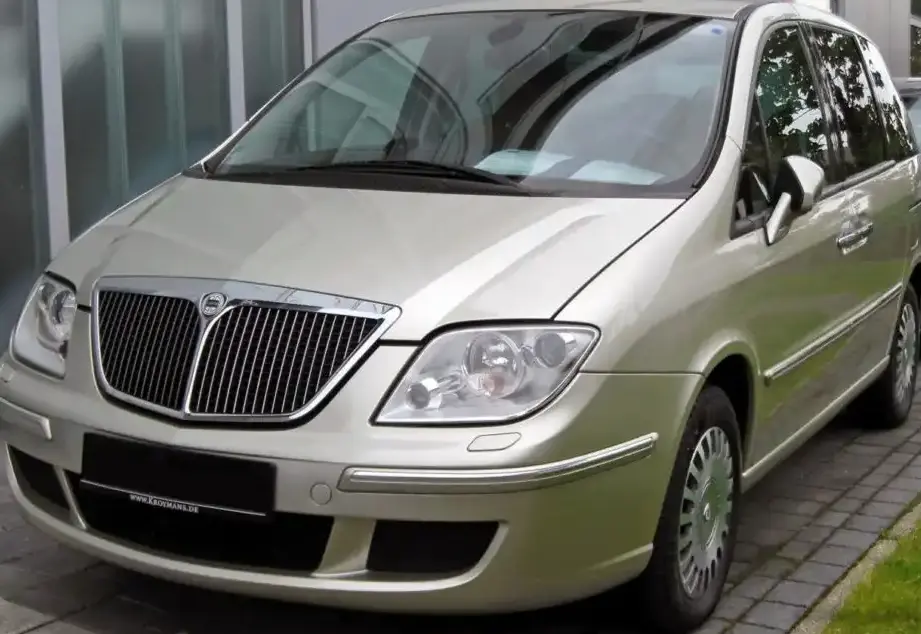
The Lancia Phedra 2.2 Multijet Automatic, produced between April 2008 and August 2010, represents a significant iteration of Lancia’s large minivan offering. Positioned as a premium people-carrier, the Phedra shared its platform and much of its mechanical underpinnings with the Peugeot 807 and Citroën C8, a result of the collaborative joint venture between the PSA Group and Fiat (Lancia’s parent company). This particular variant, equipped with the 2.2-liter Multijet diesel engine producing 170 horsepower and paired with a six-speed automatic transmission, aimed to provide a balance of performance, fuel efficiency, and convenience for family transportation. It occupied a mid-to-high range position within the Phedra lineup, offering more power and a more refined driving experience than the lower-powered engine options.
Technical Specifications
| Brand | Lancia |
| Model | Phedra |
| Generation | Phedra |
| Type (Engine) | 2.2 Multijet (170 Hp) Automatic |
| Start of production | April, 2008 |
| End of production | August, 2010 |
| Powertrain Architecture | Internal Combustion engine |
| Body type | Minivan |
| Seats | 8 |
| Doors | 5 |
| Fuel consumption (urban) | 11 l/100 km (21.4 US mpg, 25.7 UK mpg, 9.1 km/l) |
| Fuel consumption (extra urban) | 6.6 l/100 km (35.6 US mpg, 42.8 UK mpg, 15.2 km/l) |
| Fuel consumption (combined) | 8.2 l/100 km (28.7 US mpg, 34.4 UK mpg, 12.2 km/l) |
| CO2 emissions | 218 g/km |
| Fuel Type | Diesel |
| Acceleration 0 – 100 km/h | 10.8 sec |
| Acceleration 0 – 62 mph | 10.8 sec |
| Acceleration 0 – 60 mph | 10.3 sec |
| Maximum speed | 197 km/h (122.41 mph) |
| Emission standard | Euro 4 |
| Weight-to-power ratio | 11 kg/Hp, 90.7 Hp/tonne |
| Weight-to-torque ratio | 5.1 kg/Nm, 197.3 Nm/tonne |
| Power | 170 Hp @ 4000 rpm |
| Power per litre | 78 Hp/l |
| Torque | 370 Nm @ 1500 rpm (272.9 lb.-ft. @ 1500 rpm) |
| Engine layout | Front, Transverse |
| Engine Model/Code | 4HT/4HS |
| Engine displacement | 2179 cm3 (132.97 cu. in.) |
| Number of cylinders | 4 |
| Engine configuration | Inline |
| Compression ratio | 16.5:1 |
| Number of valves per cylinder | 4 |
| Fuel injection system | Diesel Commonrail |
| Engine aspiration | Turbocharger, Intercooler |
| Valvetrain | DOHC |
| Engine oil capacity | 4.75 l (5.02 US qt | 4.18 UK qt) |
| Coolant | 9 l (9.51 US qt | 7.92 UK qt) |
| Kerb Weight | 1875-2017 kg (4133.67 – 4446.72 lbs.) |
| Max. weight | 2570 kg (5665.88 lbs.) |
| Max load | 553-695 kg (1219.16 – 1532.21 lbs.) |
| Trunk (boot) space – minimum | 324 l (11.44 cu. ft.) |
| Trunk (boot) space – maximum | 2948 l (104.11 cu. ft.) |
| Fuel tank capacity | 80 l (21.13 US gal | 17.6 UK gal) |
| Max. roof load | 100 kg (220.46 lbs.) |
| Permitted trailer load with brakes (12%) | 1850 kg (4078.55 lbs.) |
| Permitted trailer load without brakes | 750 kg (1653.47 lbs.) |
| Permitted towbar download | 75 kg (165.35 lbs.) |
| Length | 4750 mm (187.01 in.) |
| Width | 1863 mm (73.35 in.) |
| Height | 1759 mm (69.25 in.) |
| Wheelbase | 2823 mm (111.14 in.) |
| Front track | 1570 mm (61.81 in.) |
| Rear (Back) track | 1548 mm (60.94 in.) |
| Minimum turning circle | 11.6 m (38.06 ft.) |
| Drivetrain Architecture | Front wheel drive |
| Number of gears and type of gearbox | 6 gears, automatic transmission |
| Front suspension | Independent, type McPherson with coil spring and anti-roll bar |
| Rear suspension | Threaded twist beam |
| Front brakes | Ventilated discs, 310 mm |
| Rear brakes | Disc, 272 mm |
| Assisting systems | ABS (Anti-lock braking system) |
| Steering type | Steering rack and pinion |
| Power steering | Hydraulic Steering |
| Tires size | 215/60 R16 |
Powertrain & Engine Architecture
The heart of the Phedra 2.2 Multijet Automatic is the 4HT/4HS engine code, a 2.2-liter inline-four cylinder diesel engine. This engine is a member of the JTD (Jet Turbo Diesel) family developed by Fiat, known for its robust construction and relatively high output for its displacement. The engine utilizes a common rail direct injection system, delivering fuel at extremely high pressure for optimized combustion and reduced emissions. A turbocharger with an intercooler further enhances performance by forcing more air into the cylinders. The engine features a double overhead camshaft (DOHC) valvetrain with four valves per cylinder, contributing to efficient gas exchange. The six-speed automatic transmission, sourced from Aisin, was chosen for its smoothness and reliability. It features adaptive shift logic, adjusting gear changes based on driving style and road conditions.
Driving Characteristics
The 170 horsepower and 370 Nm (272.9 lb-ft) of torque provided by the 2.2 Multijet engine, coupled with the automatic transmission, resulted in a comfortable and capable driving experience. While not particularly sporty, the Phedra offered sufficient power for highway cruising and overtaking maneuvers. Acceleration from 0 to 60 mph took around 10.3 seconds, and the top speed was approximately 122.41 mph. The automatic transmission, while smooth, could sometimes feel hesitant during quick acceleration, especially when fully loaded. Compared to the lower-powered 1.8-liter petrol engine option, the 2.2 Multijet offered significantly more torque, making it better suited for carrying passengers and luggage. It also provided superior fuel economy compared to the petrol variant. Compared to the manual transmission versions of the 2.2 Multijet, the automatic offered greater convenience, but at the expense of some responsiveness and fuel efficiency.
Equipment & Trim Levels
The Phedra 2.2 Multijet Automatic typically came well-equipped, reflecting its positioning as a premium minivan. Standard features included air conditioning, power windows and mirrors, central locking, an audio system with CD player, and ABS brakes. Higher trim levels offered features such as leather upholstery, automatic climate control, a sunroof, parking sensors, and a navigation system. The interior was designed with practicality and comfort in mind, offering flexible seating arrangements and ample storage space. The dashboard layout was functional and user-friendly, although the materials used were not always of the highest quality.
Chassis & Braking
The Phedra utilized a McPherson strut independent suspension at the front and a threaded twist beam suspension at the rear. This setup provided a comfortable ride, although it wasn’t particularly sporty. The front brakes were ventilated discs, while the rear brakes were solid discs. ABS (Anti-lock Braking System) was standard, enhancing safety during emergency braking. The steering was hydraulic power-assisted, providing a reasonable level of feedback.
Market Reception & Comparison
The Lancia Phedra, and its Peugeot/Citroën siblings, received mixed reviews. Critics praised the spacious interior, comfortable ride, and fuel-efficient diesel engine. However, some criticized the somewhat bland styling and the occasionally hesitant automatic transmission. Compared to other minivans on the market, such as the Chrysler Voyager or Honda Odyssey, the Phedra offered a more European driving experience and a more refined interior. Fuel economy was a strong point, with the 2.2 Multijet achieving around 28.7 US mpg in combined driving. Reliability was generally good, although some owners reported issues with the electronic systems.
Legacy
The Lancia Phedra 2.2 Multijet Automatic, while not a massive sales success, remains a viable option in the used car market. The 4HT/4HS engine is known for its durability, and with proper maintenance, it can provide many years of reliable service. The automatic transmission, while not the most advanced, is generally dependable. Today, these vehicles are often sought after by families looking for a spacious, comfortable, and fuel-efficient people carrier at an affordable price. Parts availability can be a concern, as the Phedra is no longer in production, but many components are shared with Peugeot and Citroën models, making them easier to source.
