
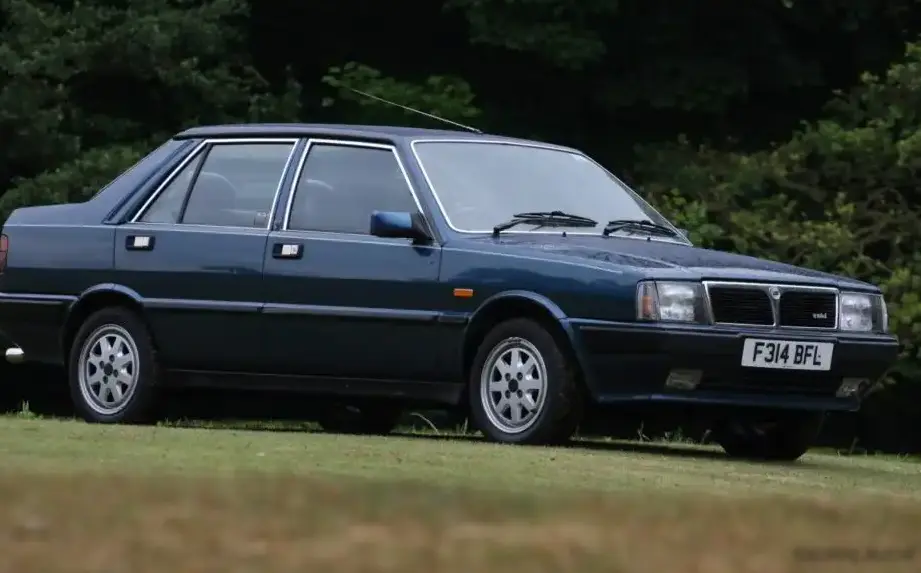
The Lancia Prisma 1.5, designated internally as the 831 AB series, was a compact sedan produced between April 1983 and May 1986. It represented Lancia’s entry into the increasingly popular C-segment, aiming to provide a more sophisticated and comfortable alternative to mass-market competitors. The Prisma was based on the Fiat Ritmo platform (Tipo Project), sharing its mechanical underpinnings but offering a more refined interior and distinctive Lancia styling. The 1.5-liter, 85 horsepower variant occupied a mid-range position in the Prisma lineup, offering a balance between affordability and performance, positioned below the more powerful 1.6 and 2.0-liter models.
Technical Specifications
| Brand | Lancia |
| Model | Prisma |
| Generation | Prisma (831 AB) |
| Type (Engine) | 1.5 (85 Hp) |
| Start of production | April, 1983 |
| End of production | May, 1986 |
| Powertrain Architecture | Internal Combustion engine |
| Body type | Sedan |
| Seats | 5 |
| Doors | 4 |
| Fuel consumption (urban) | 9.3 l/100 km (25.3 US mpg) |
| Fuel consumption (extra urban) | 5.9 l/100 km (39.9 US mpg) |
| Fuel Type | Petrol (Gasoline) |
| Acceleration 0 – 100 km/h | 12 sec |
| Acceleration 0 – 62 mph | 12 sec |
| Acceleration 0 – 60 mph | 11.4 sec |
| Maximum speed | 165 km/h (102.53 mph) |
| Weight-to-power ratio | 11.1 kg/Hp |
| Weight-to-torque ratio | 7.5 kg/Nm |
| Power | 85 Hp @ 5800 rpm |
| Power per litre | 56.7 Hp/l |
| Torque | 126 Nm @ 3500 rpm (92.93 lb.-ft. @ 3500 rpm) |
| Engine layout | Front, Transverse |
| Engine Model/Code | 831 A1.000 |
| Engine displacement | 1498 cm3 (91.41 cu. in.) |
| Number of cylinders | 4 |
| Engine configuration | Inline |
| Cylinder Bore | 86.4 mm (3.4 in.) |
| Piston Stroke | 63.9 mm (2.52 in.) |
| Compression ratio | 9.2:1 |
| Number of valves per cylinder | 2 |
| Fuel injection system | Carburettor |
| Engine aspiration | Naturally aspirated engine |
| Valvetrain | SOHC |
| Engine oil capacity | 4.3 l (4.54 US qt | 3.78 UK qt) |
| Coolant | 6 l (6.34 US qt | 5.28 UK qt) |
| Kerb Weight | 940 kg (2072.35 lbs.) |
| Max. weight | 1390 kg (3064.43 lbs.) |
| Max load | 450 kg (992.08 lbs.) |
| Trunk (boot) space – minimum | 450 l (15.89 cu. ft.) |
| Fuel tank capacity | 45 l (11.89 US gal | 9.9 UK gal) |
| Max. roof load | 50 kg (110.23 lbs.) |
| Permitted trailer load with brakes (12%) | 1000 kg (2204.62 lbs.) |
| Length | 4180 mm (164.57 in.) |
| Width | 1620 mm (63.78 in.) |
| Height | 1385 mm (54.53 in.) |
| Wheelbase | 2475 mm (97.44 in.) |
| Front track | 1400 mm (55.12 in.) |
| Rear (Back) track | 1400 mm (55.12 in.) |
| Minimum turning circle | 10.6 m (34.78 ft.) |
| Drivetrain Architecture | Front wheel drive |
| Number of gears and type of gearbox | 5 gears, manual transmission |
| Front suspension | Independent, type McPherson with coil spring and anti-roll bar |
| Rear suspension | McPherson, Transverse stabilizer |
| Front brakes | Disc |
| Rear brakes | Drum |
| Steering type | Steering rack and pinion |
| Tires size | 165/70 R13 |
| Wheel rims size | 5J x 13 |
Powertrain & Engine Architecture
The Lancia Prisma 1.5 utilized the Fiat 831A1.000 engine, a 1498cc inline-four cylinder unit. This engine was a relatively simple design, featuring a single overhead camshaft (SOHC) operating two valves per cylinder. Fuel delivery was managed by a Weber 32/32 DDA carburetor, a common setup for European cars of this era. The engine produced 85 horsepower at 5800 rpm and 126 Nm (93 lb-ft) of torque at 3500 rpm. The engine’s transverse mounting and front-wheel drive configuration were typical for compact European cars of the 1980s. The five-speed manual transmission was the standard offering for this variant, providing a reasonable balance between fuel economy and performance. The engine was known for its durability, but the carburetor required periodic adjustment and maintenance.
Driving Characteristics
The Prisma 1.5 offered a comfortable, if not particularly sporty, driving experience. With 85 horsepower propelling a vehicle weighing around 940 kg (2072 lbs), acceleration was adequate for everyday driving, with a 0-60 mph time of approximately 11.4 seconds. The five-speed manual transmission allowed drivers to keep the engine in its optimal power band, but the carburetor could sometimes lead to slight hesitation during acceleration. Compared to the more powerful 1.6 and 2.0-liter versions, the 1.5 felt less responsive, particularly when fully loaded or climbing hills. However, the 1.5’s lighter weight and simpler engine contributed to better fuel economy. The suspension provided a comfortable ride, absorbing bumps and imperfections in the road reasonably well.
Equipment & Trim Levels
The Prisma 1.5 typically came equipped with basic but functional features. Standard equipment included cloth upholstery, a basic instrument cluster, and manual windows and door locks. The interior was designed with practicality in mind, offering sufficient space for five passengers. Optional extras included a sunroof, upgraded stereo system, and metallic paint. The trim level for the 1.5 was generally considered the entry-level offering, appealing to buyers seeking a reliable and affordable family sedan. Higher trim levels, available with the larger engines, offered more luxurious features such as velour upholstery, central locking, and electric windows.
Chassis & Braking
The Prisma 1.5 utilized a McPherson strut front suspension with coil springs and an anti-roll bar, providing a good balance of ride comfort and handling. The rear suspension also employed a McPherson strut design, with a transverse stabilizer. Braking duties were handled by disc brakes at the front and drum brakes at the rear. While adequate for normal driving conditions, the drum brakes on the rear wheels were a limitation compared to the all-disc setups found on some of its competitors. The steering was a rack and pinion system, providing reasonably precise control.
Market Reception & Comparison
The Lancia Prisma 1.5 was generally well-received by automotive critics as a comfortable and practical family sedan. However, it wasn’t considered a performance leader. Compared to the more powerful Prisma variants, the 1.5 offered better fuel economy – around 39.9 US mpg on the highway – but lacked the same level of acceleration. The 1.6-liter version, while slightly more expensive, provided a noticeable performance boost. The Prisma competed with other C-segment sedans such as the Ford Escort, Opel Kadett, and Volkswagen Jetta. The Prisma distinguished itself with its more refined interior and distinctive Italian styling.
Legacy
The Lancia Prisma 1.5, while not a particularly rare or collectible car today, remains a reasonably reliable and affordable classic. The 831A1.000 engine is known for its durability, and parts availability is generally good. However, as with any car of this age, regular maintenance is essential. The carburetor requires periodic attention, and rust can be a concern, particularly in regions with harsh winters. The Prisma 1.5 represents a significant chapter in Lancia’s history, showcasing the brand’s commitment to providing stylish and comfortable vehicles for the European market. In the used car market, these models are often sought after by enthusiasts looking for a classic Italian sedan with a unique character.
