
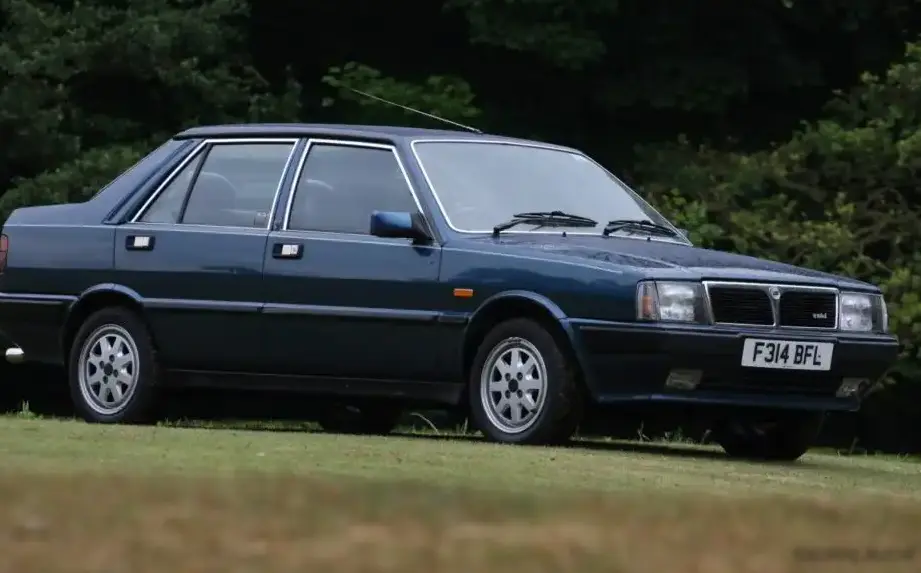
The Lancia Prisma 1.6 (831 AB) was a compact sedan produced between April 1983 and May 1986. It represented Lancia’s entry into the increasingly popular compact family car segment, building upon the foundations of the earlier Lancia Delta. The Prisma, while sharing many components with the Delta, offered a more traditionally styled sedan body, appealing to a broader customer base. The 1.6-liter, 105 horsepower variant occupied a middle ground in the Prisma lineup, offering a balance between performance and affordability. It was positioned above the base 1.3-liter models and below the more potent 2.0-liter versions.
Technical Specifications
| Brand | Lancia |
| Model | Prisma |
| Generation | Prisma (831 AB) |
| Type (Engine) | 1.6 (105 Hp) |
| Start of production | April, 1983 |
| End of production | May, 1986 |
| Powertrain Architecture | Internal Combustion engine |
| Body type | Sedan |
| Seats | 5 |
| Doors | 4 |
| Fuel consumption (urban) | 10.2 l/100 km (23.1 US mpg, 27.7 UK mpg, 9.8 km/l) |
| Fuel consumption (extra urban) | 6.4 l/100 km (36.8 US mpg, 44.1 UK mpg, 15.6 km/l) |
| Fuel Type | Petrol (Gasoline) |
| Acceleration 0 – 100 km/h | 10.2 sec |
| Acceleration 0 – 62 mph | 10.2 sec |
| Acceleration 0 – 60 mph | 9.7 sec |
| Maximum speed | 178 km/h (110.6 mph) |
| Weight-to-power ratio | 9.3 kg/Hp, 107.7 Hp/tonne |
| Weight-to-torque ratio | 7.2 kg/Nm, 138.5 Nm/tonne |
| Power | 105 Hp @ 5800 rpm |
| Power per litre | 66.2 Hp/l |
| Torque | 135 Nm @ 3300 rpm (99.57 lb.-ft. @ 3300 rpm) |
| Engine layout | Front, Transverse |
| Engine Model/Code | 831 A4.000 |
| Engine displacement | 1585 cm3 (96.72 cu. in.) |
| Number of cylinders | 4 |
| Engine configuration | Inline |
| Cylinder Bore | 84 mm (3.31 in.) |
| Piston Stroke | 71.5 mm (2.81 in.) |
| Compression ratio | 9.3:1 |
| Number of valves per cylinder | 2 |
| Fuel injection system | Carburettor |
| Engine aspiration | Naturally aspirated engine |
| Valvetrain | DOHC |
| Engine oil capacity | 5 l (5.28 US qt | 4.4 UK qt) |
| Coolant | 6 l (6.34 US qt | 5.28 UK qt) |
| Kerb Weight | 975 kg (2149.51 lbs.) |
| Max. weight | 1425 kg (3141.59 lbs.) |
| Max load | 450 kg (992.08 lbs.) |
| Trunk (boot) space – minimum | 450 l (15.89 cu. ft.) |
| Fuel tank capacity | 45 l (11.89 US gal | 9.9 UK gal) |
| Max. roof load | 50 kg (110.23 lbs.) |
| Permitted trailer load with brakes (12%) | 1000 kg (2204.62 lbs.) |
| Length | 4180 mm (164.57 in.) |
| Width | 1620 mm (63.78 in.) |
| Height | 1385 mm (54.53 in.) |
| Wheelbase | 2475 mm (97.44 in.) |
| Front track | 1400 mm (55.12 in.) |
| Rear (Back) track | 1400 mm (55.12 in.) |
| Minimum turning circle | 10.6 m (34.78 ft.) |
| Drivetrain Architecture | The Internal combustion engine (ICE) drives the front wheels of the vehicle. |
| Drive wheel | Front wheel drive |
| Number of gears and type of gearbox | 5 gears, manual transmission |
| Front suspension | Independent, type McPherson with coil spring and anti-roll bar |
| Rear suspension | McPherson, Transverse stabilizer |
| Front brakes | Disc |
| Rear brakes | Disc |
| Steering type | Steering rack and pinion |
| Tires size | 165/65 R14 |
| Wheel rims size | 5.5J x 14 |
Powertrain & Engine Architecture
The heart of the Prisma 1.6 was the Lancia-developed 831 A4.000 engine, a 1585cc inline-four cylinder unit. This engine featured a dual overhead camshaft (DOHC) valvetrain operating two valves per cylinder. Unlike later fuel-injected Lancia engines, the 1.6 utilized a carburetor for fuel delivery, a common practice for the time. The carburetor system, while simpler than fuel injection, required periodic adjustment to maintain optimal performance. The engine produced 105 horsepower at 5800 rpm and 135 Nm (99.57 lb-ft) of torque at 3300 rpm. The engine was transversely mounted in the front of the vehicle, driving the front wheels. The Prisma 1.6 came exclusively with a five-speed manual transmission, offering a reasonable balance between fuel economy and driver engagement.
Driving Characteristics
The Prisma 1.6 offered a comfortable, if not particularly sporty, driving experience. Acceleration from 0 to 60 mph took around 9.7 seconds, and it reached a top speed of 178 km/h (110.6 mph). The carburetor-fed engine delivered smooth, predictable power, but lacked the responsiveness of fuel-injected counterparts. The five-speed manual transmission allowed drivers to keep the engine in its optimal power band, but the gear ratios were geared more towards fuel efficiency than outright performance. Compared to the more powerful 2.0-liter Prisma, the 1.6 felt noticeably slower, especially during overtaking maneuvers. However, it offered a more economical and accessible option for buyers.
Equipment & Trim Levels
The Prisma 1.6 typically came with a fairly basic level of equipment, reflecting its position as a mid-range model. Standard features included cloth upholstery, a basic instrument cluster, and manual windows and door locks. Optional extras included a sunroof, upgraded audio system, and metallic paint. Interior trim was generally functional and durable, prioritizing practicality over luxury. The dashboard layout was straightforward and easy to use, typical of Italian automotive design of the era.
Chassis & Braking
The Prisma 1.6 utilized a McPherson strut suspension setup at both the front and rear, providing a comfortable ride quality. A transverse stabilizer bar was fitted to the rear to reduce body roll during cornering. The braking system consisted of disc brakes on all four wheels, offering adequate stopping power for the vehicle’s weight and performance. Steering was via a rack and pinion system, providing precise and responsive handling. The tires were typically 165/65 R14, offering a good balance between grip and ride comfort.
Market Reception & Comparison
The Lancia Prisma 1.6 was generally well-received by automotive critics as a practical and well-built family sedan. However, some reviewers noted that the carburetor-fed engine lacked the refinement and performance of fuel-injected rivals. Compared to the 2.0-liter Prisma, the 1.6 offered better fuel economy but significantly less power. The 1.3-liter models were even more economical but lacked the performance needed for highway driving. The Prisma 1.6 found a niche among buyers seeking a comfortable, reliable, and affordable family car.
Legacy
The Lancia Prisma, while not a groundbreaking vehicle, played an important role in Lancia’s history. The 1.6-liter engine proved to be relatively reliable, although carburetor maintenance was a necessary part of ownership. Today, the Prisma 1.6 is a relatively rare sight on the roads, but it has gained a following among classic Lancia enthusiasts. Well-maintained examples are sought after for their classic Italian styling and relatively simple mechanicals. The Prisma represents a transitional period in Lancia’s history, bridging the gap between the brand’s rally-bred heritage and its later, more mainstream offerings.
