
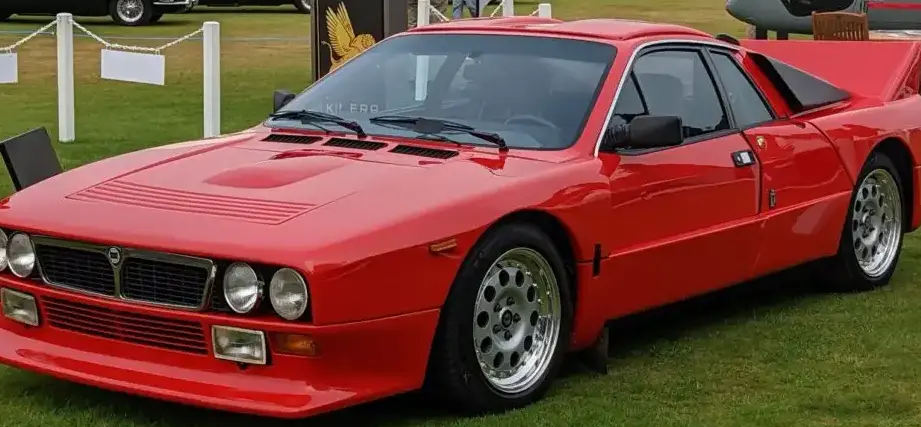
The Lancia Rally 037 Stradale 2.0, produced from 1982 to 1984, represents a pivotal moment in Lancia’s motorsport heritage. Born from the need to homologate a vehicle for Group B rally competition, the 037 was Lancia’s answer to the increasingly dominant four-wheel-drive cars of the era. While the Rally 037 competed successfully in rally racing, the Stradale was the road-going version required for homologation, offering a slightly more refined, though still aggressively focused, driving experience. It was built around the compact, mid-engine layout, a configuration relatively uncommon for production cars at the time, and served as a technological showcase for Lancia’s engineering prowess. The 2.0-liter variant, producing 205 horsepower, was the most potent version offered to the public, and a relatively rare sight even during its short production run.
Technical Specifications
| Brand | Lancia |
| Model | Rally 037 |
| Generation | Rally 037 Stradale |
| Type (Engine) | 2.0 (205 Hp) |
| Start of production | 1982 |
| End of production | 1984 |
| Powertrain Architecture | Internal Combustion engine |
| Body type | Coupe |
| Seats | 2 |
| Doors | 2 |
| Fuel consumption (urban) | 16.6 l/100 km (14.2 US mpg, 17 UK mpg, 6 km/l) |
| Fuel consumption (extra urban) | 8 l/100 km (29.4 US mpg, 35.3 UK mpg, 12.5 km/l) |
| Fuel Type | Petrol (Gasoline) |
| Acceleration 0 – 100 km/h | 7 sec |
| Acceleration 0 – 62 mph | 7 sec |
| Acceleration 0 – 60 mph | 6.7 sec |
| Maximum speed | 220 km/h (136.7 mph) |
| Weight-to-power ratio | 5.7 kg/Hp, 175.2 Hp/tonne |
| Weight-to-torque ratio | 5 kg/Nm, 199.1 Nm/tonne |
| Power | 205 Hp @ 7000 rpm |
| Power per litre | 102.8 Hp/l |
| Torque | 233 Nm @ 5000 rpm (171.85 lb.-ft. @ 5000 rpm) |
| Engine layout | Middle, Longitudinal |
| Engine Model/Code | 232AR4 |
| Engine displacement | 1995 cm3 (121.74 cu. in.) |
| Number of cylinders | 4 |
| Engine configuration | Inline |
| Cylinder Bore | 84 mm (3.31 in.) |
| Piston Stroke | 90 mm (3.54 in.) |
| Compression ratio | 7.5:1 |
| Number of valves per cylinder | 4 |
| Fuel injection system | Carburettor |
| Engine aspiration | Supercharger |
| Valvetrain | DOHC |
| Engine oil capacity | 8.89 l (9.39 US qt, 7.82 UK qt) |
| Coolant | 9 l (9.51 US qt, 7.92 UK qt) |
| Kerb Weight | 1170 kg (2579.41 lbs.) |
| Max. weight | 1330 kg (2932.15 lbs.) |
| Max load | 160 kg (352.74 lbs.) |
| Fuel tank capacity | 70 l (18.49 US gal, 15.4 UK gal) |
| Length | 3915 mm (154.13 in.) |
| Width | 1850 mm (72.83 in.) |
| Height | 1245 mm (49.02 in.) |
| Wheelbase | 2440 mm (96.06 in.) |
| Front track | 1508 mm (59.37 in.) |
| Rear track | 1490 mm (58.66 in.) |
| Front overhang | 895 mm (35.24 in.) |
| Rear overhang | 580 mm (22.83 in.) |
| Minimum turning circle | 10.6 m (34.78 ft.) |
| Drivetrain Architecture | Rear wheel drive |
| Number of gears | 5 gears, manual transmission |
| Front suspension | Coil spring, Double wishbone, Transverse stabilizer |
| Rear suspension | Double wishbone, Coil spring |
| Front brakes | Ventilated discs |
| Rear brakes | Ventilated discs |
| Steering type | Steering rack and pinion |
| Front tires | 205/55 R16 |
| Rear tires | 225/50 R16 |
| Front wheel rims | 8J x 16 |
| Rear wheel rims | 9J x 16 |
Powertrain & Engine Architecture
The heart of the Rally 037 Stradale 2.0 is the Lancia 232AR4 engine, a 1,995 cc (121.74 cu. in.) inline-four cylinder powerplant. This engine is notable for its sophisticated, albeit complex, induction system. Unlike many turbocharged engines of the time, the 037 utilized a volumetric supercharger, specifically a Roots-type blower, driven by the engine’s crankshaft. This provided instant boost and a linear power delivery, crucial for rally applications. Fuel delivery was managed by twin Weber 36 DFC carburetors, a somewhat archaic system for a high-performance engine of this era, but one that Lancia deemed reliable and tunable. The engine featured a dual overhead camshaft (DOHC) valvetrain with four valves per cylinder, contributing to its high specific output. The 7.5:1 compression ratio was a compromise between performance and reliability, considering the stresses of forced induction. Power was transmitted to the rear wheels via a robust five-speed manual transmission, chosen for its directness and driver control.
Driving Characteristics
The driving experience in the Rally 037 Stradale 2.0 is distinctly analog and demanding. The supercharger delivers a strong surge of torque from relatively low RPMs, making the car feel responsive and eager. However, the power delivery isn’t peaky; it builds steadily towards the 7,000 rpm redline. The rear-wheel-drive configuration, combined with the relatively short wheelbase, makes the 037 prone to oversteer, requiring a skilled driver to maintain control, especially on slippery surfaces. Compared to potential turbocharged alternatives, the supercharged engine offers a more predictable and less laggy power delivery. The five-speed gearbox is precise, but requires a firm hand. The car’s relatively light weight (1,170 kg or 2,579 lbs) contributes to its nimble handling, but also means that the ride is firm and unforgiving. It’s a car that rewards precision and demands respect.
Equipment & Trim Levels
The Rally 037 Stradale was not a luxury car, and its equipment level reflected this. The interior was spartan, focused on functionality rather than comfort. Standard features included supportive bucket seats upholstered in cloth or leather (leather was an option), a three-spoke steering wheel, and basic instrumentation including a speedometer, tachometer, oil pressure gauge, and water temperature gauge. Air conditioning and power windows were optional extras. The dashboard layout was simple and driver-focused. The interior trim was generally minimalist, with a focus on lightweight materials. The exterior featured distinctive flared wheel arches, a prominent rear wing, and a purposeful, aggressive stance.
Chassis & Braking
The Rally 037 Stradale utilized a steel monocoque chassis, designed for both rigidity and lightness. Suspension consisted of independent double wishbones at both the front and rear, with coil springs and transverse stabilizer bars. The suspension setup was tuned for performance, prioritizing handling over ride comfort. Braking was provided by ventilated discs at all four corners, offering adequate stopping power for the car’s performance capabilities. The steering was a rack-and-pinion system, providing precise and direct steering feel. The car rode on 16-inch wheels, with wider tires at the rear (225/50 R16) than at the front (205/55 R16) to improve traction.
Market Reception & Comparison
The Lancia Rally 037 Stradale was met with critical acclaim for its performance and handling. However, its high price and uncompromising nature limited its appeal to a relatively small group of enthusiasts. Compared to other sports cars of the era, such as the Porsche 911, the 037 offered a more raw and visceral driving experience. Its fuel economy was relatively poor (16.6 l/100 km urban, 8 l/100 km extra-urban), reflecting its high-performance engine and supercharging system. Reliability was also a concern, with the complex engine and electrical systems requiring regular maintenance. However, the 037’s unique character and motorsport pedigree made it a highly desirable car among collectors.
Legacy
The Lancia Rally 037 Stradale remains a highly sought-after collector’s car today. Its rarity, performance, and historical significance contribute to its enduring appeal. The 232AR4 engine, while complex, is considered a masterpiece of engineering. The car’s mid-engine layout and rear-wheel-drive configuration provide a unique driving experience that is difficult to replicate in modern cars. While maintenance can be expensive due to the scarcity of parts, the Rally 037 Stradale continues to be celebrated as one of Lancia’s greatest achievements and a defining example of the Group B rally era.
