
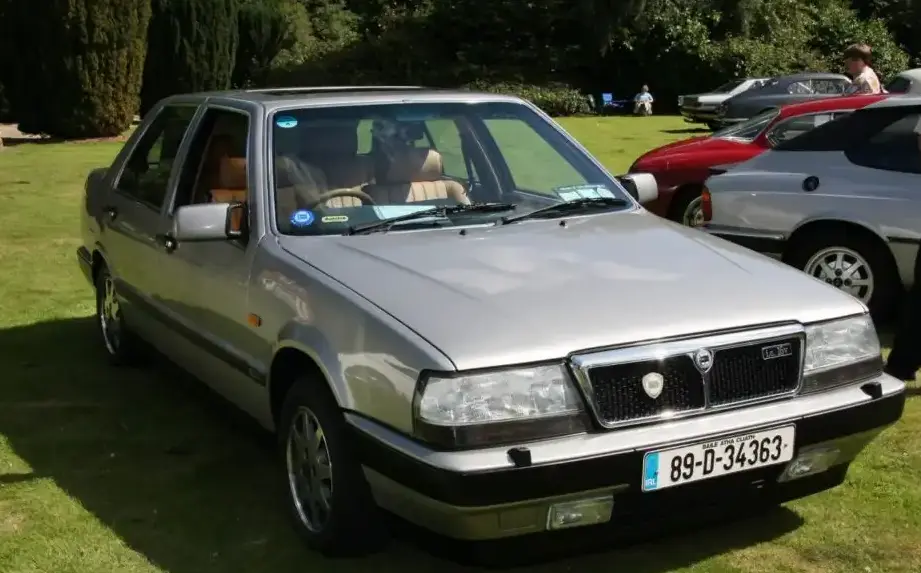
The Lancia Thema (834) 2000 16V Automatic, produced between 1992 and 1993, represented a refinement of the second-generation Thema, a flagship sedan for the Italian automaker. Positioned as a mid-range offering within the 834 series, it aimed to balance performance with the convenience of an automatic transmission. The Thema, in its second generation, was a collaborative effort with Saab (resulting in the Saab 9000), Fiat (Croma), and Alfa Romeo (164), all sharing the Type Four platform. This particular variant, with its 2.0-liter 16-valve engine and automatic gearbox, was primarily aimed at buyers seeking a comfortable and relatively powerful executive car, though it didn’t achieve the same sporting reputation as some of its siblings.
Technical Specifications
| Brand | Lancia |
| Model | Thema |
| Generation | Thema (834) |
| Type (Engine) | 2000 16V (152 Hp) Automatic |
| Start of production | 1992 |
| End of production | 1993 |
| Powertrain Architecture | Internal Combustion engine |
| Body type | Sedan |
| Seats | 5 |
| Doors | 4 |
| Fuel consumption (urban) | 12.5 l/100 km (18.8 US mpg, 22.6 UK mpg, 8 km/l) |
| Fuel consumption (extra urban) | 6.8 l/100 km (34.6 US mpg, 41.5 UK mpg, 14.7 km/l) |
| Fuel consumption (combined) | 8.4 l/100 km (28 US mpg, 33.6 UK mpg, 11.9 km/l) |
| Fuel Type | Petrol (Gasoline) |
| Acceleration 0 – 100 km/h | 12 sec |
| Acceleration 0 – 62 mph | 12 sec |
| Acceleration 0 – 60 mph | 11.4 sec |
| Maximum speed | 200 km/h (124.27 mph) |
| Weight-to-power ratio | 8.2 kg/Hp, 121.6 Hp/tonne |
| Weight-to-torque ratio | 6.8 kg/Nm, 147.2 Nm/tonne |
| Power | 152 Hp @ 6000 rpm |
| Power per litre | 76.2 Hp/l |
| Torque | 184 Nm @ 4000 rpm (135.71 lb.-ft. @ 4000 rpm) |
| Engine layout | Front, Transverse |
| Engine Model/Code | 834 F1.000 |
| Engine displacement | 1995 cm3 (121.74 cu. in.) |
| Number of cylinders | 4 |
| Engine configuration | Inline |
| Cylinder Bore | 84 mm (3.31 in.) |
| Piston Stroke | 90 mm (3.54 in.) |
| Compression ratio | 9.85:1 |
| Number of valves per cylinder | 4 |
| Fuel injection system | Multi-port manifold injection |
| Engine aspiration | Naturally aspirated engine |
| Engine oil capacity | 5.5 l (5.81 US qt | 4.84 UK qt) |
| Coolant capacity | 8.2 l (8.66 US qt | 7.21 UK qt) |
| Kerb Weight | 1250 kg (2755.78 lbs.) |
| Max. weight | 1750 kg (3858.09 lbs.) |
| Max load | 500 kg (1102.31 lbs.) |
| Trunk (boot) space – minimum | 440 l (15.54 cu. ft.) |
| Trunk (boot) space – maximum | 1000 l (35.31 cu. ft.) |
| Fuel tank capacity | 70 l (18.49 US gal | 15.4 UK gal) |
| Length | 4590 mm (180.71 in.) |
| Width | 1750 mm (68.9 in.) |
| Height | 1435 mm (56.5 in.) |
| Wheelbase | 2660 mm (104.72 in.) |
| Front track | 1480 mm (58.27 in.) |
| Rear (Back) track | 1470 mm (57.87 in.) |
| Drivetrain Architecture | Front wheel drive |
| Number of gears and type of gearbox | 4 gears, automatic transmission |
| Front suspension | Coil spring |
| Rear suspension | Coil spring |
| Front brakes | Disc |
| Rear brakes | Disc |
| Assisting systems | ABS (Anti-lock braking system) |
| Steering type | Steering rack and pinion |
| Power steering | Hydraulic Steering |
| Tires size | 185/70 R14 |
| Wheel rims size | 14 |
Powertrain & Engine Architecture
The heart of the Thema 2000 16V Automatic is the 834 F1.000 engine, a 1995cc inline-four cylinder powerplant. This engine featured a dual overhead camshaft (DOHC) design with four valves per cylinder, contributing to its relatively high output for its displacement. It utilized Bosch multi-port fuel injection, a common setup for the era, and a compression ratio of 9.85:1. The engine was transversely mounted in the front of the vehicle, driving the front wheels. The automatic transmission was a four-speed unit, designed to provide smooth shifts and ease of driving, but at the expense of some performance compared to the available five-speed manual. The engine code, 834 F1.000, is crucial for identifying specific parts and maintenance requirements.
Driving Characteristics
The 152 horsepower and 135.71 lb-ft of torque delivered by the 2.0-liter engine, coupled with the four-speed automatic, resulted in a comfortable but not particularly exhilarating driving experience. Acceleration to 60 mph took around 11.4 seconds, and top speed was approximately 124 mph. The automatic transmission, while convenient, did sap some of the engine’s potential, resulting in slower acceleration than the manual transmission equipped versions. Gear ratios were optimized for cruising comfort rather than outright performance. Compared to the more powerful Thema 2.0 16V with a manual gearbox, the automatic version felt noticeably less responsive. However, it offered a more relaxed driving experience, particularly in city traffic.
Equipment & Trim Levels
The Thema 2000 16V Automatic typically came equipped with features expected of a luxury sedan in the early 1990s. Standard equipment included power windows, central locking, power steering, and an anti-lock braking system (ABS). Interior upholstery was generally cloth, though leather was available as an option. Dashboard design was functional and relatively understated, reflecting the Italian design aesthetic of the time. Optional extras included a sunroof, upgraded audio system, and climate control. The trim level was generally considered a step up from the base models, offering a more refined interior and additional convenience features.
Chassis & Braking
The Thema 834 utilized a coil spring suspension system at both the front and rear, providing a comfortable ride. The front suspension featured independent components, while the rear suspension was a semi-independent setup. Braking was handled by disc brakes on all four wheels, a significant upgrade over the rear drum brakes found on some lower-spec models. The ABS system enhanced braking performance and stability, particularly on slippery surfaces. Stabilizer bars were fitted to both the front and rear axles to reduce body roll during cornering.
Market Reception & Comparison
The Lancia Thema 2000 16V Automatic received mixed reviews. Critics praised its comfortable ride, spacious interior, and relatively strong engine. However, the automatic transmission was often criticized for its lack of responsiveness and its impact on fuel economy. Compared to the manual transmission versions, the automatic offered less engaging driving experience. Fuel economy was rated at around 28 US mpg combined, which was reasonable for the time but not exceptional. Reliability was generally considered average, with some reports of electrical issues and minor mechanical problems. The Thema competed with other executive sedans such as the BMW 5 Series, Mercedes-Benz E-Class, and Audi 100.
Legacy
The Lancia Thema 2000 16V Automatic, while not a standout performer, remains a fondly remembered example of Italian automotive engineering from the early 1990s. The 834 F1.000 engine, when properly maintained, proved to be reasonably durable. Today, these vehicles are relatively rare and sought after by enthusiasts, particularly those interested in classic Italian cars. Parts availability can be a challenge, but a dedicated community of owners and specialists exists to support the preservation of these vehicles. The Thema’s collaborative design and its role as a flagship Lancia sedan contribute to its enduring appeal.
