
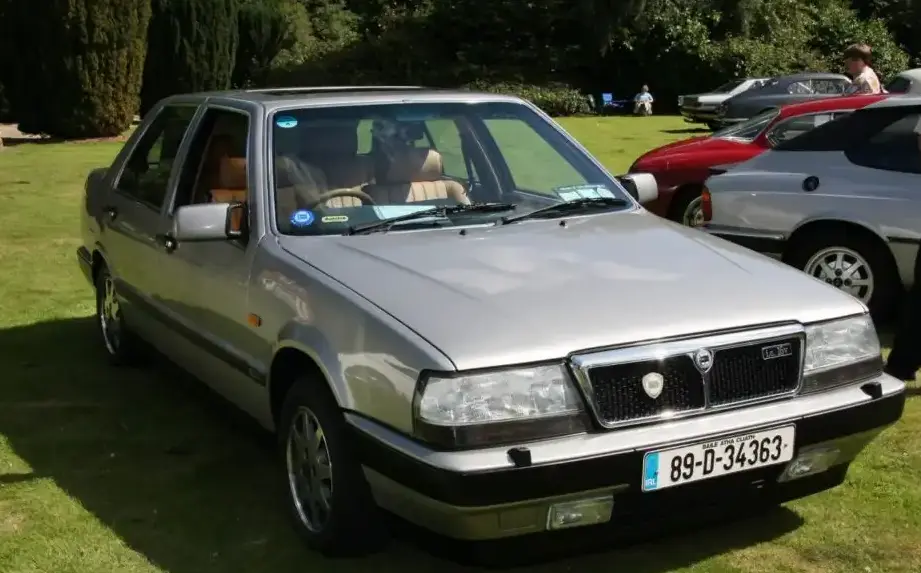
The Lancia Thema 834, specifically the 2850 V6 i.e. variant paired with an automatic transmission, represented a significant offering in the upper-midsize executive car segment during its production run from 1984 to 1988. Positioned as a premium model within the Thema range, it aimed to blend Italian styling and comfort with robust mechanical engineering. This generation Thema (834) was built upon the Type Four platform, shared with the Fiat Croma, Alfa Romeo 164, and Saab 9000, representing a collaborative effort to create a competitive European offering. The 2.8L V6 automatic was a step up from the base models, targeting buyers who desired a more refined and powerful driving experience without the engagement of a manual gearbox.
Technical Specifications
| Brand | Lancia |
| Model | Thema |
| Generation | Thema (834) |
| Type (Engine) | 2850 V6 i.e. (150 Hp) Automatic |
| Start of production | 1984 |
| End of production | 1988 |
| Powertrain Architecture | Internal Combustion engine |
| Body type | Sedan |
| Seats | 5 |
| Doors | 4 |
| Fuel consumption (urban) | 14.3 l/100 km (16.4 US mpg, 19.8 UK mpg, 7 km/l) |
| Fuel consumption (extra urban) | 8.6 l/100 km (27.4 US mpg, 32.8 UK mpg, 11.6 km/l) |
| Fuel consumption (combined) | 10.5 l/100 km (22.4 US mpg, 26.9 UK mpg, 9.5 km/l) |
| Fuel Type | Petrol (Gasoline) |
| Acceleration 0 – 100 km/h | 8.4 sec |
| Acceleration 0 – 62 mph | 8.4 sec |
| Acceleration 0 – 60 mph | 8 sec |
| Maximum speed | 205 km/h (127.38 mph) |
| Weight-to-power ratio | 8.5 kg/Hp, 117.2 Hp/tonne |
| Weight-to-torque ratio | 5.6 kg/Nm, 179.7 Nm/tonne |
| Power | 150 Hp @ 5000 rpm |
| Power per litre | 52.7 Hp/l |
| Torque | 230 Nm @ 3500 rpm (169.64 lb.-ft. @ 3500 rpm) |
| Engine layout | Front, Transverse |
| Engine Model/Code | 834 E.000 |
| Engine displacement | 2849 cm3 (173.86 cu. in.) |
| Number of cylinders | 6 |
| Engine configuration | V-engine |
| Cylinder Bore | 91 mm (3.58 in.) |
| Piston Stroke | 73 mm (2.87 in.) |
| Compression ratio | 9.5:1 |
| Number of valves per cylinder | 2 |
| Fuel injection system | Multi-port manifold injection |
| Engine aspiration | Naturally aspirated engine |
| Engine oil capacity | 6.6 l (6.97 US qt | 5.81 UK qt) |
| Coolant capacity | 6 l (6.34 US qt | 5.28 UK qt) |
| Kerb Weight | 1280 kg (2821.92 lbs.) |
| Max. weight | 1780 kg (3924.23 lbs.) |
| Max load | 500 kg (1102.31 lbs.) |
| Trunk (boot) space – minimum | 440 l (15.54 cu. ft.) |
| Trunk (boot) space – maximum | 1000 l (35.31 cu. ft.) |
| Fuel tank capacity | 70 l (18.49 US gal | 15.4 UK gal) |
| Length | 4590 mm (180.71 in.) |
| Width | 1750 mm (68.9 in.) |
| Height | 1435 mm (56.5 in.) |
| Wheelbase | 2660 mm (104.72 in.) |
| Front track | 1480 mm (58.27 in.) |
| Rear track | 1470 mm (57.87 in.) |
| Drivetrain Architecture | Front wheel drive |
| Number of gears | 4 |
| Gearbox type | Automatic transmission |
| Front suspension | Coil spring |
| Rear suspension | Coil spring |
| Front brakes | Disc |
| Rear brakes | Disc |
| Assisting systems | ABS (Anti-lock braking system) |
| Steering type | Steering rack and pinion |
| Power steering | Hydraulic |
| Tires size | 185/70 R14 |
| Wheel rims size | 14 |
Powertrain & Engine Architecture
The heart of the Thema 2850 V6 i.e. was the 834 E.000 engine, a 2.8-liter, 60-degree V6. This engine featured a cast iron block and aluminum cylinder heads, a common configuration for European engines of the era. It utilized multi-port fuel injection, managed by an early electronic control unit (ECU), to deliver fuel to the cylinders. The engine produced 150 horsepower at 5000 rpm and 230 Nm (169.64 lb-ft) of torque at 3500 rpm. The automatic transmission was a four-speed unit, designed to provide smooth shifts and ease of driving. While not a particularly advanced transmission by modern standards, it was well-suited to the engine’s characteristics and the intended market for the vehicle.
Driving Characteristics
The 2.8L V6 automatic Thema offered a comfortable and refined driving experience. Acceleration to 60 mph took approximately 8 seconds, and it had a top speed of 127.38 mph. Compared to the manual transmission versions, the automatic offered less direct control and slightly slower acceleration. However, it provided a more relaxed driving experience, particularly in city traffic. The automatic transmission’s gear ratios were tuned for smooth cruising and adequate acceleration, but it wasn’t designed for aggressive driving. The V6 engine delivered a smooth power delivery, making it a pleasant companion for long journeys.
Equipment & Trim Levels
The 2850 V6 i.e. automatic typically came with a generous level of standard equipment. This included power windows, central locking, power steering, and an anti-lock braking system (ABS). Interior upholstery was typically cloth, although leather was available as an option. Dashboard configuration featured analog gauges and a relatively simple layout, prioritizing functionality over flashy design. Optional extras included a sunroof, upgraded audio system, and metallic paint finishes. The Thema aimed for a balance between luxury and practicality, offering a comfortable and well-equipped interior.
Chassis & Braking
The Thema 834 utilized a front-engine, front-wheel-drive layout. Suspension consisted of coil springs all around, providing a comfortable ride. The front brakes were discs, while the rear brakes were also discs, a relatively uncommon feature for front-wheel-drive cars of this era. The steering was rack and pinion with hydraulic assistance, offering precise and responsive handling. The car rode on 185/70 R14 tires, providing a good balance of grip and comfort.
Market Reception & Comparison
The Lancia Thema 2850 V6 i.e. automatic was generally well-received by automotive critics. It was praised for its comfortable ride, refined engine, and spacious interior. However, some critics noted that the automatic transmission detracted slightly from the driving experience compared to the manual versions. Compared to other cars in its class, such as the BMW 5 Series and Mercedes-Benz E-Class, the Thema offered a more affordable alternative with a distinctive Italian flair. Fuel economy was typical for a V6 engine of the time, averaging around 22.4 US mpg in combined driving. Reliability was generally good, although some owners reported issues with the electronic fuel injection system.
Legacy
The Lancia Thema 834, including the 2850 V6 i.e. automatic variant, holds a place as a stylish and comfortable executive car from the 1980s. While not as widely recognized as some of its German competitors, it remains a popular choice among Lancia enthusiasts. The V6 engine is known for its durability and smooth operation, and well-maintained examples are still found on the road today. In the used car market, these Themas are appreciated for their classic Italian design and relatively affordable price point. However, finding parts can be challenging, and specialized knowledge is often required for maintenance and repair.
