
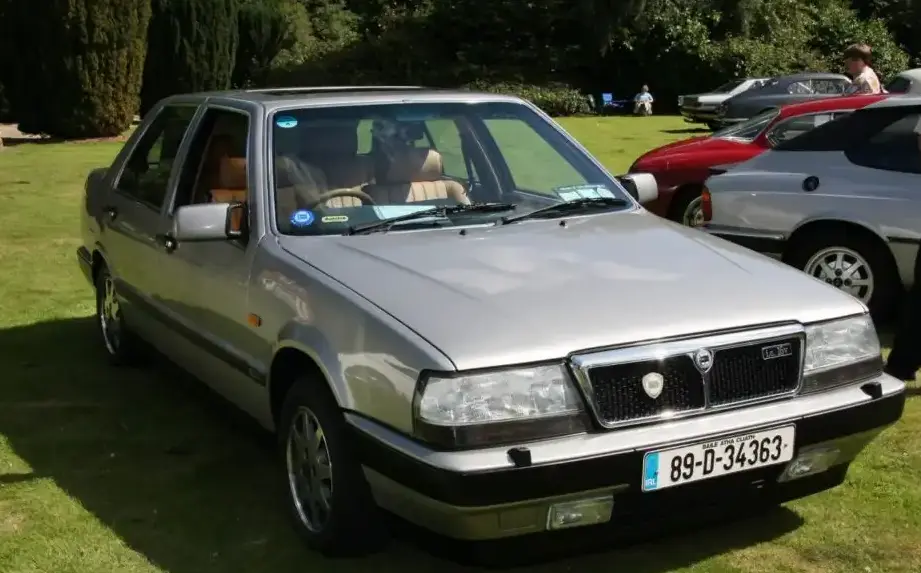
The Lancia Thema 8.32, produced between 1987 and 1989, represents the pinnacle of the second-generation Thema (834) range. This flagship model distinguished itself with a sophisticated, all-aluminum, 3.0-liter V8 engine, a feature rarely seen in front-wheel-drive sedans of the era. Positioned as the luxury performance variant, the 8.32 aimed to compete with executive cars from German manufacturers like BMW and Mercedes-Benz, offering a unique blend of Italian style and robust engineering. It was a relatively short-lived model, reflecting Lancia’s financial constraints and shifting market priorities during that period.
Technical Specifications
| Brand | Lancia |
| Model | Thema |
| Generation | Thema (834) |
| Type (Engine) | 8.32 (215 Hp) |
| Start of production | 1987 |
| End of production | 1989 |
| Powertrain Architecture | Internal Combustion engine |
| Body type | Sedan |
| Seats | 5 |
| Doors | 4 |
| Fuel consumption (urban) | 17.5 l/100 km (13.4 US mpg, 16.1 UK mpg, 5.7 km/l) |
| Fuel consumption (extra urban) | 9.2 l/100 km (25.6 US mpg, 30.7 UK mpg, 10.9 km/l) |
| Fuel consumption (combined) | 10.5 l/100 km (22.4 US mpg, 26.9 UK mpg, 9.5 km/l) |
| Fuel Type | Petrol (Gasoline) |
| Acceleration 0 – 100 km/h | 7.2 sec |
| Acceleration 0 – 62 mph | 7.2 sec |
| Acceleration 0 – 60 mph | 6.8 sec |
| Maximum speed | 234 km/h (145.4 mph) |
| Weight-to-power ratio | 6.5 kg/Hp, 153.6 Hp/tonne |
| Weight-to-torque ratio | 4.9 kg/Nm, 202.9 Nm/tonne |
| Power | 215 Hp @ 6750 rpm |
| Power per litre | 73.5 Hp/l |
| Torque | 284 Nm @ 4500 rpm (209.47 lb.-ft. @ 4500 rpm) |
| Engine layout | Front, Transverse |
| Engine Model/Code | F 105 L |
| Engine displacement | 2927 cm3 (178.62 cu. in.) |
| Number of cylinders | 8 |
| Engine configuration | V-engine |
| Cylinder Bore | 81 mm (3.19 in.) |
| Piston Stroke | 71 mm (2.8 in.) |
| Compression ratio | 9.5:1 |
| Number of valves per cylinder | 4 |
| Fuel injection system | Multi-port manifold injection |
| Engine aspiration | Naturally aspirated engine |
| Engine oil capacity | 7.7 l (8.14 US qt | 6.78 UK qt) |
| Coolant capacity | 10 l (10.57 US qt | 8.8 UK qt) |
| Kerb Weight | 1400 kg (3086.47 lbs.) |
| Max. weight | 1880 kg (4144.69 lbs.) |
| Max load | 480 kg (1058.22 lbs.) |
| Trunk (boot) space – minimum | 440 l (15.54 cu. ft.) |
| Trunk (boot) space – maximum | 1000 l (35.31 cu. ft.) |
| Fuel tank capacity | 70 l (18.49 US gal | 15.4 UK gal) |
| Length | 4590 mm (180.71 in.) |
| Width | 1750 mm (68.9 in.) |
| Height | 1435 mm (56.5 in.) |
| Wheelbase | 2660 mm (104.72 in.) |
| Front track | 1480 mm (58.27 in.) |
| Rear (Back) track | 1470 mm (57.87 in.) |
| Drivetrain Architecture | The Internal combustion engine (ICE) drives the front wheels of the vehicle. |
| Drive wheel | Front wheel drive |
| Number of gears and type of gearbox | 5 gears, manual transmission |
| Front suspension | Coil spring |
| Rear suspension | Coil spring |
| Front brakes | Disc |
| Rear brakes | Disc |
| Assisting systems | ABS (Anti-lock braking system) |
| Steering type | Steering rack and pinion |
| Power steering | Hydraulic Steering |
| Tires size | 205/55 R15 |
Powertrain & Engine Architecture
The heart of the Thema 8.32 is the F105L engine, a 2.9-liter, 60-degree V8. This engine was derived from the Ferrari 308’s V8, though significantly detuned for use in a front-wheel-drive application. It featured an all-aluminum construction, including the block and cylinder heads, contributing to a relatively lightweight engine for its displacement. Fuel delivery was managed by Bosch Motronic multi-port fuel injection, optimizing combustion for both performance and efficiency. The engine produced 215 horsepower at 6,750 rpm and 284 Nm (209.47 lb-ft) of torque at 4,500 rpm. The Thema 8.32 exclusively came with a 5-speed manual transmission, chosen to handle the engine’s power output and provide a more engaging driving experience. The engine’s transverse mounting within the front-wheel-drive chassis presented packaging challenges, but Lancia engineers successfully integrated the V8 without compromising interior space.
Driving Characteristics
The Thema 8.32 offered a unique driving experience for a front-wheel-drive sedan. The V8 engine provided smooth, linear power delivery, with a distinctive exhaust note. Acceleration to 60 mph was achieved in approximately 6.8 seconds, and it could reach a top speed of 145.4 mph. While the power output was substantial, the front-wheel-drive configuration meant that traction could be a limitation, particularly under hard acceleration. The 5-speed manual transmission allowed drivers to fully exploit the engine’s capabilities, offering precise gear changes and a direct connection to the powertrain. Compared to the more common 1.8-liter and 2.0-liter four-cylinder Thema models, the 8.32 provided a significantly more refined and powerful driving experience, albeit at the cost of increased fuel consumption.
Equipment & Trim Levels
The Thema 8.32 was generously equipped, reflecting its position as the range-topping model. Standard features included leather upholstery, power windows, central locking, an electric sunroof, and an upgraded sound system. Air conditioning was also standard. The interior trim was typically finished in dark wood veneer, adding to the luxurious ambiance. Optional extras included a premium audio system, heated front seats, and a trip computer. The exterior was distinguished by unique alloy wheels and subtle badging, setting it apart from other Thema variants.
Chassis & Braking
The Thema 8.32 utilized a MacPherson strut front suspension and a semi-trailing arm rear suspension. The suspension was tuned to provide a comfortable ride while maintaining reasonable handling characteristics. The car featured disc brakes on all four wheels, along with an anti-lock braking system (ABS) as standard equipment. The ABS system enhanced braking performance and stability, particularly in adverse conditions. The steering was a rack-and-pinion system with hydraulic power assistance, providing precise and responsive steering feel.
Market Reception & Comparison
The Lancia Thema 8.32 received generally positive reviews from automotive critics. It was praised for its unique powertrain, luxurious interior, and refined driving experience. However, its high price and relatively limited availability hindered its sales success. Compared to its rivals, such as the BMW 5 Series and Mercedes-Benz E-Class, the Thema 8.32 offered a distinctive alternative, but lacked the brand recognition and established reputation of its German competitors. Fuel economy was a notable drawback, with combined fuel consumption averaging around 22.4 US mpg. Reliability was generally good, although the complexity of the V8 engine and its associated systems meant that maintenance costs could be higher than those of simpler four-cylinder models.
Legacy
The Lancia Thema 8.32 remains a relatively rare and sought-after classic car. Its unique combination of Italian styling, Ferrari-derived V8 engine, and front-wheel-drive configuration makes it a distinctive and collectible vehicle. While the engine is generally robust, finding qualified mechanics familiar with the F105L V8 can be challenging. Parts availability can also be an issue, although a dedicated network of Lancia enthusiasts and specialists exists to support owners. Today, the Thema 8.32 is appreciated by collectors and enthusiasts who value its unique character and engineering ingenuity. It represents a bold and ambitious attempt by Lancia to compete in the executive car segment, and a fascinating chapter in the brand’s history.
