
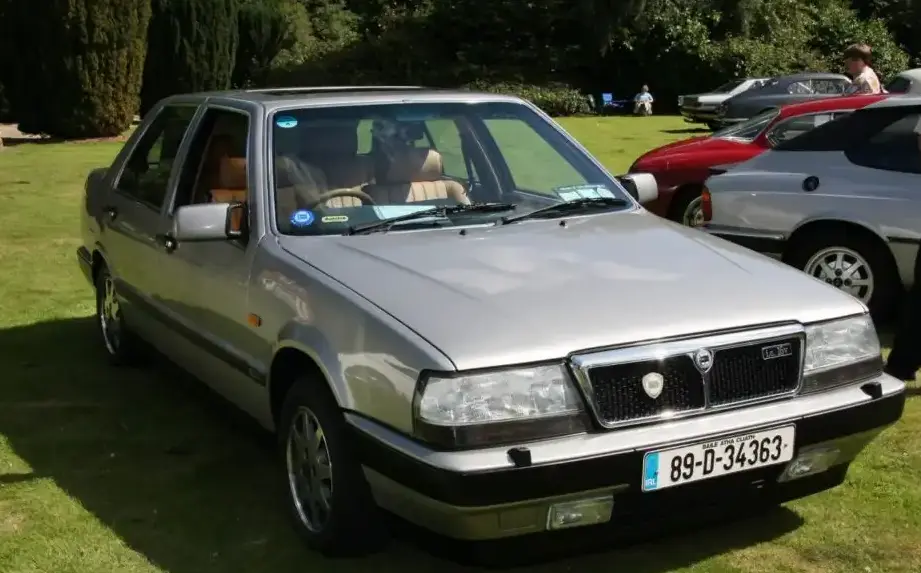
The Lancia Thema (834) 2000 i.e., produced between 1986 and 1988, represents a significant iteration of Lancia’s flagship sedan. Positioned as a mid-range offering within the 834 series, it aimed to balance performance and fuel efficiency for the discerning European driver. The Thema, launched in 1984, was Lancia’s answer to the executive sedan market, sharing its Type Four platform with the Fiat Croma, Alfa Romeo 164, and Saab 9000. The 2000 i.e. variant, with its 113 horsepower engine, offered a step up from the base models while remaining more accessible than the more powerful V6 options.
Technical Specifications
| Brand | Lancia |
| Model | Thema |
| Generation | Thema (834) |
| Type (Engine) | 2000 i.e. (113 Hp) |
| Start of production | 1986 |
| End of production | 1988 |
| Powertrain Architecture | Internal Combustion engine |
| Body type | Sedan |
| Fuel Type | Petrol (Gasoline) |
| Power | 113 Hp |
| Engine Model/Code | 834 B.048 |
| Engine aspiration | Naturally aspirated engine |
| Engine oil capacity | 5.5 l (5.81 US qt | 4.84 UK qt) |
| Coolant capacity | 9 l (9.51 US qt | 7.92 UK qt) |
Powertrain & Engine Architecture
The heart of the Thema 2000 i.e. is the 834 B.048, a 1995cc (approximately 2.0 liters) inline-four cylinder engine. This engine is a naturally aspirated unit, meaning it doesn’t employ forced induction like a turbocharger or supercharger. It features a cast iron block and an aluminum cylinder head, a common configuration for engines of this era aiming for a balance of durability and weight reduction. Fuel delivery is managed by Bosch Motronic fuel injection, a sophisticated system for the time that allowed for precise control of the air-fuel mixture, improving both performance and emissions. The engine utilizes a single overhead camshaft (SOHC) valvetrain, operating two valves per cylinder. This configuration, while not as high-revving as a dual overhead cam (DOHC) design, provided a good compromise between simplicity, reliability, and adequate power output. The engine’s 113 horsepower at 5800 rpm and 137 Nm (101 lb-ft) of torque at 3800 rpm were respectable figures for a 2.0-liter engine in the mid-1980s. The engine was typically paired with a four-speed automatic transmission, although a five-speed manual was also available, offering drivers a choice based on their preference for convenience or control.
Driving Characteristics
The Thema 2000 i.e. with the automatic transmission offered a comfortable and refined driving experience, typical of grand touring sedans of the period. Acceleration was adequate, with a 0-60 mph time estimated around 11-12 seconds. While not a sports car, the engine provided sufficient power for effortless cruising on highways and smooth overtaking maneuvers. The automatic transmission, while providing convenience, did slightly diminish the engine’s responsiveness compared to the manual version. Gear ratios were tuned for fuel efficiency and comfortable cruising, rather than outright performance. The automatic transmission’s shift points were generally smooth, but could feel somewhat hesitant during quick acceleration. Compared to the Thema 2.0 i.e. with a manual gearbox, the automatic version sacrificed some agility and driver engagement. The higher-spec V6 models, with significantly more power, offered a dramatically different driving experience, prioritizing performance over fuel economy. The 2000 i.e. aimed for a sweet spot, providing a balance between the two.
Equipment & Trim Levels
The Thema 2000 i.e. was generally well-equipped for its time, reflecting Lancia’s reputation for providing a luxurious experience. Standard features typically included central locking, electric windows, power steering, and a decent audio system. Interior upholstery was usually cloth, although leather options were available as upgrades. The dashboard layout was functional and ergonomically designed, with clear instrumentation. Optional extras included air conditioning, a sunroof, and upgraded sound systems. The trim level of the 2000 i.e. sat between the base models and the more luxurious V6 variants. It offered a step up in terms of features and refinement compared to the entry-level Thema, but didn’t quite reach the level of opulence found in the top-of-the-line models. The exterior styling was understated and elegant, with clean lines and a relatively conservative design.
Chassis & Braking
The Thema 834 utilized an independent suspension system all around, featuring MacPherson struts at the front and semi-trailing arms at the rear. This setup provided a comfortable ride and good handling characteristics. The chassis was relatively lightweight, contributing to the car’s overall agility. Braking was initially equipped with front disc brakes and rear drum brakes on the base models. However, the 2000 i.e. and higher trims typically featured disc brakes on all four wheels, providing improved stopping power and fade resistance. Anti-lock braking system (ABS) was available as an optional extra, further enhancing safety. Stabilizer bars were fitted to both the front and rear axles, helping to reduce body roll during cornering. The steering was power-assisted, making it easy to maneuver at low speeds.
Market Reception & Comparison
The Lancia Thema 2000 i.e. was generally well-received by automotive critics. It was praised for its comfortable ride, refined interior, and decent performance. However, some critics noted that the engine lacked the punch of the V6 models. Fuel economy was considered reasonable for a car of its size and class, averaging around 25-30 mpg. Compared to its rivals, such as the BMW 5 Series and Mercedes-Benz E-Class, the Thema offered a more affordable alternative with a distinctive Italian flair. The Thema 2000 i.e. was often seen as a more practical and sensible choice than the more expensive and performance-oriented V6 variants. Reliability was generally good, although some owners reported issues with the Bosch Motronic fuel injection system. Maintenance costs were comparable to other European sedans of the period.
Legacy
The Lancia Thema 2000 i.e. remains a fondly remembered classic among enthusiasts. The 834 B.048 engine, while not particularly powerful by modern standards, proved to be relatively durable and reliable. Today, well-maintained examples are becoming increasingly collectible. The Thema’s innovative design and comfortable ride continue to appeal to those seeking a classic Italian sedan. Parts availability can be a challenge, as the car is no longer in production, but a dedicated community of owners and specialists exists to support the preservation of these vehicles. The Thema 2000 i.e. represents a high point in Lancia’s history, showcasing the brand’s commitment to engineering excellence and elegant design. Its blend of comfort, refinement, and reasonable performance makes it a desirable classic for those seeking a taste of Italian automotive heritage.
