
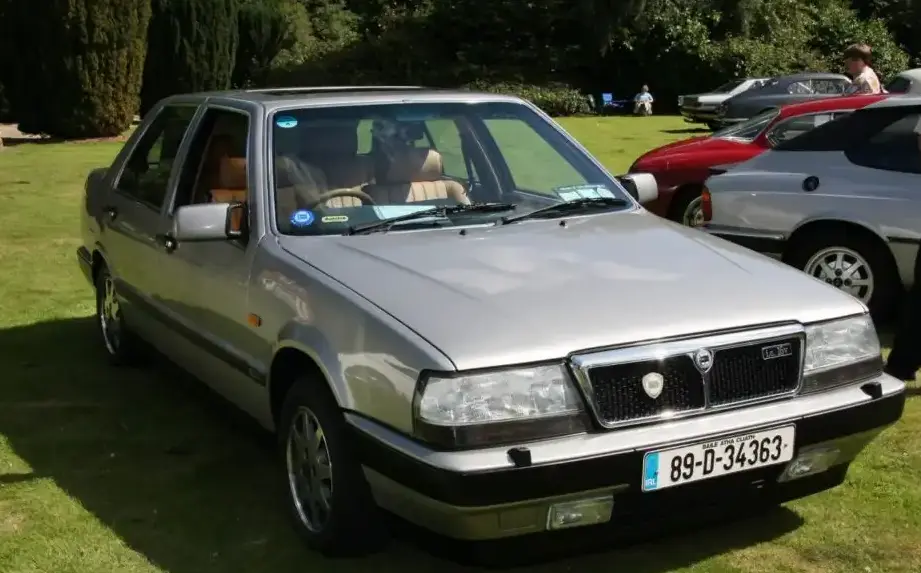
The Lancia Thema (834) 2000 i.e., produced between 1992 and 1994, represents a late iteration of the second-generation Thema, a flagship sedan intended to compete with executive cars from German manufacturers. This variant, powered by a 2.0-liter inline-four engine producing 115 horsepower, occupied a middle ground in the Thema lineup, offering a balance between performance and affordability. It was positioned below the more powerful 2.0 Turbo and V6 models, and aimed at buyers seeking a comfortable and refined driving experience without the higher price tag associated with the range-topping trims. The 834 series Thema, launched in 1988, was a significant departure from its predecessor, featuring a more modern design and advanced technology for its time.
Technical Specifications
| Brand | Lancia |
| Model | Thema |
| Generation | Thema (834) |
| Type (Engine) | 2000 i.e. (115 Hp) |
| Start of production | 1992 |
| End of production | 1994 |
| Powertrain Architecture | Internal Combustion engine |
| Body type | Sedan |
| Fuel Type | Petrol (Gasoline) |
| Power | 115 Hp |
| Engine Model/Code | 834 B.146 |
| Engine aspiration | Naturally aspirated engine |
| Engine oil capacity | 5.5 l (5.81 US qt | 4.84 UK qt) |
| Coolant capacity | 8.2 l (8.66 US qt | 7.21 UK qt) |
Powertrain & Engine Architecture
The heart of the Thema 2000 i.e. is the 834 B.146 engine, a 1995cc inline-four cylinder unit. This engine is a naturally aspirated design, utilizing a Bosch Motronic fuel injection system for precise fuel delivery. The engine features a single overhead camshaft (SOHC) valvetrain with two valves per cylinder. While not a particularly high-revving engine, it delivers a respectable amount of torque for everyday driving. The 115 horsepower output is achieved at 5500 rpm, while peak torque of approximately 137 lb-ft (186 Nm) arrives at 3500 rpm. The engine’s design prioritized smoothness and reliability over outright performance. The Thema 2000 i.e. was typically paired with a four-speed automatic transmission, although a five-speed manual was available in some markets. The automatic transmission, while providing convenience, was known for its somewhat conservative shift programming, prioritizing fuel economy and comfort over sporty acceleration.
Driving Characteristics
The driving experience in the Thema 2000 i.e. is best described as comfortable and refined. The 115 hp engine provides adequate power for cruising on highways and navigating city streets, but it doesn’t offer the brisk acceleration of the turbocharged or V6 variants. The automatic transmission contributes to a relaxed driving style, with smooth gear changes. However, downshifts can be slow and hesitant, particularly when attempting to overtake. The gear ratios are tuned for fuel efficiency, meaning the engine often operates at lower rpm ranges. Compared to the manual transmission version, the automatic results in a slight performance decrease due to the transmission’s inherent power loss. The Thema’s independent suspension, featuring MacPherson struts at the front and semi-trailing arms at the rear, provides a comfortable ride, absorbing bumps and imperfections in the road surface effectively. Steering is power-assisted, offering a light and easy feel, but lacks the precision and feedback of more sporty sedans.
Equipment & Trim Levels
The Thema 2000 i.e. typically came equipped with a reasonable level of standard features, reflecting its positioning as a mid-range model. Standard equipment generally included power windows, central locking, power steering, and air conditioning. Interior upholstery was typically cloth, although leather options were available. The dashboard layout is functional and straightforward, with clearly labeled controls. Optional extras included a sunroof, upgraded audio system, and alloy wheels. Higher trim levels, often denoted by specific packages, could add features such as heated seats, automatic climate control, and a more luxurious interior trim. The Thema’s interior was known for its spaciousness, offering ample legroom and headroom for both front and rear passengers.
Chassis & Braking
The Thema 834 chassis is a monocoque construction, providing a solid and rigid platform. The front suspension utilizes MacPherson struts with an anti-roll bar, while the rear suspension employs a semi-trailing arm setup. Braking on the Thema 2000 i.e. typically consisted of disc brakes at the front and drum brakes at the rear. Anti-lock braking system (ABS) was often an optional extra, enhancing safety by preventing wheel lockup during hard braking. The steering system is a power-assisted rack and pinion setup, providing a relatively light and responsive feel. The Thema’s suspension tuning prioritizes comfort over handling, resulting in a slightly softer and more forgiving ride. Stabilizer bar thickness was moderate, contributing to reduced body roll during cornering, but not offering the same level of control as more performance-oriented vehicles.
Market Reception & Comparison
The Lancia Thema 2000 i.e. received mixed reviews from automotive critics. While praised for its comfortable ride, spacious interior, and refined driving experience, it was often criticized for its relatively modest performance compared to its rivals. Compared to the Thema 2.0 Turbo and V6 models, the 2000 i.e. offered significantly less power and acceleration. However, it was more fuel-efficient and less expensive to maintain. Against competitors such as the BMW 5 Series, Mercedes-Benz E-Class, and Audi 100, the Thema 2000 i.e. offered a compelling value proposition, providing a similar level of comfort and refinement at a lower price point. Fuel economy was respectable for its time, averaging around 22-26 mpg in mixed driving conditions. Reliability was generally good, although some owners reported issues with the Bosch Motronic fuel injection system and the automatic transmission.
Legacy
The Lancia Thema 2000 i.e. represents a transitional period for the brand, bridging the gap between traditional Italian luxury and the increasing demands for modern technology and efficiency. While not as iconic as some of Lancia’s earlier models, it remains a well-regarded classic among enthusiasts. The 834 B.146 engine, while not particularly groundbreaking, proved to be a durable and reliable powerplant. Today, the Thema 2000 i.e. is a relatively rare sight on the roads, and well-maintained examples are becoming increasingly collectible. The automatic transmission, while not known for its sportiness, has proven to be reasonably durable with proper maintenance. Parts availability can be a challenge, as the Thema is no longer in production, but a dedicated community of enthusiasts continues to support the model, ensuring its survival for years to come. The car’s blend of Italian style, comfort, and relative affordability has secured it a niche following among those seeking a distinctive and classic European sedan.
