
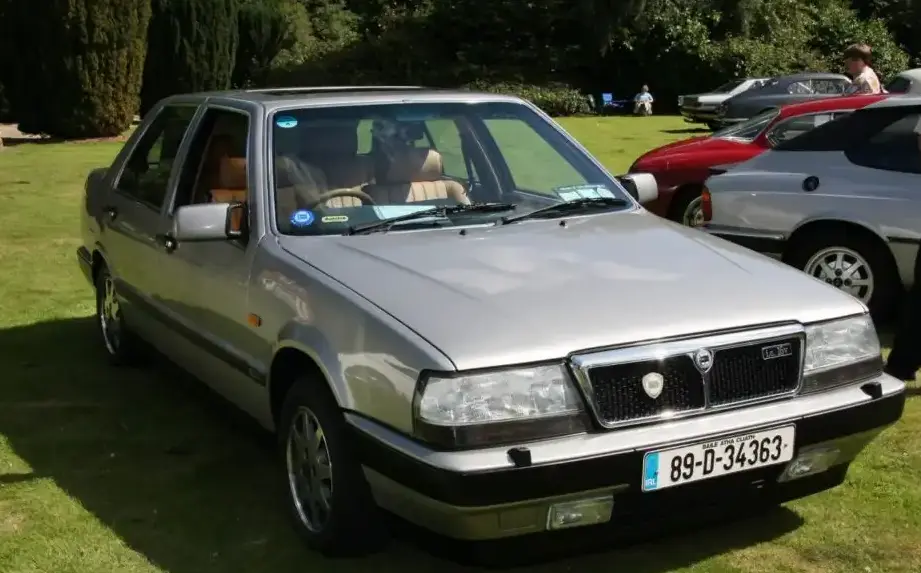
The Lancia Thema (834) 2000 i.e., produced between 1984 and 1988, represented a significant offering in the upper-midsize segment for the Italian automaker. Positioned as a more accessible entry point into the Thema range, the 2000 i.e. utilized a 2.0-liter inline-four engine producing 120 horsepower. It was a key variant within the 834 series, which was Lancia’s replacement for the aging Aurelia and aimed to compete with vehicles like the BMW 5 Series, Mercedes-Benz E-Class, and Audi 100. The Thema, designed by Giorgetto Giugiaro, was notable for its aerodynamic styling and spacious interior, and it played a crucial role in re-establishing Lancia as a maker of sophisticated, modern automobiles.
Technical Specifications
| Brand | Lancia |
| Model | Thema |
| Generation | Thema (834) |
| Type (Engine) | 2000 i.e. (120 Hp) |
| Start of production | 1984 |
| End of production | 1988 |
| Powertrain Architecture | Internal Combustion engine |
| Body type | Sedan |
| Seats | 5 |
| Doors | 4 |
| Fuel consumption (urban) | 9.8 l/100 km (24 US mpg, 28.8 UK mpg, 10.2 km/l) |
| Fuel consumption (extra urban) | 6.5 l/100 km (36.2 US mpg, 43.5 UK mpg, 15.4 km/l) |
| Fuel consumption (combined) | 8.4 l/100 km (28 US mpg, 33.6 UK mpg, 11.9 km/l) |
| Fuel Type | Petrol (Gasoline) |
| Acceleration 0 – 100 km/h | 10.5 sec |
| Acceleration 0 – 62 mph | 10.5 sec |
| Acceleration 0 – 60 mph | 10 sec |
| Maximum speed | 195 km/h (121.17 mph) |
| Weight-to-power ratio | 10.3 kg/Hp, 97.6 Hp/tonne |
| Weight-to-torque ratio | 7.5 kg/Nm, 134.1 Nm/tonne |
| Power | 120 Hp @ 5250 rpm |
| Power per litre | 60.2 Hp/l |
| Torque | 165 Nm @ 3300 rpm (121.7 lb.-ft. @ 3300 rpm) |
| Engine layout | Front, Transverse |
| Engine Model/Code | 834 B.000 |
| Engine displacement | 1995 cm3 (121.74 cu. in.) |
| Number of cylinders | 4 |
| Engine configuration | Inline |
| Cylinder Bore | 84 mm (3.31 in.) |
| Piston Stroke | 90 mm (3.54 in.) |
| Compression ratio | 9.5:1 |
| Number of valves per cylinder | 2 |
| Fuel injection system | Multi-port manifold injection |
| Engine aspiration | Naturally aspirated engine |
| Engine oil capacity | 5.5 l (5.81 US qt | 4.84 UK qt) |
| Coolant capacity | 9 l (9.51 US qt | 7.92 UK qt) |
| Kerb Weight | 1230 kg (2711.69 lbs.) |
| Max. weight | 1730 kg (3814 lbs.) |
| Max load | 500 kg (1102.31 lbs.) |
| Trunk (boot) space – minimum | 440 l (15.54 cu. ft.) |
| Trunk (boot) space – maximum | 1000 l (35.31 cu. ft.) |
| Fuel tank capacity | 70 l (18.49 US gal | 15.4 UK gal) |
| Length | 4590 mm (180.71 in.) |
| Width | 1750 mm (68.9 in.) |
| Height | 1435 mm (56.5 in.) |
| Wheelbase | 2660 mm (104.72 in.) |
| Front track | 1480 mm (58.27 in.) |
| Rear track | 1470 mm (57.87 in.) |
| Drivetrain Architecture | Front wheel drive |
| Number of gears | 5 |
| Gearbox type | Manual transmission |
| Front suspension | Coil spring |
| Rear suspension | Coil spring |
| Front brakes | Disc |
| Rear brakes | Disc |
| Assisting systems | ABS (Anti-lock braking system) |
| Steering type | Steering rack and pinion |
| Power steering | Hydraulic |
| Tires size | 175/70 R14 |
Powertrain & Engine Architecture
The heart of the Thema 2000 i.e. was the 834 B.000 engine, a 1995cc inline-four cylinder gasoline engine. This engine featured a cast iron block and an aluminum cylinder head, employing a belt-driven single overhead camshaft (SOHC) valvetrain with two valves per cylinder. Fuel delivery was managed by Bosch multi-port fuel injection, a relatively advanced system for its time, contributing to improved fuel efficiency and smoother operation compared to carbureted engines. The engine’s 9.5:1 compression ratio helped extract a respectable 120 horsepower at 5250 rpm and 165 Nm (121.7 lb-ft) of torque at 3300 rpm. The engine was transversely mounted, driving the front wheels. The Thema 2000 i.e. was exclusively offered with a five-speed manual transmission, providing drivers with direct control over the engine’s power band.
Driving Characteristics
The 2000 i.e. offered a balanced driving experience, prioritizing comfort and usability over outright performance. Acceleration from 0 to 60 mph took around 10 seconds, and top speed was approximately 121 mph. While not a sports car, the engine provided adequate power for everyday driving and highway cruising. The five-speed manual transmission allowed drivers to keep the engine in its optimal power range, but the relatively long gearing emphasized fuel economy over rapid acceleration. Compared to the more powerful Thema 2.0 Turbo or the diesel-powered versions, the 2000 i.e. felt less urgent, but it offered a more refined and predictable driving experience. The front-wheel-drive layout provided good traction in most conditions, but could exhibit some understeer when pushed hard.
Equipment & Trim Levels
The Thema 2000 i.e. was generally well-equipped for its price point. Standard features typically included power steering, central locking, electric windows, and a basic stereo system. Interior upholstery was usually cloth, with options for upgraded velour or leather available. The dashboard layout was functional and ergonomically designed, with clear instrumentation. Optional extras included air conditioning, a sunroof, and upgraded sound systems. The Thema aimed for a premium feel, with attention paid to interior materials and build quality. The 2000 i.e. served as the entry-level trim, offering a good balance of features and affordability.
Chassis & Braking
The Thema 834 featured an independent suspension setup at all four wheels, utilizing coil springs and telescopic shock absorbers. The front suspension employed MacPherson struts, while the rear used a semi-trailing arm configuration. This setup provided a comfortable ride and good handling characteristics. Braking was handled by disc brakes on all four wheels, with ABS (Anti-lock Braking System) becoming increasingly common as an option, and later standard equipment. The steering was a rack-and-pinion system with hydraulic power assistance, providing precise and responsive steering feel. The 175/70 R14 tires offered a good compromise between comfort and grip.
Market Reception & Comparison
The Lancia Thema 2000 i.e. was generally well-received by automotive critics. It was praised for its spacious interior, comfortable ride, and aerodynamic styling. However, some critics noted that the engine lacked the punch of its turbocharged counterparts. Fuel economy was considered respectable for a vehicle of its size and class, averaging around 28 US mpg on the combined cycle. Compared to the Thema 2.0 Turbo, the 2000 i.e. offered lower running costs and a more relaxed driving experience, making it a popular choice for drivers who prioritized comfort and practicality. The diesel versions offered even better fuel economy, but at the expense of performance.
Legacy
The Lancia Thema 834, including the 2000 i.e. variant, represents a high point in Lancia’s engineering and design history. While the Thema itself was eventually replaced, the 834 platform continued to underpin other vehicles, including the Saab 9000 and the Alfa Romeo 164. The 834 B.000 engine proved to be a relatively reliable unit, although regular maintenance is essential to prevent issues such as oil leaks and timing belt failure. Today, the Thema 2000 i.e. is a sought-after classic car, appreciated by enthusiasts for its distinctive styling, comfortable ride, and Italian flair. Finding well-maintained examples can be challenging, but the Thema 2000 i.e. offers a unique and rewarding driving experience for those willing to invest in its upkeep.
