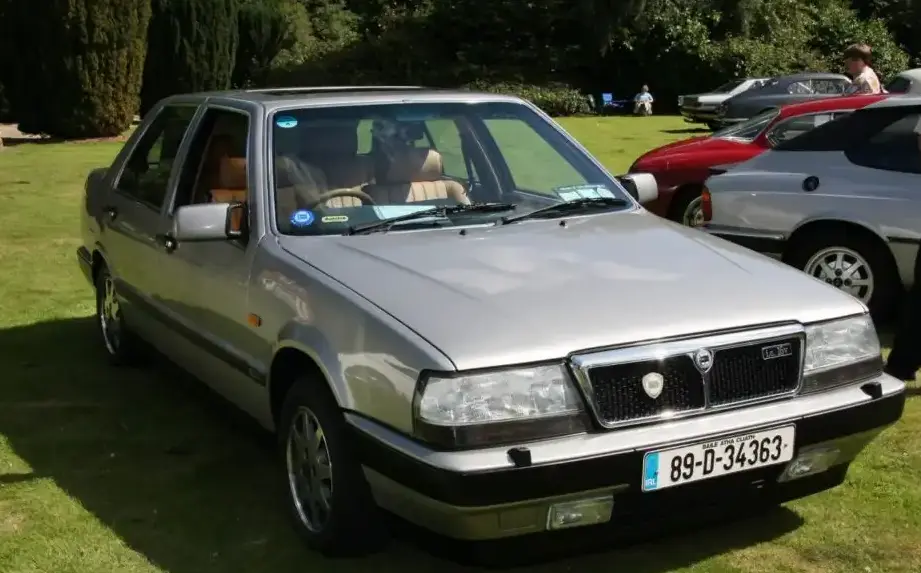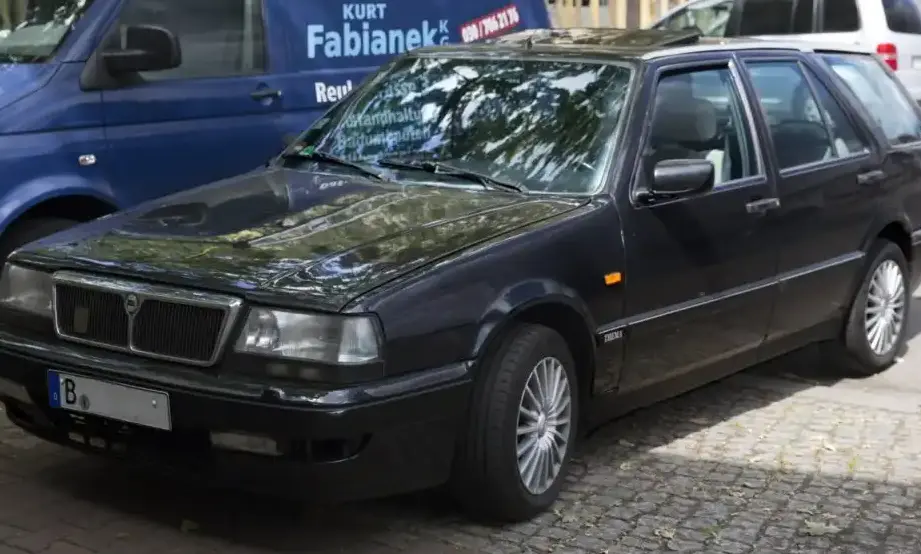
The Lancia Thema Station Wagon (834) 2000 Turbo 16V, produced between 1992 and 1994, represents a high-performance variant of the Thema estate. Positioned as the flagship of the Thema wagon range, it combined the practicality of a station wagon with the potent engine derived from Lancia’s rally heritage. This model was part of the second-generation Thema (834 series), which was notable for its advanced engineering and luxurious appointments, sharing its platform with the Saab 9000, Fiat Croma, and Alfa Romeo 164. The 2000 Turbo 16V offered a significant performance upgrade over the naturally aspirated engines available in the Thema lineup, appealing to buyers seeking a refined yet spirited driving experience.
Technical Specifications
| Brand | Lancia |
| Model | Thema |
| Generation | Thema Station Wagon (834) |
| Type (Engine) | 2000 Turbo 16V (201 Hp) |
| Start of production | 1992 |
| End of production | 1994 |
| Powertrain Architecture | Internal Combustion engine |
| Body type | Station wagon (estate) |
| Fuel Type | Petrol (Gasoline) |
| Power | 201 Hp |
| Engine Model/Code | 834 F2.000 |
| Engine aspiration | Turbocharger |
| Engine oil capacity | 5.5 l (5.81 US qt | 4.84 UK qt) |
| Coolant capacity | 8.2 l (8.66 US qt | 7.21 UK qt) |
Powertrain & Engine Architecture
The heart of the Thema 2000 Turbo 16V is the 834 F2.000 engine, a 1995cc, inline-four cylinder powerplant. This engine is a direct descendant of the units used in Lancia’s successful Group A rally cars of the 1980s, albeit in a more refined and detuned state for road use. The “16V” designation refers to the dual overhead camshafts (DOHC) operating four valves per cylinder, enhancing breathing and overall efficiency. A key feature is the Garrett T25 turbocharger with an intercooler, providing significant boost to increase power output. Fuel delivery is managed by Bosch Motronic electronic fuel injection, optimizing the air-fuel mixture for performance and emissions. The engine utilizes a cast iron block and an aluminum cylinder head, a common configuration for durability and weight reduction. The engine’s compression ratio is 8.8:1. While specific torque figures varied slightly depending on market and testing conditions, the engine typically produced around 220 lb-ft of torque.
Driving Characteristics
The Thema 2000 Turbo 16V offered a noticeably different driving experience compared to the lower-spec Thema wagons. The turbocharger provides a surge of power in the mid-range, resulting in strong acceleration. While not a sports car, the Thema Turbo could achieve 0-60 mph times in the low 7-second range, making it one of the quicker station wagons of its era. The engine is relatively smooth and refined, with minimal turbo lag. The Thema’s independent suspension, featuring MacPherson struts at the front and semi-trailing arms at the rear, contributes to a comfortable ride, even when pushed. The steering is precise, though it lacks the feedback of more modern systems. The Thema’s weight, approximately 3,500 lbs, is noticeable, but the turbo engine provides ample power to overcome this.
Equipment & Trim Levels
The 2000 Turbo 16V was typically the highest trim level available for the Thema wagon. Standard equipment included leather upholstery, power windows, power locks, central locking, and an upgraded sound system. Air conditioning was also standard. Many examples were equipped with optional features such as a sunroof, heated front seats, and a more advanced audio system. The interior design was characterized by its Italian flair, with a focus on comfort and aesthetics. The dashboard featured wood trim and a comprehensive instrument cluster. The Thema’s interior space was generous, offering ample room for passengers and cargo. The rear seats could be folded down to increase cargo capacity further.
Chassis & Braking
The Thema Station Wagon utilized a robust chassis designed for both comfort and handling. The suspension system, as mentioned, employed MacPherson struts at the front and semi-trailing arms at the rear. Stabilizer bars were fitted to both axles to reduce body roll during cornering. Braking duties were handled by ventilated disc brakes at the front and solid disc brakes at the rear. Anti-lock braking system (ABS) was standard on the 2000 Turbo 16V, enhancing safety and control. The Thema’s steering system was a power-assisted rack-and-pinion setup, providing precise and responsive steering. The wheel size was typically 15 inches, with tires optimized for both grip and ride comfort.
Market Reception & Comparison
The Lancia Thema 2000 Turbo 16V was generally well-received by automotive critics. It was praised for its powerful engine, comfortable ride, and luxurious interior. However, some critics noted the Thema’s relatively high price and its complex electronics, which could be prone to failure. Compared to other performance wagons of the time, such as the Volvo 850 T-5 or the Audi 80 Quattro, the Thema offered a more distinctive and luxurious experience. The Thema’s fuel economy was reasonable for a turbocharged engine of its size, averaging around 22-25 mpg in mixed driving. Reliability was a concern for some owners, with reports of issues related to the turbocharger, fuel injection system, and electrical components. However, with proper maintenance, the Thema Turbo could be a reliable and enjoyable vehicle.
Legacy
The Lancia Thema 2000 Turbo 16V remains a relatively rare and sought-after vehicle among enthusiasts. Its combination of performance, luxury, and Italian styling has earned it a cult following. Today, well-maintained examples command a premium in the used car market. The Thema Turbo’s engine, while complex, is considered a robust and capable unit when properly cared for. Parts availability can be a challenge, as many components are specific to the Thema and are no longer in production. However, a dedicated network of Lancia enthusiasts and specialists exists to provide support and assistance to owners. The Thema 2000 Turbo 16V represents a unique and memorable chapter in Lancia’s history, showcasing the brand’s engineering prowess and commitment to innovation.