
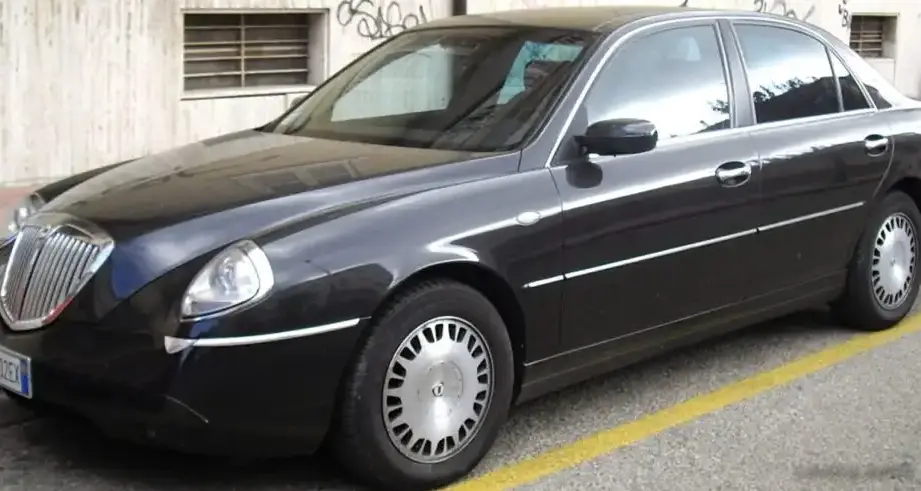
The Lancia Thesis 2.4 Multijet 20v Comfortronic, produced from December 2006 to June 2009, represented a sophisticated offering in the upper-midsize executive sedan segment. Positioned as a flagship model for the Lancia brand, the Thesis aimed to blend Italian style with advanced technology. This particular variant, powered by a 2.4-liter turbocharged diesel engine paired with a five-speed Comfortronic automatic transmission, occupied a middle ground within the Thesis lineup, offering a balance between performance, fuel efficiency, and comfort. It was primarily marketed in Europe, where Lancia maintained a stronger presence than in North America.
Technical Specifications
| Brand | Lancia |
| Model | Thesis |
| Generation | Thesis |
| Type (Engine) | 2.4 Multijet 20v (185 Hp) Comfortronic |
| Start of production | December, 2006 |
| End of production | June, 2009 |
| Powertrain Architecture | Internal Combustion engine |
| Body type | Sedan |
| Seats | 5 |
| Doors | 4 |
| Fuel consumption (urban) | 12.1 l/100 km (19.4 US mpg) |
| Fuel consumption (extra urban) | 6.9 l/100 km (34.1 US mpg) |
| Fuel consumption (combined) | 8.8 l/100 km (26.7 US mpg) |
| CO2 emissions | 234 g/km |
| Fuel Type | Diesel |
| Acceleration 0 – 100 km/h | 9.7 sec |
| Acceleration 0 – 62 mph | 9.7 sec |
| Acceleration 0 – 60 mph | 9.2 sec |
| Maximum speed | 220 km/h (136.7 mph) |
| Emission standard | Euro 4 |
| Weight-to-power ratio | 9.8 kg/Hp |
| Weight-to-torque ratio | 5.5 kg/Nm |
| Power | 185 Hp @ 4000 rpm |
| Torque | 330 Nm @ 1750 rpm (243.4 lb.-ft. @ 1750 rpm) |
| Engine layout | Front, Transverse |
| Engine Model/Code | 841H.000 |
| Engine displacement | 2387 cm3 (145.66 cu. in.) |
| Number of cylinders | 5 |
| Engine configuration | Inline |
| Compression ratio | 18.1:1 |
| Number of valves per cylinder | 4 |
| Fuel injection system | Diesel Commonrail |
| Engine aspiration | Turbocharger, Intercooler |
| Valvetrain | DOHC |
| Engine oil capacity | 5 l (5.28 US qt | 4.4 UK qt) |
| Coolant capacity | 8.6 l (9.09 US qt | 7.57 UK qt) |
| Kerb Weight | 1820 kg (4012.41 lbs.) |
| Max. weight | 2330 kg (5136.77 lbs.) |
| Max load | 510 kg (1124.36 lbs.) |
| Trunk (boot) space – minimum | 400 l (14.13 cu. ft.) |
| Fuel tank capacity | 75 l (19.81 US gal | 16.5 UK gal) |
| Max. roof load | 80 kg (176.37 lbs.) |
| Permitted trailer load with brakes (12%) | 1500 kg (3306.93 lbs.) |
| Permitted trailer load without brakes | 500 kg (1102.31 lbs.) |
| Permitted towbar download | 75 kg (165.35 lbs.) |
| Length | 4888 mm (192.44 in.) |
| Width | 1830 mm (72.05 in.) |
| Height | 1465 mm (57.68 in.) |
| Wheelbase | 2803 mm (110.35 in.) |
| Front track | 1569 mm (61.77 in.) |
| Rear track | 1541 mm (60.67 in.) |
| Minimum turning circle | 12.4 m (40.68 ft.) |
| Drivetrain | Front wheel drive |
| Number of gears | 5 |
| Gearbox type | Automatic transmission Comfortronic |
| Front suspension | Independent multi-link suspension, Transverse stabilizer |
| Rear suspension | Independent multi-link spring suspension with stabilizer |
| Front brakes | Ventilated discs, 305×28 mm |
| Rear brakes | Ventilated discs, 281×22 mm |
| Assisting systems | ABS (Anti-lock braking system) |
| Steering type | Steering rack and pinion |
| Power steering | Hydraulic Steering |
Powertrain & Engine Architecture
The heart of the Thesis 2.4 Multijet was the 841H.000 engine, a 2.4-liter inline-five cylinder diesel. This engine was a product of Fiat’s Multijet technology, a second-generation common rail direct injection system. The 20 valves (four per cylinder) and a double overhead camshaft (DOHC) configuration contributed to efficient combustion and power delivery. A turbocharger with an intercooler further boosted performance, allowing the engine to produce 185 horsepower at 4000 rpm and 330 Nm (243 lb-ft) of torque at a low 1750 rpm. The Comfortronic transmission was a five-speed automatic, offering a smoother driving experience than a manual gearbox, but generally at the expense of some performance and fuel economy. It featured manual shift capabilities, allowing drivers some control over gear selection.
Driving Characteristics
The 2.4 Multijet Comfortronic Thesis offered a comfortable and refined driving experience. While not overtly sporty, the engine provided adequate power for relaxed highway cruising and confident overtaking. The automatic transmission, while smooth, could feel somewhat hesitant during quick acceleration compared to the available manual transmission options. The gear ratios were tuned for fuel efficiency and comfort rather than outright performance. The inline-five engine provided a unique engine note, distinct from the more common four-cylinder diesels. The front-wheel-drive configuration offered predictable handling, but lacked the all-weather capability of an all-wheel-drive system.
Equipment & Trim Levels
The Thesis 2.4 Multijet Comfortronic typically came well-equipped, reflecting its positioning as a luxury sedan. Standard features included leather upholstery, automatic climate control, power-adjustable front seats, a premium audio system, and alloy wheels. Optional extras included a navigation system, sunroof, and upgraded leather trim. The interior design emphasized elegance and comfort, with high-quality materials and a spacious cabin. The dashboard layout was relatively conventional, prioritizing ease of use over cutting-edge design.
Chassis & Braking
The Thesis utilized an independent multi-link suspension system at both the front and rear, providing a comfortable ride and good handling characteristics. A transverse stabilizer bar was fitted to both axles to reduce body roll during cornering. Braking duties were handled by ventilated disc brakes on all four wheels, providing ample stopping power. An Anti-lock Braking System (ABS) was standard, enhancing safety and control during emergency braking situations. The suspension was tuned for comfort, prioritizing a smooth ride over sharp handling.
Market Reception & Comparison
The Lancia Thesis, in general, received mixed reviews. Critics praised its elegant styling, comfortable interior, and refined ride. However, it was often criticized for its relatively high price, limited brand recognition outside of Italy, and the sometimes-sluggish performance of the automatic transmission. Compared to other trims in the Thesis lineup, the 2.4 Multijet Comfortronic offered a good balance between performance and fuel economy. The more powerful 2.8 V6 petrol engine provided significantly more performance, but at the cost of increased fuel consumption. The 2.0 JTD diesel offered better fuel economy but less power. Reliability reports were mixed, with some owners reporting issues with the Comfortronic transmission and electronic systems.
Legacy
The Lancia Thesis, despite its limited sales success, remains a distinctive and interesting vehicle. The 2.4 Multijet engine proved to be relatively durable, although the Comfortronic transmission can be prone to issues if not properly maintained. Today, the Thesis is a relatively rare sight on the road, and well-maintained examples are becoming increasingly sought after by enthusiasts. The car represents a final flourish of Italian automotive design and engineering before Lancia’s product range was significantly scaled back. The 2.4 Multijet engine itself continued in use in other Fiat Group vehicles, demonstrating its versatility and reliability.
