
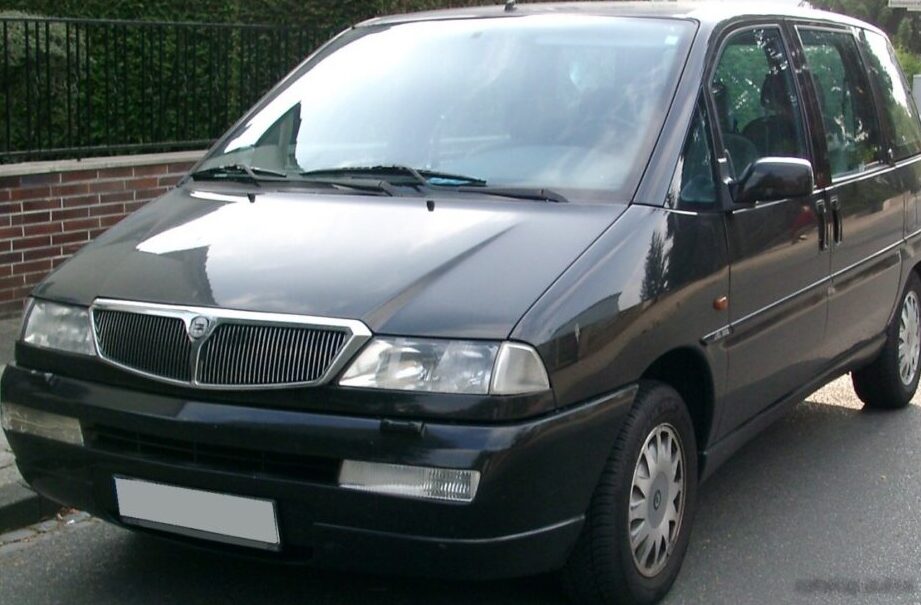
The Lancia Zeta 2.0 Turbo (designated “220” internally) was a performance-oriented variant of the Lancia Zeta minivan, produced between 1995 and 2000. Positioned as the top-of-the-line trim level, it offered a significant power upgrade over the base models, aiming to provide a more engaging driving experience within the practical confines of a seven-seat family vehicle. The Zeta, overall, represented Lancia’s attempt to enter the growing European minivan market, offering a blend of Italian styling and practicality. This particular 2.0 Turbo model was primarily sold in European markets, where it competed with vehicles like the Renault Espace and Citroën Evasion.
Technical Specifications
| Brand | Lancia |
| Model | Zeta |
| Generation | Zeta |
| Type (Engine) | 2.0 Turbo (220) (147 Hp) |
| Start of production | 1995 year |
| End of production | 2000 year |
| Powertrain Architecture | Internal Combustion engine |
| Body type | Minivan |
| Seats | 7 |
| Doors | 4 |
| Fuel consumption (economy) – urban | 14.8 l/100 km (15.9 US mpg, 19.1 UK mpg, 6.8 km/l) |
| Fuel consumption (economy) – extra urban | 9 l/100 km (26.1 US mpg, 31.4 UK mpg, 11.1 km/l) |
| Fuel Type | Petrol (Gasoline) |
| Acceleration 0 – 100 km/h | 10.1 sec |
| Acceleration 0 – 62 mph | 10.1 sec |
| Acceleration 0 – 60 mph | 9.6 sec |
| Maximum speed | 195 km/h (121.17 mph) |
| Weight-to-power ratio | 11.2 kg/Hp, 89.4 Hp/tonne |
| Weight-to-torque ratio | 7 kg/Nm, 142.9 Nm/tonne |
| Power | 147 Hp @ 5300 rpm |
| Power per litre | 73.6 Hp/l |
| Torque | 235 Nm @ 2500 rpm (173.33 lb.-ft. @ 2500 rpm) |
| Engine layout | Front, Transverse |
| Engine Model/Code | RGX XU10J2TE |
| Engine displacement | 1998 cm3 (121.93 cu. in.) |
| Number of cylinders | 4 |
| Engine configuration | Inline |
| Cylinder Bore | 86 mm (3.39 in.) |
| Piston Stroke | 86 mm (3.39 in.) |
| Compression ratio | 8.5:1 |
| Number of valves per cylinder | 2 |
| Fuel injection system | Multi-port manifold injection |
| Engine aspiration | Turbocharger |
| Valvetrain | OHC |
| Engine oil capacity | 5 l (5.28 US qt | 4.4 UK qt) |
| Coolant | 8.5 l (8.98 US qt | 7.48 UK qt) |
| Kerb Weight | 1645 kg (3626.6 lbs.) |
| Max. weight | 2340 kg (5158.82 lbs.) |
| Max load | 695 kg (1532.21 lbs.) |
| Trunk (boot) space – minimum | 1170 l (41.32 cu. ft.) |
| Trunk (boot) space – maximum | 2600 l (91.82 cu. ft.) |
| Fuel tank capacity | 80 l (21.13 US gal | 17.6 UK gal) |
| Length | 4454 mm (175.35 in.) |
| Width | 1834 mm (72.2 in.) |
| Height | 1714 mm (67.48 in.) |
| Wheelbase | 2824 mm (111.18 in.) |
| Front track | 1593 mm (62.72 in.) |
| Rear (Back) track | 1540 mm (60.63 in.) |
| Drivetrain Architecture | The Internal combustion engine (ICE) drives the front wheels of the vehicle. |
| Drive wheel | Front wheel drive |
| Number of gears and type of gearbox | 5 gears, manual transmission |
| Front suspension | Coil spring |
| Rear suspension | Coil spring |
| Front brakes | Ventilated discs |
| Rear brakes | Disc |
| Assisting systems | ABS (Anti-lock braking system) |
| Steering type | Steering rack and pinion |
| Power steering | Hydraulic Steering |
| Tires size | 205/65 R15 |
Powertrain & Engine Architecture
The heart of the Zeta 2.0 Turbo was the RGX XU10J2TE engine, a 1.998-liter, inline-four cylinder gasoline engine. This engine was sourced from Peugeot-Citroën-Renault (PCR) alliance, and was a common powerplant in various European vehicles of the era. The engine featured a single overhead camshaft (OHC) valvetrain with two valves per cylinder. Crucially, it was equipped with a turbocharger and multi-port fuel injection, allowing it to produce 147 horsepower at 5300 rpm and 235 Nm (173 lb-ft) of torque at 2500 rpm. The turbocharger provided a noticeable boost in power compared to the naturally aspirated engines available in other Zeta models. The engine’s relatively high compression ratio of 8.5:1 contributed to its performance. The Zeta 2.0 Turbo was exclusively offered with a five-speed manual transmission, designed to handle the increased power output.
Driving Characteristics
The 2.0 Turbo variant of the Lancia Zeta offered a distinctly different driving experience compared to the lower-powered models. The turbocharger provided a surge of acceleration, making overtaking and highway merging considerably easier. While not a sports car by any means, the 2.0 Turbo Zeta felt noticeably more responsive and capable. The five-speed manual transmission allowed drivers to effectively utilize the engine’s powerband. The gear ratios were well-suited for both city driving and highway cruising. Compared to the base 1.8-liter engine, the 2.0 Turbo offered a significant improvement in performance, reducing the 0-60 mph time to around 9.6 seconds and achieving a top speed of 195 km/h (121 mph). However, the added power did come at the cost of slightly increased fuel consumption.
Equipment & Trim Levels
The Zeta 2.0 Turbo “220” was the highest trim level available. Standard equipment included features such as air conditioning, power windows, central locking, and an upgraded audio system. Interior upholstery typically consisted of cloth or a combination of cloth and velour. Optional extras included leather upholstery, a sunroof, and alloy wheels. The dashboard layout was functional and ergonomically designed, with a focus on practicality. The 2.0 Turbo models often featured unique badging and exterior trim details to distinguish them from the lower trims.
Chassis & Braking
The Lancia Zeta featured a conventional front-wheel-drive layout with coil spring suspension at all four corners. The front suspension utilized MacPherson struts, while the rear suspension employed a twist beam setup. The 2.0 Turbo model benefited from slightly stiffer suspension components to better manage the increased power and weight. Braking duties were handled by ventilated discs at the front and solid discs at the rear. An anti-lock braking system (ABS) was standard equipment, enhancing safety and control. The steering system was a hydraulic power-assisted rack and pinion setup, providing precise and responsive steering feel.
Market Reception & Comparison
The Lancia Zeta 2.0 Turbo was generally well-received by automotive critics, who praised its performance and spacious interior. However, some reviewers noted that the minivan’s styling was somewhat conservative compared to its rivals. Compared to the base models, the 2.0 Turbo offered a significant improvement in driving enjoyment, but it also came with a higher price tag and slightly reduced fuel economy. The 2.0 Turbo was positioned as a competitor to other performance-oriented minivans, such as the Renault Espace Turbo and Citroën Evasion 2.0i. In terms of reliability, the Zeta 2.0 Turbo was generally considered to be reasonably dependable, although the turbocharger could be a potential source of issues if not properly maintained.
Legacy
The Lancia Zeta, while not a commercial blockbuster, remains a fondly remembered vehicle among enthusiasts. The 2.0 Turbo variant, in particular, is appreciated for its blend of practicality and performance. Today, the Zeta 2.0 Turbo is a relatively rare sight on the roads, and well-maintained examples are becoming increasingly collectible. The RGX XU10J2TE engine, while aging, is known for its durability and relatively straightforward maintenance. However, finding replacement parts can be challenging due to the vehicle’s age and limited production numbers. The Lancia Zeta 2.0 Turbo represents a unique chapter in Lancia’s history, showcasing the brand’s willingness to experiment with different vehicle segments and powertrain options.
