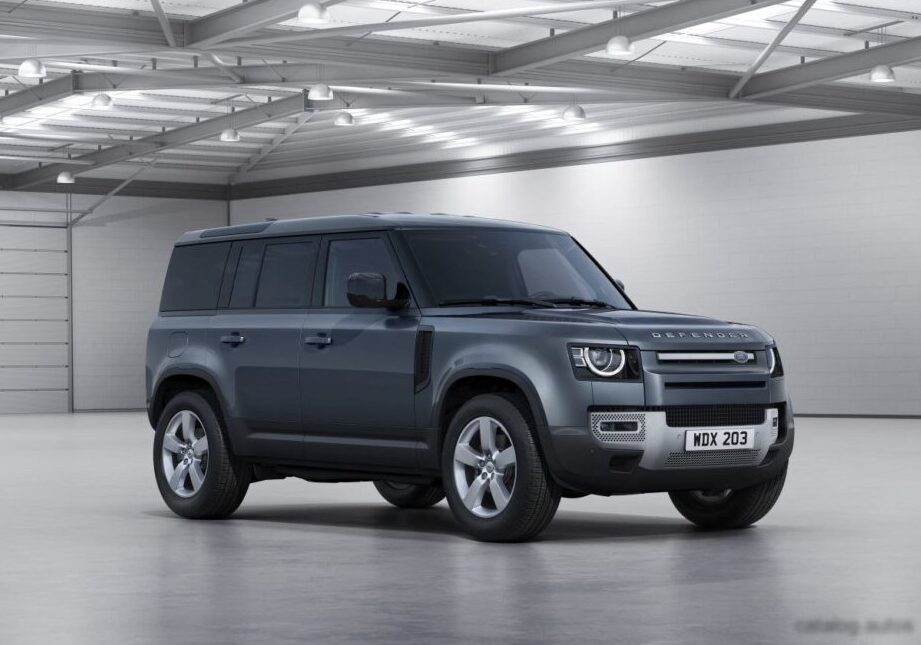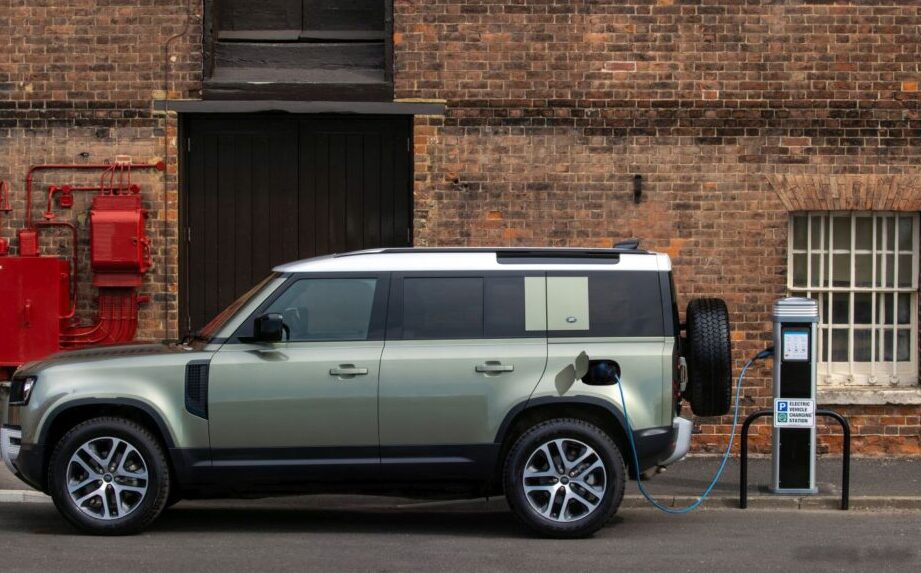
The Land Rover Defender 110 (L663) 2.0 P400e represents a significant step in the evolution of the iconic Defender, blending traditional off-road capability with modern plug-in hybrid technology. Introduced in September 2020 and produced through May 2024, this variant offered a compelling option for buyers seeking a balance between environmental responsibility and the rugged character synonymous with the Defender nameplate. It occupied a mid-to-upper position within the 110 lineup, offering a premium experience with enhanced efficiency.
Technical Specifications
| Brand | Land Rover |
| Model | Defender |
| Generation | Defender 110 (L663) |
| Type | 2.0 P400e (404 Hp) Plug-in Hybrid AWD Automatic 6 Seat |
| Start of production | September, 2020 |
| End of production | May, 2024 |
| Powertrain Architecture | PHEV (Plug-in Hybrid Electric Vehicle) |
| Body type | Off-road vehicle |
| Seats | 6 |
| Doors | 5 |
| Combined fuel consumption (WLTP) | 3.3-3.9 l/100 km (71.3 – 60.3 US mpg, 85.6 – 72.4 UK mpg, 30.3 – 25.6 km/l) |
| CO2 emissions (WLTP) | 75-89 g/km |
| Fuel consumption (NEDC, WLTP equivalent) | 2.8 l/100 km (84 US mpg, 100.9 UK mpg, 35.7 km/l) |
| CO2 emissions (NEDC, WLTP equivalent) | 64 g/km |
| Fuel Type | Petrol / electricity |
| Acceleration 0 – 100 km/h | 5.6 sec |
| Acceleration 0 – 62 mph | 5.6 sec |
| Acceleration 0 – 60 mph | 5.4 sec |
| Maximum speed | 191 km/h (118.68 mph) |
| Emission standard | Euro 6d-F |
| Weight-to-power ratio | 6.3 kg/Hp, 158.6 Hp/tonne |
| Weight-to-torque ratio | 4 kg/Nm, 251.2 Nm/tonne |
| Gross battery capacity | 19.2 kWh |
| Net (usable) battery capacity | 15.4 kWh |
| Battery technology | Lithium-ion (Li-Ion) |
| Battery location | Under the trunk |
| All-electric range (WLTP) | 40-43 km (24.85 – 26.72 mi) |
| All-electric range (NEDC, WLTP equivalent) | 53 km (32.93 mi) |
| Average Energy consumption (NEDC, WLTP equivalent) | 23.8-24.5 kWh/100 km (38.3 – 39.43 kWh/100 mi, 88 – 85 MPGe, 4.2 – 4.1 km/kWh, 2.6 – 2.5 mi/kWh) |
| Max speed (electric) | 140 km/h (86.99 mph) |
| Electric motor power | 143 Hp |
| Electric motor location | Between the combustion engine and the transmission |
| System power | 404 Hp @ 5500 rpm |
| System torque | 640 Nm @ 1500-4400 rpm (472.04 lb.-ft. @ 1500-4400 rpm) |
| Power | 300 Hp @ 5500 rpm |
| Power per litre | 150.2 Hp/l |
| Torque | 400 Nm (295.02 lb.-ft.) |
| Engine layout | Front, Longitudinal |
| Engine Model/Code | Ingenium / PT204 |
| Engine displacement | 1997 cm3 (121.86 cu. in.) |
| Number of cylinders | 4 |
| Engine configuration | Inline |
| Cylinder Bore | 83.01 mm (3.27 in.) |
| Piston Stroke | 92.28 mm (3.63 in.) |
| Compression ratio | 9.5:1 |
| Number of valves per cylinder | 4 |
| Fuel injection system | Direct injection |
| Engine aspiration | Twin-scroll turbo, Intercooler |
| Valvetrain | DOHC |
| Engine oil capacity | 7 l (7.4 US qt | 6.16 UK qt) |
| Coolant | 16.8 l (17.75 US qt | 14.78 UK qt) |
| Kerb Weight | 2548 kg (5617.38 lbs.) |
| Max. weight | 3320 kg (7319.35 lbs.) |
| Max load | 772 kg (1701.97 lbs.) |
| Trunk (boot) space – minimum | 853 l (30.12 cu. ft.) |
| Trunk (boot) space – maximum | 2127 l (75.11 cu. ft.) |
| Fuel tank capacity | 90 l (23.78 US gal | 19.8 UK gal) |
| Max. roof load | 100 kg (220.46 lbs.) |
| Permitted trailer load with brakes (12%) | 3000 kg (6613.87 lbs.) |
| Permitted trailer load without brakes | 750 kg (1653.47 lbs.) |
| Permitted towbar download | 150 kg (330.69 lbs.) |
| Length | 5018 mm (197.56 in.) |
| Width | 1996 mm (78.58 in.) |
| Width with mirrors folded | 2008 mm (79.06 in.) |
| Width including mirrors | 2105 mm (82.87 in.) |
| Height | 1967 mm (77.44 in.) |
| Wheelbase | 3022 mm (118.98 in.) |
| Front track | 1706 mm (67.17 in.) |
| Rear (Back) track | 1702 mm (67.01 in.) |
| Front overhang | 845 mm (33.27 in.) |
| Rear overhang | 1151 mm (45.31 in.) |
| Ride height (ground clearance) | 218-291 mm (8.58 – 11.46 in.) |
| Drag coefficient (Cd) | 0.39 |
| Minimum turning circle (turning diameter) | 13.1 m (42.98 ft.) |
| Approach angle | 30.1-37.5° |
| Departure angle | 37.7-40.0° |
| Ramp-over (brakeover) angle | 22-27.8° |
| Climb angle | 45° |
| Wading depth | 900 mm (35.43 in.) |
| Drivetrain Architecture | The Internal combustion engine (ICE) and the electric motor permanently drive the four wheels of the car with the ability to work in full electric or mixed mode. |
| Drive wheel | All wheel drive (4×4) |
| Number of gears and type of gearbox | 8 gears, automatic transmission |
| Front suspension | Double wishbone, Air suspension |
| Rear suspension | Independent multi-link suspension, Air suspension |
| Front brakes | Ventilated discs, 380 mm |
| Rear brakes | Ventilated discs, 365 mm |
| Assisting systems | ABS (Anti-lock braking system) |
| Steering type | Steering rack and pinion |
| Power steering | Electric Steering |
| Tires size | 255/60 R20 |
| Wheel rims size | 8.5J x 20 |
A New Era for the Defender
The L663 Defender marked a radical departure from its predecessors, moving away from the traditional body-on-frame construction to a more modern monocoque chassis. This change, while initially controversial among purists, allowed for significant improvements in refinement, on-road handling, and safety. The introduction of the P400e powertrain further modernized the Defender, aligning it with growing environmental concerns and tightening emissions regulations. The Defender 110, being the longer wheelbase version, offered increased passenger and cargo space, making it a practical choice for families and those requiring versatility.
Powertrain and Performance
At the heart of the 2.0 P400e lies a 2.0-liter turbocharged four-cylinder Ingenium engine paired with an electric motor integrated into the transmission. This combination delivers a total system output of 404 horsepower and 472 lb.-ft. of torque. The electric motor provides instant torque, enhancing acceleration and responsiveness, while the petrol engine offers extended range. The 15.4 kWh usable battery capacity allows for an all-electric range of between 24.85 and 26.72 miles (WLTP), sufficient for many daily commutes. Acceleration from 0 to 60 mph is achieved in a brisk 5.4 seconds, and the vehicle boasts a top speed of 118.68 mph. The eight-speed automatic transmission ensures smooth and efficient power delivery.
Positioning and Trim Levels
The 2.0 P400e sat comfortably within the mid-to-upper range of the Defender 110 lineup. It offered a more affordable entry point into the plug-in hybrid experience compared to the higher-powered six-cylinder options. It appealed to buyers who prioritized fuel efficiency and reduced emissions without sacrificing the Defender’s renowned off-road capability. Standard features typically included premium interior appointments, advanced driver-assistance systems, and a comprehensive infotainment system. The six-seat configuration was a popular choice, providing ample space for passengers and cargo.
Comparison with Other Variants
Compared to the other engine options available in the Defender 110, the 2.0 P400e offered a unique blend of performance and efficiency. The more powerful six-cylinder engines (P400 and P500) provided greater outright performance and a more traditional engine sound, but at the cost of increased fuel consumption. The diesel variants (D200 and D250) offered excellent fuel economy and torque, but lacked the electric driving capability of the P400e. Maintenance on the P400e, while potentially more complex due to the hybrid system, could be offset by lower fuel costs and potential government incentives. The target audience for the P400e was environmentally conscious buyers who still desired the ruggedness and versatility of the Defender.
Technology and Features
The Defender 110 P400e was equipped with a suite of advanced technologies, including Land Rover’s Terrain Response system, which allows drivers to optimize the vehicle’s settings for various off-road conditions. Air suspension provided adjustable ride height and enhanced comfort. The Pivi Pro infotainment system offered a user-friendly interface with smartphone integration and over-the-air software updates. Safety features included autonomous emergency braking, lane keep assist, and adaptive cruise control. The vehicle’s robust construction and advanced safety systems earned it high ratings in crash tests.
Legacy and Impact
The Land Rover Defender 110 2.0 P400e represents a pivotal moment in the Defender’s history. It demonstrated Land Rover’s commitment to sustainability and its ability to adapt to changing market demands. While the traditional Defender was celebrated for its simplicity and ruggedness, the L663 P400e proved that the iconic vehicle could evolve without losing its core identity. It paved the way for further electrification of the Defender lineup and solidified its position as a modern, versatile, and capable off-road vehicle.