Technical Specifications
| Brand | Land Rover |
| Model | Defender |
| Generation | Defender 110 (L663) |
| Type | 3.0 D200 (200 Hp) Mild Hybrid AWD Automatic 5+2 Seating |
| Start of production | September, 2020 |
| Powertrain Architecture | MHEV (Mild Hybrid Electric Vehicle) |
| Body type | Off-road vehicle |
| Seats | 7 |
| Doors | 5 |
| Combined fuel consumption (WLTP) | 8.9-9.5 l/100 km (26.4 – 24.8 US mpg, 31.7 – 29.7 UK mpg, 11.2 – 10.5 km/l) |
| CO2 emissions (WLTP) | 232-249 g/km |
| Fuel consumption (NEDC) | 7.6 l/100 km (30.9 US mpg, 37.2 UK mpg, 13.2 km/l) |
| CO2 emissions (NEDC) | 200 g/km |
| Fuel Type | Diesel |
| Acceleration 0 – 100 km/h | 10.2 sec |
| Acceleration 0 – 62 mph | 10.2 sec |
| Acceleration 0 – 60 mph | 9.5 sec |
| Maximum speed | 175 km/h (108.74 mph) |
| Emission standard | Euro 6d-F |
| Weight-to-power ratio | 12 kg/Hp, 83.5 Hp/tonne |
| Weight-to-torque ratio | 4.8 kg/Nm, 208.7 Nm/tonne |
| Power | 200 Hp @ 4000 rpm |
| Power per litre | 66.8 Hp/l |
| Torque | 500 Nm @ 1250-2500 rpm (368.78 lb.-ft. @ 1250-2500 rpm) |
| Engine Model/Code | Ingenium / DT306 |
| Engine displacement | 2996 cm3 (182.83 cu. in.) |
| Number of cylinders | 6 |
| Engine configuration | Inline |
| Cylinder Bore | 83 mm (3.27 in.) |
| Piston Stroke | 92.31 mm (3.63 in.) |
| Compression ratio | 15.5:1 |
| Number of valves per cylinder | 4 |
| Fuel injection system | Diesel Commonrail |
| Engine aspiration | Turbocharger, Intercooler |
| Engine oil capacity | 8.8 l (9.3 US qt | 7.74 UK qt) |
| Coolant capacity | 11.6 l (12.26 US qt | 10.21 UK qt) |
| Kerb Weight | 2396 kg (5282.28 lbs.) |
| Trunk (boot) space – minimum | 231 l (8.16 cu. ft.) |
| Trunk (boot) space – maximum | 2233 l (78.86 cu. ft.) |
| Fuel tank capacity | 89 l (23.51 US gal | 19.58 UK gal) |
| AdBlue tank capacity | 20.7 l (5.47 US gal | 4.55 UK gal) |
| Permitted trailer load with brakes (12%) | 3500 kg (7716.18 lbs.) |
| Permitted trailer load without brakes | 750 kg (1653.47 lbs.) |
| Length | 5018 mm (197.56 in.) |
| Width | 1996 mm (78.58 in.) |
| Width with mirrors folded | 2008 mm (79.06 in.) |
| Width including mirrors | 2105 mm (82.87 in.) |
| Height | 1967-1972 mm (77.44 – 77.64 in.) |
| Wheelbase | 3022 mm (118.98 in.) |
| Front track | 1701-1706 mm (66.97 – 67.17 in.) |
| Rear track | 1697-1702 mm (66.81 – 67.01 in.) |
| Front overhang | 845 mm (33.27 in.) |
| Rear overhang | 1151 mm (45.31 in.) |
| Ride height (ground clearance) | 218-291 mm (8.58 – 11.46 in.) |
| Drag coefficient (Cd) | 0.41 |
| Minimum turning circle | 13.1 m (42.98 ft.) |
| Approach angle | 30.1-37.5° |
| Departure angle | 37.7-40.0° |
| Ramp-over angle | 22-28° |
| Climb angle | 45° |
| Wading depth | 850-900 mm (33.46 – 35.43 in.) |
| Drivetrain Architecture | ICE and electric motor permanently drive all four wheels. |
| Drive wheel | All wheel drive (4×4) |
| Number of gears | 8 |
| Gearbox type | Automatic transmission |
| Front suspension | Double wishbone |
| Rear suspension | Independent multi-link suspension |
| Front brakes | Disc, 349-380 mm |
| Rear brakes | Disc, 325-365 mm |
| Steering type | Steering rack and pinion |
| Power steering | Electric |
| Tires size | 255/70 R18; 255/65 R19; 255/60 R20; 275/45 R22 |
| Wheel rims size | 8.0J x 18; 8.0J x 19; 8.5J x 20; 9.0J x 22 |
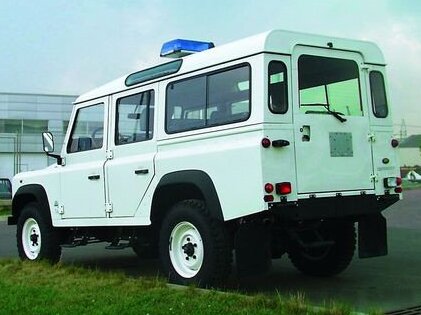
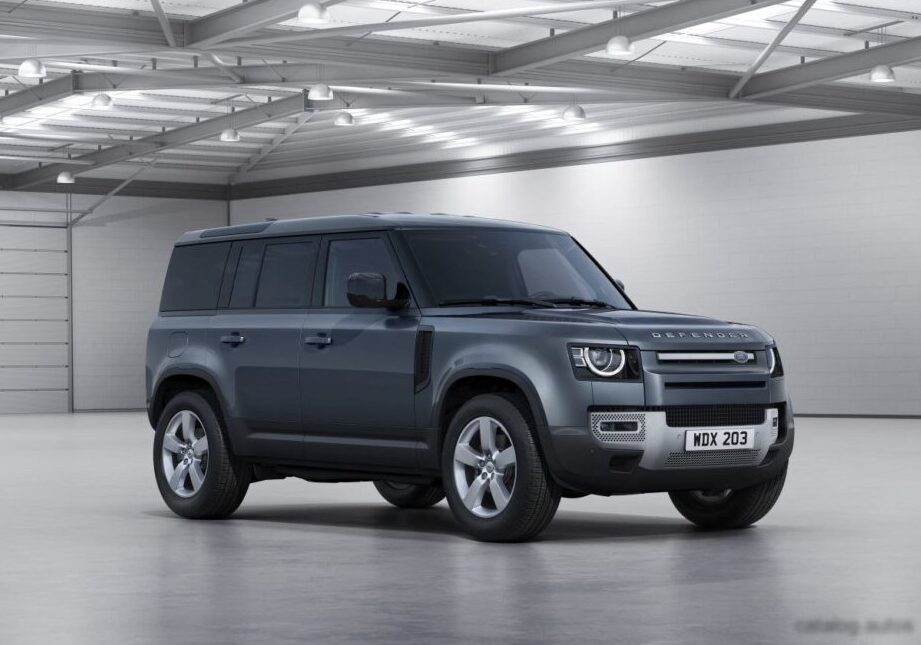
The Land Rover Defender 110 D200, introduced in 2020, signifies the return of the legendary Defender after a 23-year absence. This iteration represents a substantial departure from its predecessor, abandoning the traditional body-on-frame construction in favor of a monocoque chassis based on the Premium Lightweight Architecture (PLA) – a platform shared with other Jaguar Land Rover models. This new architecture enables enhanced refinement, improved on-road handling, and the integration of contemporary technologies. The D200 trim, equipped with a 3.0-liter Ingenium diesel engine and an eight-speed automatic transmission, is positioned to attract buyers who value practicality and fuel efficiency alongside the Defender’s celebrated off-road capabilities. The standard seven-seat configuration further enhances its versatility, making it suitable for larger families or groups.
Powertrain & Engine Architecture
The D200’s power comes from the Ingenium DT306 engine, a 2.996-liter inline-six cylinder diesel. This engine utilizes a single turbocharger and a sophisticated common-rail direct injection system, producing 200 horsepower at 4000 rpm and a robust 500 Nm (368 lb-ft) of torque between 1250 and 2500 rpm. A key feature is the 48-volt mild-hybrid system, incorporating a Belt-integrated Starter Generator (BSG) to provide a small power boost during acceleration and facilitate smoother start-stop functionality. This system also enables regenerative braking, recovering energy during deceleration to improve fuel economy. The eight-speed automatic transmission, sourced from ZF, is renowned for its smooth gear changes and wide range of ratios, contributing to both on-road comfort and off-road performance. The transmission’s programming prioritizes fuel efficiency during normal driving, but readily downshifts when increased power is demanded.
Driving Characteristics
The Defender 110 D200 delivers a composed and comfortable driving experience, especially on paved roads. While not as aggressively powerful as the higher-output engine options, the 200 hp diesel provides sufficient performance for daily commutes and highway travel. The eight-speed automatic transmission complements the engine’s torque curve, offering smooth and responsive shifts. The gear ratios are optimized for both fuel efficiency and off-road crawling. Compared to the more potent D300 or P400 variants, the D200 exhibits a less urgent acceleration, taking 10.2 seconds to reach 62 mph. However, the ample low-end torque allows it to confidently navigate challenging terrain. The mild-hybrid system provides a subtle but noticeable boost during acceleration, enhancing responsiveness.
Equipment & Trim Levels
The D200 trim generally includes a comprehensive suite of standard features. Interior appointments typically include leather upholstery, heated front seats, a touchscreen infotainment system with Apple CarPlay and Android Auto integration, and a range of driver-assistance technologies such as lane-keeping assist and emergency braking. Optional extras include a panoramic sunroof, a premium audio system, adaptive cruise control, and various off-road packages. The seven-seat configuration features a third-row of seats best suited for children or occasional passengers. The dashboard design is modern and minimalist, emphasizing functionality and durability.
Chassis & Braking
The Defender 110’s chassis is engineered to strike a balance between on-road comfort and off-road capability. It features a double-wishbone front suspension and an independent multi-link rear suspension. Air suspension is often included, allowing for adjustable ride height and improved off-road articulation. The braking system utilizes disc brakes on all four wheels, with larger rotors available on higher trim levels. ABS (Anti-lock Braking System) is standard, along with electronic stability control and traction control. The D200’s weight of approximately 2396 kg (5282 lbs) is effectively managed by the suspension and braking systems, providing confident handling and stopping power.
Market Reception & Comparison
The Land Rover Defender 110 D200 has received generally positive reviews, with critics praising its combination of practicality, capability, and refinement. Compared to the higher-output engine options, the D200 offers improved fuel economy, achieving between 8.9 and 9.5 l/100 km (26.4 – 24.8 US mpg). However, some reviewers have noted that the 200 hp engine can feel somewhat underpowered when fully loaded or tackling steep inclines. Compared to competitors such as the Jeep Grand Cherokee and Toyota Land Cruiser, the Defender 110 D200 offers a distinctive blend of modern technology, off-road prowess, and British design aesthetics.
Legacy
The Land Rover Defender 110 D200 represents a significant evolution for the Defender lineage, seamlessly integrating iconic design elements with contemporary technology and efficiency. While long-term reliability data is still being gathered, the Ingenium engine family has demonstrated a generally robust track record. The mild-hybrid system introduces added complexity, but also contributes to improved fuel economy and reduced emissions. In the used car market, the D200 is expected to maintain its value well, appealing to buyers seeking a versatile and capable all-terrain vehicle with a touch of luxury and the enduring appeal of the Defender nameplate.