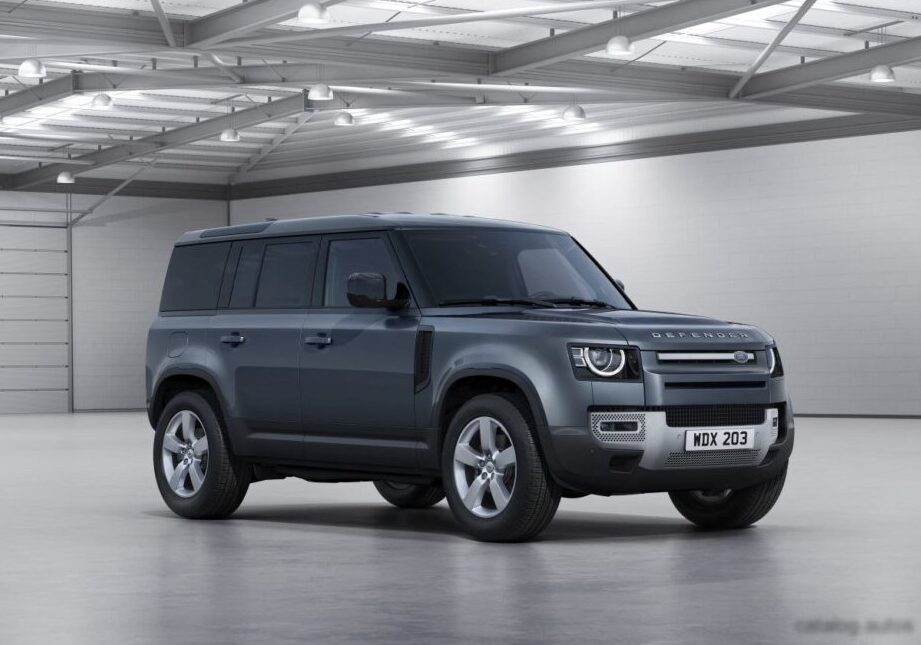
The Land Rover Defender 110 (L663) 3.0 D300, introduced in September 2020, represents a significant departure from its iconic predecessor while attempting to retain the spirit of off-road capability that defined the Defender name. This variant, equipped with a 3.0-liter inline-six diesel engine producing 299 horsepower and featuring mild-hybrid technology, occupies a mid-to-upper position within the 110 model range. It’s designed to balance performance, fuel efficiency, and practicality for families and those requiring a versatile, capable vehicle. The L663 generation marked the Defender’s transition from a rugged, utilitarian workhorse to a more refined and technologically advanced SUV, appealing to a broader audience while still maintaining its off-road prowess.
Technical Specifications
| Brand | Land Rover |
| Model | Defender |
| Generation | Defender 110 (L663) |
| Type | 3.0 D300 (299 Hp) Mild Hybrid AWD Automatic 6 Seat |
| Start of production | September, 2020 |
| Powertrain Architecture | MHEV (Mild Hybrid Electric Vehicle) |
| Body type | Off-road vehicle |
| Seats | 6 |
| Doors | 5 |
| Combined fuel consumption (WLTP) | 8.8-9.5 l/100 km (26.7 – 24.8 US mpg, 32.1 – 29.7 UK mpg, 11.4 – 10.5 km/l) |
| CO2 emissions (WLTP) | 231-248 g/km |
| Fuel consumption (NEDC) | 7.6 l/100 km (30.9 US mpg, 37.2 UK mpg, 13.2 km/l) |
| CO2 emissions (NEDC) | 200 g/km |
| Fuel Type | Diesel |
| Acceleration 0 – 100 km/h | 7.0 sec |
| Acceleration 0 – 62 mph | 7.0 sec |
| Acceleration 0 – 60 mph | 6.6 sec |
| Maximum speed | 191 km/h (118.68 mph) |
| Emission standard | Euro 6d-F |
| Weight-to-power ratio | 7.9 kg/Hp, 126.6 Hp/tonne |
| Weight-to-torque ratio | 3.6 kg/Nm, 275.2 Nm/tonne |
| Power | 299 Hp @ 4000 rpm |
| Power per litre | 99.8 Hp/l |
| Torque | 650 Nm @ 1500-2500 rpm (479.42 lb.-ft. @ 1500-2500 rpm) |
| Engine Model/Code | Ingenium / DT306 |
| Engine displacement | 2996 cm3 (182.83 cu. in.) |
| Number of cylinders | 6 |
| Engine configuration | Inline |
| Cylinder Bore | 83.01 mm (3.27 in.) |
| Piston Stroke | 92.3 mm (3.63 in.) |
| Compression ratio | 15.5:1 |
| Number of valves per cylinder | 4 |
| Fuel injection system | Diesel Commonrail |
| Engine aspiration | Turbocharger, Intercooler |
| Engine oil capacity | 8.8 l (9.3 US qt | 7.74 UK qt) |
| Coolant | 11.6 l (12.26 US qt | 10.21 UK qt) |
| Kerb Weight | 2362 kg (5207.32 lbs.) |
| Trunk (boot) space – minimum | 972 l (34.33 cu. ft.) |
| Trunk (boot) space – maximum | 2277 l (80.41 cu. ft.) |
| Fuel tank capacity | 89 l (23.51 US gal | 19.58 UK gal) |
| AdBlue tank | 20.7 l (5.47 US gal | 4.55 UK gal) |
| Permitted trailer load with brakes (12%) | 3500 kg (7716.18 lbs.) |
| Permitted trailer load without brakes | 750 kg (1653.47 lbs.) |
| Length | 5018 mm (197.56 in.) |
| Width | 1996 mm (78.58 in.) |
| Width with mirrors folded | 2008 mm (79.06 in.) |
| Width including mirrors | 2105 mm (82.87 in.) |
| Height | 1967-1972 mm (77.44 – 77.64 in.) |
| Wheelbase | 3022 mm (118.98 in.) |
| Front track | 1701-1706 mm (66.97 – 67.17 in.) |
| Rear track | 1697-1702 mm (66.81 – 67.01 in.) |
| Front overhang | 845 mm (33.27 in.) |
| Rear overhang | 1151 mm (45.31 in.) |
| Ride height (ground clearance) | 218-291 mm (8.58 – 11.46 in.) |
| Drag coefficient (Cd) | 0.41 |
| Minimum turning circle | 13.1 m (42.98 ft.) |
| Approach angle | 30.1-37.5° |
| Departure angle | 37.7-40.0° |
| Ramp-over angle | 22-28° |
| Climb angle | 45° |
| Wading depth | 850-900 mm (33.46 – 35.43 in.) |
| Drivetrain Architecture | ICE and electric motor permanently drive all four wheels. |
| Drive wheel | All wheel drive (4×4) |
| Number of gears | 8 |
| Gearbox type | Automatic transmission |
| Front suspension | Double wishbone |
| Rear suspension | Independent multi-link suspension |
| Front brakes | Disc, 349-380 mm |
| Rear brakes | Disc, 325-365 mm |
| Steering type | Steering rack and pinion |
| Power steering | Electric |
| Tires size | 255/70 R18; 255/65 R19; 255/60 R20; 275/45 R22 |
| Wheel rims size | 8.0J x 18; 8.0J x 19; 8.5J x 20; 9.0J x 22 |
Powertrain & Engine Architecture
The heart of the D300 is Land Rover’s Ingenium engine family, specifically the DT306, a 3.0-liter inline-six diesel. This engine utilizes a sophisticated turbocharging system and direct fuel injection to deliver a substantial 299 horsepower and 650 Nm (479 lb-ft) of torque. The mild-hybrid system, incorporating a 48-volt electrical architecture, assists the engine during acceleration and allows for smoother start-stop operation, contributing to improved fuel economy. The engine boasts a high compression ratio of 15.5:1 and features a cast aluminum block with a closed-deck design for enhanced strength and durability. The eight-speed automatic transmission, sourced from ZF, is a crucial component, providing smooth and efficient gear changes. It’s calibrated to prioritize both on-road refinement and off-road capability, with close gear ratios for responsive acceleration and a low-range crawl function for challenging terrain.
Driving Characteristics
The D300 Automatic offers a compelling blend of performance and comfort. While not as overtly sporty as some competitors, the engine’s ample torque provides strong acceleration, particularly in the mid-range. The eight-speed transmission shifts smoothly and intelligently, rarely feeling hesitant. Compared to the four-cylinder diesel options, the D300 delivers a more relaxed driving experience, with less need for frequent gear changes. The mild-hybrid system provides a noticeable boost during initial acceleration. However, it doesn’t offer the same level of responsiveness as a full hybrid or electric powertrain. The automatic transmission, while refined, doesn’t offer the same level of driver engagement as a manual gearbox, and some drivers may find it slightly less intuitive in off-road situations requiring precise control.
Equipment & Trim Levels
The D300 trim typically includes a generous level of standard equipment. Interior features often include leather upholstery, heated and ventilated front seats, a panoramic sunroof, and a premium sound system. The infotainment system, powered by Land Rover’s Pivi Pro software, features a large touchscreen display with navigation, Apple CarPlay, and Android Auto compatibility. Available options include adaptive cruise control, a head-up display, and a rear-seat entertainment system. The six-seat configuration provides ample space for passengers, although the third-row seats are best suited for children or shorter adults. Exterior features typically include LED headlights, alloy wheels, and a power tailgate.
Chassis & Braking
The Defender 110 utilizes a robust aluminum-intensive monocoque chassis, providing a strong and lightweight foundation. The suspension system consists of a double-wishbone front setup and an independent multi-link rear arrangement, optimized for both on-road comfort and off-road articulation. The D300 variant typically features larger brakes than lower-spec models, with ventilated discs all around. ABS, electronic stability control, and traction control are standard features. Air suspension is often an optional extra, providing adjustable ride height and further enhancing off-road capability.
Market Reception & Comparison
The Defender 110 D300 received generally positive reviews from automotive critics. It was praised for its blend of refinement, capability, and technology. Compared to the lower-powered diesel variants, the D300 offered a more satisfying driving experience, particularly for those who frequently tow or carry heavy loads. Fuel economy, while respectable, wasn’t class-leading, but the mild-hybrid system helped to mitigate some of the fuel consumption associated with the larger engine. Reliability reports have been mixed, with some owners reporting minor electrical issues, but overall, the Ingenium engine has proven to be relatively durable.
Legacy
The Land Rover Defender 110 D300 represents a significant evolution of the Defender lineage. While it may not appeal to purists who prefer the simplicity of the original, it successfully modernizes the Defender for a new generation of buyers. The Ingenium engine and eight-speed automatic transmission have proven to be reliable and efficient powertrains. On the used car market, the D300 commands a premium price due to its performance and equipment levels. Its combination of luxury, capability, and technology ensures its continued appeal for years to come.