
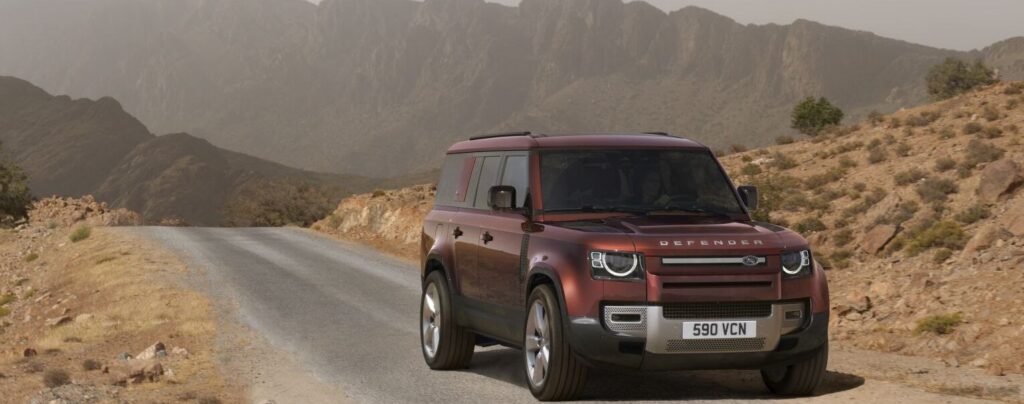
The Land Rover Defender 130 (L663) 3.0 D250 AWD Automatic represents a significant expansion of the revived Defender lineup, introduced in May 2022. Positioned as the largest variant of the L663 generation, the 130 offers optional eight-seat accommodation, differentiating it from the standard 90 and 110 models. This version caters to buyers needing substantial passenger and cargo capacity without sacrificing the Defender’s renowned off-road capability and modern luxury. The D250 designation indicates the powertrain: a 3.0-liter inline-six diesel engine producing 249 horsepower, coupled with an eight-speed automatic transmission and a full-time all-wheel-drive system. It occupies a mid-range position within the 130 lineup, offering a balance between performance, fuel economy, and price.
Technical Specifications
| Brand | Land Rover |
| Model | Defender |
| Generation | Defender 130 (L663) |
| Type (Engine) | 3.0 D250 (249 Hp) AWD Automatic |
| Start of production | May, 2022 |
| Powertrain Architecture | Internal Combustion engine |
| Body type | Off-road vehicle |
| Seats | 5-8 |
| Doors | 5 |
| Fuel consumption (economy) – combined (NEDC) | 8.2 l/100 km |
| Fuel consumption (economy) – combined (US mpg) | 28.7 US mpg |
| Fuel consumption (economy) – combined (UK mpg) | 34.4 UK mpg |
| Fuel consumption (economy) – combined (km/l) | 12.2 km/l |
| CO2 emissions (NEDC) | 216 g/km |
| Fuel Type | Diesel |
| Acceleration 0 – 100 km/h | 8.9 sec |
| Acceleration 0 – 62 mph | 8.9 sec |
| Acceleration 0 – 60 mph | 8.4 sec |
| Maximum speed | 188 km/h (116.82 mph) |
| Weight-to-power ratio | 10.1 kg/Hp, 98.8 Hp/tonne |
| Weight-to-torque ratio | 4.2 kg/Nm, 238.2 Nm/tonne |
| Power | 249 Hp @ 4000 rpm |
| Power per litre | 83.1 Hp/l |
| Torque | 600 Nm @ 1250-2250 rpm (442.54 lb.-ft. @ 1250-2250 rpm) |
| Engine layout | Front, Longitudinal |
| Engine Model/Code | Ingenium / DT306 |
| Engine displacement | 2997 cm3 (182.89 cu. in.) |
| Number of cylinders | 6 |
| Engine configuration | Inline |
| Cylinder Bore | 83 mm (3.27 in.) |
| Piston Stroke | 92.3 mm (3.63 in.) |
| Compression ratio | 15.5:1 |
| Number of valves per cylinder | 4 |
| Fuel injection system | Diesel Commonrail |
| Engine aspiration | Turbocharger, Intercooler |
| Valvetrain | DOHC |
| Engine oil capacity | 8.8 l (9.3 US qt | 7.74 UK qt) |
| Coolant | 11.6 l (12.26 US qt | 10.21 UK qt) |
| Kerb Weight | 2519-2559 kg (5553.44 – 5641.63 lbs.) |
| Max. weight | 3375 kg (7440.6 lbs.) |
| Max load | 816-856 kg (1798.97 – 1887.16 lbs.) |
| Trunk (boot) space – minimum | 290 l (10.24 cu. ft.) |
| Trunk (boot) space – maximum | 2078 l (73.38 cu. ft.) |
| Fuel tank capacity | 89 l (23.51 US gal | 19.58 UK gal) |
| AdBlue tank | 20.7 l (5.47 US gal | 4.55 UK gal) |
| Max. roof load | 168 kg (370.38 lbs.) |
| Permitted trailer load with brakes (12%) | 3000 kg (6613.87 lbs.) |
| Permitted trailer load without brakes | 750 kg (1653.47 lbs.) |
| Permitted towbar download | 120 kg (264.55 lbs.) |
| Length | 5358 mm (210.94 in.) |
| Width with mirrors folded | 2008 mm (79.06 in.) |
| Width including mirrors | 2105 mm (82.87 in.) |
| Height | 1970 mm (77.56 in.) |
| Front track | 1706 mm (67.17 in.) |
| Rear (Back) track | 1702 mm (67.01 in.) |
| Ride height (ground clearance) | 219-290 mm (8.62 – 11.42 in.) |
| Minimum turning circle (turning diameter) | 13.1 m (42.98 ft.) |
| Approach angle | 30.1-37.5° |
| Departure angle | 24.5-28.5° |
| Ramp-over (brakeover) angle | 22-27.8° |
| Wading depth | 900 mm (35.43 in.) |
| Drivetrain Architecture | The Internal combustion engine (ICE) drives permanently the four wheels of the vehicle. |
| Drive wheel | All wheel drive (4×4) |
| Number of gears and type of gearbox | 8 gears, automatic transmission |
| Front suspension | Double wishbone |
| Rear suspension | Independent multi-link suspension |
| Front brakes | Ventilated discs, 363 mm |
| Rear brakes | Ventilated discs, 350 mm |
| Assisting systems | ABS (Anti-lock braking system) |
| Steering type | Steering rack and pinion |
| Power steering | Electric Steering |
Powertrain & Engine Architecture
The heart of the D250 is Land Rover’s Ingenium engine family, specifically the DT306, a 3.0-liter inline-six diesel. This engine utilizes a sophisticated diesel commonrail fuel injection system and a single turbocharger with an intercooler to deliver a balance of power and efficiency. The engine boasts a high compression ratio of 15.5:1 and a double overhead camshaft (DOHC) valvetrain with four valves per cylinder. The Ingenium engine is notable for its modular design, allowing for easy adaptation to different fuel types and power outputs. Paired with the engine is an eight-speed automatic transmission, providing smooth and efficient gear changes. This transmission is known for its responsiveness and ability to handle the engine’s substantial torque output. The transmission is programmed for both on-road comfort and off-road capability, with features like a sport mode and manual shift control.
Driving Characteristics
The 130 D250 offers a composed and capable driving experience. While not as overtly sporty as some of its competitors, the 600 Nm (442.54 lb-ft) of torque available from 1250-2250 rpm provides ample pulling power for both on-road overtaking and challenging off-road situations. The eight-speed automatic transmission contributes to relaxed cruising, keeping engine speeds low at highway speeds. Compared to the higher-output D300 variant, the D250 feels slightly less urgent in acceleration, but the difference is often negligible in real-world driving. The automatic transmission’s gear ratios are well-suited to the engine’s torque curve, providing strong acceleration from a standstill and effortless cruising. The all-wheel-drive system ensures excellent traction in various conditions, making the 130 a confident performer on slippery surfaces.
Equipment & Trim Levels
The Defender 130 D250 typically comes well-equipped as standard. Interior features generally include leather upholstery, heated front seats, a touchscreen infotainment system with navigation, and a premium sound system. Standard safety features include a suite of driver-assistance systems, such as lane departure warning, automatic emergency braking, and adaptive cruise control. Optional extras for the D250 trim can include a panoramic sunroof, upgraded leather trim, a rear entertainment system, and advanced off-road packages with features like electronic active differential and terrain response systems. The 130’s extended wheelbase allows for a more spacious interior, particularly in the third row, making it a comfortable option for families.
Chassis & Braking
The Defender 130 utilizes a robust chassis designed for both on-road comfort and off-road durability. The suspension system consists of a double-wishbone front suspension and an independent multi-link rear suspension. The braking system features ventilated discs on all four wheels, with larger discs at the front (363mm) compared to the rear (350mm). An anti-lock braking system (ABS) is standard, along with electronic brake-force distribution and brake assist. The 130’s increased weight compared to the 90 and 110 models necessitates a slightly firmer suspension setup to maintain stability and control.
Market Reception & Comparison
The Defender 130 has been generally well-received by automotive critics, praised for its spacious interior, comfortable ride, and capable off-road performance. The D250 variant is often seen as a sweet spot in the lineup, offering a good balance between performance and fuel economy. Compared to the more powerful D300, the D250 offers slightly better fuel economy, although the performance difference is not substantial. Reliability reports are still emerging for the L663 generation, but the Ingenium engine family has generally proven to be reliable in other Land Rover models. The 130 competes with other large luxury SUVs, such as the BMW X7 and Mercedes-Benz GLS, offering a more rugged and adventurous alternative.
Legacy
The Defender 130 D250 represents a modern interpretation of the iconic Defender nameplate. While it departs significantly from the original’s utilitarian roots, it retains the brand’s reputation for durability and off-road capability. The Ingenium engine and eight-speed automatic transmission are expected to provide long-term reliability, although regular maintenance is crucial for any modern diesel engine. On the used car market, the 130 D250 is likely to hold its value well due to its spaciousness, luxury features, and the enduring appeal of the Defender brand. Its combination of practicality, capability, and modern technology positions it as a desirable option for buyers seeking a versatile and capable luxury SUV.


