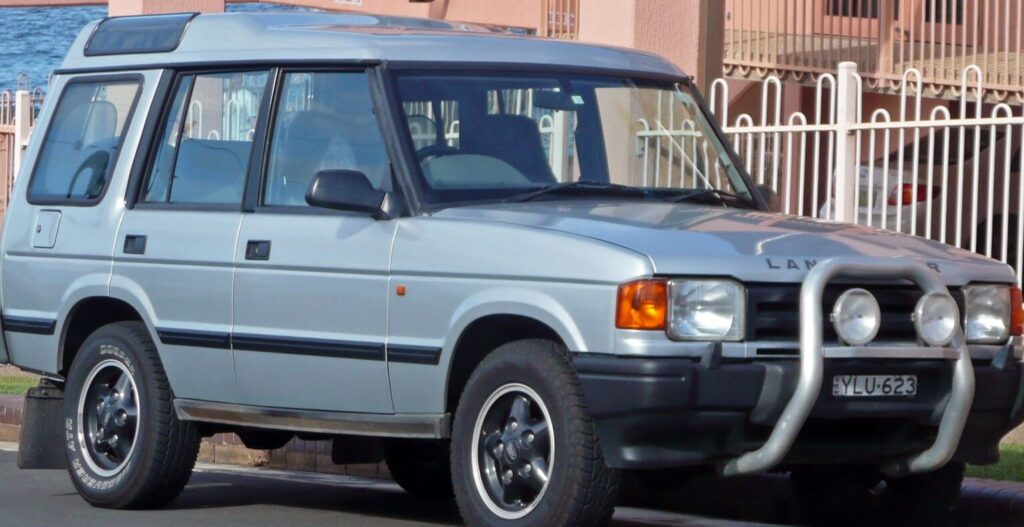
The Land Rover Discovery I 2.5 TDi (3-door), produced from 1989 to 1994, represented a crucial entry point into the Discovery range, offering a blend of off-road capability and practicality in a more compact package. Positioned as a more affordable and accessible alternative to the five-door model, the 3-door TDi appealed to buyers seeking a rugged vehicle for both work and leisure. It was built on the 1HX0 platform, shared with the Range Rover, and aimed to bridge the gap between luxury and utility in the Land Rover lineup. This variant, powered by the 2.5-liter turbocharged diesel engine producing 113 horsepower, offered a unique driving experience compared to its petrol counterparts and the later, more powerful diesel iterations.
Technical Specifications
| Brand | Land Rover |
| Model | Discovery |
| Generation | Discovery I |
| Type (Engine) | 2.5 TDi (3 dr) (113 Hp) |
| Start of production | 1989 |
| End of production | 1994 |
| Powertrain Architecture | Internal Combustion engine |
| Body type | SUV |
| Seats | 5 |
| Doors | 3 |
| Fuel consumption (urban) | 11.3 l/100 km (20.8 US mpg, 25 UK mpg, 8.8 km/l) |
| Fuel consumption (extra urban) | 7.5 l/100 km (31.4 US mpg, 37.7 UK mpg, 13.3 km/l) |
| Fuel consumption (combined) | 8.3 l/100 km (28.3 US mpg, 34 UK mpg, 12 km/l) |
| Fuel Type | Diesel |
| Acceleration 0 – 100 km/h | 18.5 sec |
| Acceleration 0 – 62 mph | 18.5 sec |
| Acceleration 0 – 60 mph | 17.6 sec |
| Maximum speed | 148 km/h (91.96 mph) |
| Weight-to-power ratio | 17 kg/Hp, 58.7 Hp/tonne |
| Weight-to-torque ratio | 7.3 kg/Nm, 137.7 Nm/tonne |
| Power | 113 Hp @ 4000 rpm |
| Power per litre | 45.3 Hp/l |
| Torque | 265 Nm @ 1800 rpm (195.45 lb.-ft. @ 1800 rpm) |
| Engine layout | Front, Longitudinal |
| Engine displacement | 2496 cm3 (152.32 cu. in.) |
| Number of cylinders | 4 |
| Engine configuration | Inline |
| Cylinder Bore | 90.5 mm (3.56 in.) |
| Piston Stroke | 97 mm (3.82 in.) |
| Compression ratio | 19.5:1 |
| Number of valves per cylinder | 2 |
| Fuel injection system | Direct injection |
| Engine aspiration | Turbocharger |
| Engine oil capacity | 5.8 l (6.13 US qt | 5.1 UK qt) |
| Coolant capacity | 11.5 l (12.15 US qt | 10.12 UK qt) |
| Kerb Weight | 1925 kg (4243.9 lbs.) |
| Max. weight | 2720 kg (5996.57 lbs.) |
| Max load | 795 kg (1752.67 lbs.) |
| Trunk (boot) space – minimum | 1290 l (45.56 cu. ft.) |
| Trunk (boot) space – maximum | 1970 l (69.57 cu. ft.) |
| Fuel tank capacity | 82 l (21.66 US gal | 18.04 UK gal) |
| Length | 4520 mm (177.95 in.) |
| Width | 1795 mm (70.67 in.) |
| Height | 1915 mm (75.39 in.) |
| Wheelbase | 2540 mm (100 in.) |
| Front track | 1485 mm (58.46 in.) |
| Rear track | 1485 mm (58.46 in.) |
| Drive wheel | All wheel drive (4×4) |
| Number of gears | 5 |
| Gearbox type | Manual transmission |
| Front suspension | Rigid axle suspension |
| Rear suspension | Rigid axle suspension |
| Front brakes | Ventilated discs |
| Rear brakes | Disc |
| Assisting systems | ABS (Anti-lock braking system) |
| Power steering | Hydraulic Steering |
| Tires size | 205/80 R16 |
Powertrain & Engine Architecture
The heart of the 3-door Discovery I TDi was the 2.5-liter inline-four cylinder diesel engine, typically identified by engine codes such as 200Tdi. This engine represented a significant step forward for Land Rover, offering improved fuel economy and torque compared to the gasoline options. The engine utilized direct injection, a technology that improved combustion efficiency and reduced emissions. A turbocharger was employed to boost power output, bringing it to 113 horsepower. The five-speed manual transmission was standard, providing a reasonable balance between fuel efficiency and usability. The engine’s longitudinal mounting and the vehicle’s permanent four-wheel-drive system contributed to its off-road prowess.
Driving Characteristics
The 2.5 TDi 3-door Discovery wasn’t about outright speed. Acceleration was leisurely, taking around 18.5 seconds to reach 62 mph. However, the engine’s 265 Nm (195 lb-ft) of torque, available from a relatively low 1800 rpm, provided ample pulling power for off-road adventures and towing. The manual transmission allowed for precise control, and the gear ratios were well-suited to both on-road cruising and low-speed rock crawling. Compared to the later 300Tdi engine, the 200Tdi felt less refined but offered a more direct and engaging driving experience. The shorter wheelbase of the 3-door model made it more nimble in tight spaces, both on and off the road, compared to the five-door variant.
Equipment & Trim Levels
The 3-door Discovery I TDi was generally equipped with a functional, rather than luxurious, interior. Standard features included cloth upholstery, basic instrumentation, and a relatively simple dashboard layout. Power steering was standard, a welcome addition given the vehicle’s weight and off-road tires. Optional extras included features like a sunroof, upgraded sound system, and additional interior trim options. The trim level was fairly basic, focusing on durability and practicality rather than lavish appointments. The emphasis was on providing a capable and reliable vehicle at a competitive price point.
Chassis & Braking
The Discovery I utilized a robust ladder-frame chassis, providing excellent strength and durability. Suspension consisted of a rigid axle setup at both the front and rear, offering considerable articulation for off-road use. Front brakes were ventilated discs, while the rear brakes were solid discs. Anti-lock braking system (ABS) was available, enhancing safety on paved roads. The 3-door model’s shorter wheelbase and lighter weight contributed to its improved handling compared to the longer five-door version. Tire size was typically 205/80 R16, providing a good balance between on-road comfort and off-road traction.
Market Reception & Comparison
The 3-door Discovery I TDi was well-received in Europe and other markets where smaller, more affordable 4x4s were in demand. Critics praised its off-road capability, fuel efficiency, and practicality. Compared to the petrol-powered Discoverys, the TDi offered significantly better fuel economy, making it a more attractive option for those covering long distances. Compared to the later 300Tdi, the 200Tdi was often seen as a more raw and engaging driving experience, though it lacked some of the refinement of its successor. The 3-door model was also seen as a more focused off-road vehicle than the five-door, appealing to enthusiasts who prioritized capability over passenger space.
Legacy
The Land Rover Discovery I 2.5 TDi (3-door) holds a significant place in the history of the Discovery model line. It established the Discovery as a versatile and capable 4×4, appealing to a wide range of buyers. The 200Tdi engine proved to be remarkably durable and reliable, and many examples are still in use today. In the used car market, these vehicles are sought after by enthusiasts and collectors, particularly those who appreciate their simplicity and off-road prowess. While maintenance can be required due to the vehicle’s age, the 200Tdi engine is generally considered to be relatively easy to work on, and parts availability remains reasonably good. The 3-door TDi remains a testament to Land Rover’s commitment to building rugged and capable vehicles.