
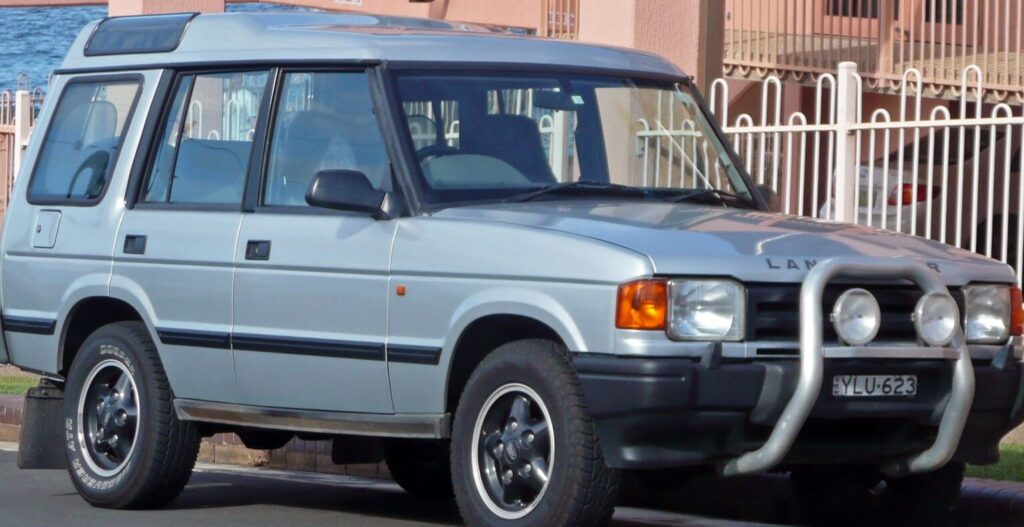
The Land Rover Discovery I 3.5i V8 (3-door), produced from 1989 to 1998, represented a significant entry into the luxury, yet capable, SUV market. Positioned as a more affordable and compact alternative to the Range Rover, the Discovery I, internally designated the Series IV, aimed to blend off-road prowess with family practicality. The 3.5i V8 3-door model, delivering 155 horsepower, was a key variant, particularly in European and select Commonwealth markets, offering a balance between performance and cost within the Discovery I lineup. It was built on the 1989-1998 Discovery I platform, sharing many components with the Land Rover Defender.
Technical Specifications
| Brand | Land Rover |
| Model | Discovery |
| Generation | Discovery I |
| Type (Engine) | 3.5 i V8 (3 dr) (155 Hp) |
| Start of production | 1989 |
| End of production | 1998 |
| Powertrain Architecture | Internal Combustion engine |
| Body type | SUV |
| Seats | 5 |
| Doors | 3 |
| Fuel consumption (urban) | 19.1 l/100 km (12.3 US mpg, 14.8 UK mpg, 5.2 km/l) |
| Fuel consumption (extra urban) | 10.5 l/100 km (22.4 US mpg, 26.9 UK mpg, 9.5 km/l) |
| Fuel consumption (combined) | 14.9 l/100 km (15.8 US mpg, 19 UK mpg, 6.7 km/l) |
| Fuel Type | Petrol (Gasoline) |
| Acceleration 0 – 100 km/h | 12.8 sec |
| Acceleration 0 – 62 mph | 12.8 sec |
| Acceleration 0 – 60 mph | 12.2 sec |
| Maximum speed | 171 km/h (106.25 mph) |
| Weight-to-power ratio | 12.4 kg/Hp, 80.5 Hp/tonne |
| Weight-to-torque ratio | 7.4 kg/Nm, 135.6 Nm/tonne |
| Power | 155 Hp @ 4750 rpm |
| Power per litre | 43.9 Hp/l |
| Torque | 261 Nm @ 3000 rpm (192.5 lb.-ft. @ 3000 rpm) |
| Engine layout | Front, Longitudinal |
| Engine Model/Code | 22D |
| Engine displacement | 3532 cm3 (215.54 cu. in.) |
| Number of cylinders | 8 |
| Engine configuration | V-engine |
| Cylinder Bore | 88.9 mm (3.5 in.) |
| Piston Stroke | 71.12 mm (2.8 in.) |
| Compression ratio | 8:1 |
| Number of valves per cylinder | 2 |
| Fuel injection system | Multi-port manifold injection |
| Engine aspiration | Naturally aspirated engine |
| Valvetrain | OHC |
| Engine oil capacity | 5.7 l (6.02 US qt | 5.02 UK qt) |
| Coolant capacity | 11.3 l (11.94 US qt | 9.94 UK qt) |
| Kerb Weight | 1925 kg (4243.9 lbs.) |
| Max. weight | 2720 kg (5996.57 lbs.) |
| Max load | 795 kg (1752.67 lbs.) |
| Trunk (boot) space – minimum | 1290 l (45.56 cu. ft.) |
| Trunk (boot) space – maximum | 1970 l (69.57 cu. ft.) |
| Fuel tank capacity | 82 l (21.66 US gal | 18.04 UK gal) |
| Length | 4520 mm (177.95 in.) |
| Width | 1795 mm (70.67 in.) |
| Height | 1915 mm (75.39 in.) |
| Wheelbase | 2540 mm (100 in.) |
| Front track | 1485 mm (58.46 in.) |
| Rear track | 1485 mm (58.46 in.) |
| Drive wheel | All wheel drive (4×4) |
| Number of gears | 5 gears, manual transmission |
| Front suspension | Rigid axle suspension |
| Rear suspension | Rigid axle suspension |
| Front brakes | Ventilated discs |
| Rear brakes | Disc |
| Assisting systems | ABS (Anti-lock braking system) |
| Power steering | Hydraulic Steering |
| Tires size | 205/80 R16 |
Powertrain & Engine Architecture
The heart of the Discovery I 3.5i was the Rover 22D V8 engine. This 3.5-liter (3532 cc) naturally aspirated engine, a descendant of the Buick-derived Rover V8, featured a 90-degree V configuration and a relatively low 8:1 compression ratio. It utilized a multi-port fuel injection system, a significant upgrade from earlier carbureted Rover V8s, improving efficiency and driveability. The engine produced 155 horsepower at 4750 rpm and 261 Nm (192.5 lb-ft) of torque at 3000 rpm. The 5-speed manual transmission was the standard offering for this variant, providing a direct connection to the engine’s power. The engine’s longitudinal mounting and rear-wheel-drive bias, coupled with a selectable four-wheel-drive system, were hallmarks of Land Rover’s off-road heritage.
Driving Characteristics
The 3.5i V8 3-door Discovery I offered a distinct driving experience. While not exceptionally quick – 0-60 mph took around 12.2 seconds – the V8 provided ample low-end torque, making it capable in off-road situations and comfortable for everyday driving. The manual transmission allowed for greater driver control, but the gear ratios were spaced to prioritize torque delivery over outright acceleration. Compared to the later 2.0-liter inline-four or 2.5-liter turbodiesel versions, the V8 offered a smoother, more refined experience, albeit at the cost of fuel economy. The 3-door configuration, while offering increased maneuverability, resulted in a slightly more compromised interior space compared to the 5-door model.
Equipment & Trim Levels
The 3.5i V8 3-door typically came with a reasonably well-equipped interior for its time. Standard features included cloth upholstery, basic instrumentation, and power steering. Optional extras, common for this trim level, included air conditioning, a sunroof, and upgraded sound systems. The dashboard layout was functional and utilitarian, reflecting the Discovery’s focus on practicality. Trim levels were relatively basic, with options primarily revolving around comfort and convenience features rather than significant aesthetic changes.
Chassis & Braking
The Discovery I utilized a robust ladder-frame chassis, providing excellent strength and durability, essential for off-road use. Suspension consisted of a rigid axle setup with coil springs at the front and rear, offering a comfortable ride on and off-road. Braking was handled by ventilated discs at the front and discs at the rear, with ABS becoming increasingly common as production progressed. The 3-door model, being lighter than the 5-door, generally exhibited slightly more agile handling. The tires, typically 205/80 R16, were chosen for a balance of on-road comfort and off-road traction.
Market Reception & Comparison
The Discovery I 3.5i V8 3-door was generally well-received by automotive critics. It was praised for its off-road capability, comfortable ride, and relatively affordable price point compared to the Range Rover. However, its fuel economy was often criticized, and some reviewers found the interior to be somewhat basic. Compared to the 2.0-liter and 2.5-liter diesel variants, the V8 offered superior refinement and performance but suffered from significantly higher running costs. The 3-door model appealed to buyers seeking a more compact and maneuverable SUV, often those with outdoor lifestyles.
Legacy
The Land Rover Discovery I 3.5i V8 3-door has become a popular classic among Land Rover enthusiasts. The Rover V8 engine, while known for its potential maintenance needs, is relatively simple to work on and benefits from a large aftermarket support network. Reliability is generally good, provided the vehicle has been well-maintained. Today, these Discoveries are sought after for their character, off-road capability, and relatively affordable entry price into the Land Rover ownership experience. Parts availability remains reasonable, although some trim-specific components can be challenging to find. The 3.5i V8 3-door represents a pivotal moment in Land Rover’s history, bridging the gap between rugged utility and refined comfort.


