
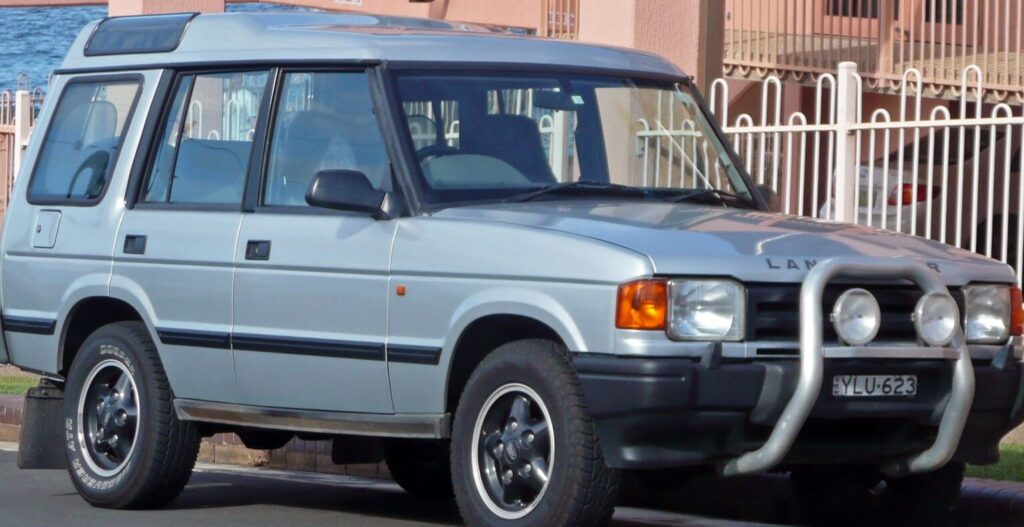
The Land Rover Discovery I 3.5i V8, produced from 1990 to 1998, represented a significant step for the British automaker. Positioned between the rugged, utilitarian One Ten/Defender and the more luxurious Range Rover, the Discovery I aimed to offer a blend of off-road capability, family practicality, and a more accessible price point. The 3.5i V8 variant, generating 166 horsepower, was a key part of the initial lineup, offering a more refined experience than the base four-cylinder models, but remaining a more affordable option than the Range Rover’s V8s. It was built on the 1HX0 platform, later designated A3, and quickly became a popular choice for families and those needing a versatile vehicle capable of both daily commuting and adventurous excursions.
Technical Specifications
| Brand | Land Rover |
| Model | Discovery |
| Generation | Discovery I |
| Type (Engine) | 3.5 i V8 (5 dr) (166 Hp) |
| Start of production | 1990 |
| End of production | 1998 |
| Powertrain Architecture | Internal Combustion engine |
| Body type | SUV |
| Seats | 7 |
| Doors | 5 |
| Fuel consumption (urban) | 18.6 l/100 km (12.6 US mpg, 15.2 UK mpg, 5.4 km/l) |
| Fuel consumption (extra urban) | 11.7 l/100 km (20.1 US mpg, 24.1 UK mpg, 8.5 km/l) |
| Fuel consumption (combined) | 15.7 l/100 km (15 US mpg, 18 UK mpg, 6.4 km/l) |
| Fuel Type | Petrol (Gasoline) |
| Acceleration 0 – 100 km/h | 12.8 sec |
| Acceleration 0 – 62 mph | 12.8 sec |
| Acceleration 0 – 60 mph | 12.2 sec |
| Maximum speed | 163 km/h (101.28 mph) |
| Weight-to-power ratio | 11.6 kg/Hp, 86.2 Hp/tonne |
| Weight-to-torque ratio | 6.7 kg/Nm, 149.1 Nm/tonne |
| Power | 166 Hp @ 4750 rpm |
| Power per litre | 47 Hp/l |
| Torque | 287 Nm @ 2600 rpm (211.68 lb.-ft. @ 2600 rpm) |
| Engine layout | Front, Longitudinal |
| Engine displacement | 3532 cm3 (215.54 cu. in.) |
| Number of cylinders | 8 |
| Engine configuration | V-engine |
| Cylinder Bore | 88.9 mm (3.5 in.) |
| Piston Stroke | 71.12 mm (2.8 in.) |
| Compression ratio | 8.1:1 |
| Number of valves per cylinder | 2 |
| Fuel injection system | Multi-port manifold injection |
| Engine aspiration | Naturally aspirated engine |
| Engine oil capacity | 5.7 l (6.02 US qt | 5.02 UK qt) |
| Coolant capacity | 11.3 l (11.94 US qt | 9.94 UK qt) |
| Kerb Weight | 1925 kg (4243.9 lbs.) |
| Max. weight | 2720 kg (5996.57 lbs.) |
| Max load | 795 kg (1752.67 lbs.) |
| Trunk (boot) space – minimum | 1290 l (45.56 cu. ft.) |
| Trunk (boot) space – maximum | 1970 l (69.57 cu. ft.) |
| Fuel tank capacity | 88 l (23.25 US gal | 19.36 UK gal) |
| Length | 4520 mm (177.95 in.) |
| Width | 1795 mm (70.67 in.) |
| Height | 1960 mm (77.17 in.) |
| Wheelbase | 2540 mm (100 in.) |
| Front track | 1485 mm (58.46 in.) |
| Rear (Back) track | 1485 mm (58.46 in.) |
| Drive wheel | All wheel drive (4×4) |
| Number of gears and type of gearbox | 5 gears, manual transmission |
| Front suspension | Rigid axle suspension |
| Rear suspension | Rigid axle suspension |
| Front brakes | Ventilated discs |
| Rear brakes | Disc |
| Assisting systems | ABS (Anti-lock braking system) |
| Power steering | Hydraulic Steering |
| Tires size | 205/80 R16 |
Powertrain & Engine Architecture
The heart of the Discovery I 3.5i V8 is the Rover V8 engine, specifically the 3.5-liter version. This engine, with roots tracing back to Buick designs of the 1960s, had undergone significant development by Rover over the years. The 166 horsepower output was achieved through a 8.1:1 compression ratio, multi-port fuel injection, and a relatively conservative camshaft profile. The engine’s architecture is a 90-degree V8, known for its inherent smoothness and balance. The 5-speed manual transmission was the standard offering for this variant, providing a direct connection to the engine’s power. While an automatic transmission was available, the manual was favored by enthusiasts for its greater control and responsiveness. The engine’s longitudinal front-engine layout contributed to a balanced weight distribution, enhancing handling both on and off-road.
Driving Characteristics
The 3.5i V8 Discovery I offered a noticeably more refined driving experience compared to the four-cylinder models. While not a sports car, the V8 provided ample torque for comfortable cruising and confident overtaking. The 0-60 mph time of around 12.2 seconds was respectable for the early 1990s, and the engine’s power delivery was smooth and predictable. The manual transmission allowed drivers to fully utilize the engine’s capabilities, while the gear ratios were well-suited for both on-road and off-road driving. Compared to later, more powerful Discovery variants, the 3.5i V8 felt less hurried, but its relaxed nature made it a pleasant vehicle for long journeys. The relatively high curb weight of around 4,244 pounds did impact acceleration and handling, but the robust suspension system helped to mitigate body roll and maintain stability.
Equipment & Trim Levels
The 3.5i V8 Discovery I typically came with a reasonable level of standard equipment. This included power steering, central locking, electric windows, and a basic stereo system. Interior upholstery was typically cloth, although leather options were available. The dashboard layout was functional and straightforward, with clearly labeled controls. Optional extras included air conditioning, a sunroof, and upgraded sound systems. The trim level generally sat in the mid-range of the Discovery I lineup, offering a step up in refinement and performance from the base models, but without the full luxury appointments of the Range Rover.
Chassis & Braking
The Discovery I utilized a body-on-frame construction, providing a robust and durable chassis. The suspension system consisted of a rigid axle setup at both the front and rear, with coil springs and shock absorbers. This configuration provided excellent off-road articulation and a comfortable ride on paved surfaces. Braking duties were handled by ventilated discs at the front and discs at the rear, with ABS (Anti-lock Braking System) as standard equipment. The braking system was adequate for the vehicle’s weight and performance, but it lacked the sophistication of more modern braking technologies.
Market Reception & Comparison
The Land Rover Discovery I 3.5i V8 was generally well-received by automotive critics. It was praised for its blend of off-road capability, practicality, and relative affordability. Compared to the four-cylinder models, the V8 offered a significant improvement in performance and refinement. However, its fuel economy of around 15 mpg combined was considered relatively poor, even for the early 1990s. Compared to the Range Rover, the Discovery I offered a similar level of off-road capability at a lower price point, but it lacked the Range Rover’s luxurious interior and more powerful engine options. The 3.5i V8 was often seen as a sweet spot in the Discovery I lineup, offering a good balance of performance, practicality, and value.
Legacy
The Land Rover Discovery I 3.5i V8 has become a popular classic among enthusiasts. The Rover V8 engine is known for its reliability and relatively simple maintenance requirements, although parts availability can be a challenge. The Discovery I’s robust construction and capable off-road performance have ensured its longevity, and many examples are still in regular use today. In the used car market, well-maintained 3.5i V8 Discoveries command a premium, particularly those with low mileage and a complete service history. The model represents a pivotal moment in Land Rover’s history, bridging the gap between rugged utility and refined luxury, and establishing the Discovery as a distinct and desirable vehicle in its own right.


