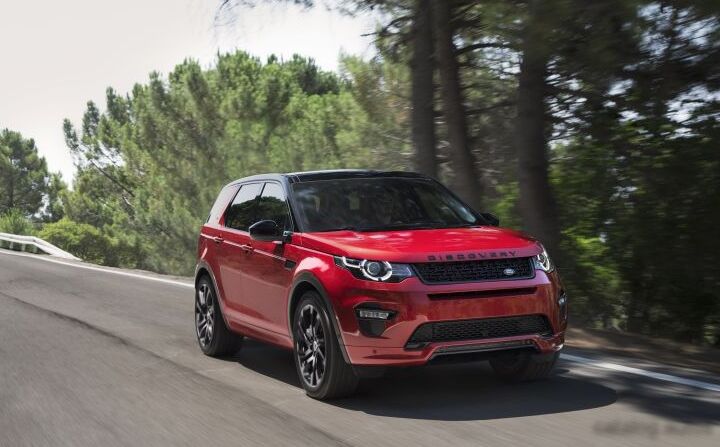
The Land Rover Discovery Sport 2.0 eD4 (150 hp) was a front-wheel-drive variant of the first-generation Discovery Sport (L550), produced primarily for the European market between 2018 and 2019. Positioned as an entry-level option, it offered a balance of fuel efficiency and practicality within the Discovery Sport range. This model aimed to attract buyers seeking the style and versatility of the Discovery Sport at a more accessible price point, though it was not officially sold in the United States.
Technical Specifications
| Brand | Land Rover |
| Model | Discovery Sport |
| Generation | Discovery Sport |
| Type (Engine) | 2.0 eD4 (150 Hp) |
| Start of production | 2018 |
| End of production | 2019 |
| Powertrain Architecture | Internal Combustion engine |
| Body type | SUV |
| Seats | 5 |
| Doors | 5 |
| Fuel consumption (combined) | 5.7-5.8 l/100 km (41.3 – 40.6 US mpg, 49.6 – 48.7 UK mpg, 17.5 – 17.2 km/l) |
| CO2 emissions | 149-152 g/km |
| Fuel Type | Diesel |
| Acceleration 0 – 100 km/h | 10.4 sec |
| Acceleration 0 – 62 mph | 10.4 sec |
| Acceleration 0 – 60 mph | 9.9 sec |
| Maximum speed | 180 km/h (111.85 mph) |
| Weight-to-power ratio | 11.5 kg/Hp, 86.6 Hp/tonne |
| Weight-to-torque ratio | 4.6 kg/Nm, 219.4 Nm/tonne |
| Power | 150 Hp |
| Power per litre | 75 Hp/l |
| Torque | 380 Nm @ 1750 rpm (280.27 lb.-ft. @ 1750 rpm) |
| Engine layout | Front, Transverse |
| Engine Model/Code | Ingenium / 204DTD |
| Engine displacement | 1999 cm3 (121.99 cu. in.) |
| Number of cylinders | 4 |
| Engine configuration | Inline |
| Cylinder Bore | 83 mm (3.27 in.) |
| Piston Stroke | 92.35 mm (3.64 in.) |
| Compression ratio | 15.5:1 |
| Number of valves per cylinder | 4 |
| Fuel injection system | Diesel Commonrail |
| Engine aspiration | Turbocharger, Intercooler |
| Engine oil capacity | 6.5 l (6.87 US qt | 5.72 UK qt) |
| Coolant | 7.4 l (7.82 US qt | 6.51 UK qt) |
| Kerb Weight | 1732 kg (3818.41 lbs.) |
| Max. weight | 2380 kg (5247 lbs.) |
| Max load | 648 kg (1428.6 lbs.) |
| Trunk (boot) space – maximum | 981 l (34.64 cu. ft.) |
| Fuel tank capacity | 54 l (14.27 US gal | 11.88 UK gal) |
| Max. roof load | 75 kg (165.35 lbs.) |
| Permitted trailer load with brakes (12%) | 1800 kg (3968.32 lbs.) |
| Permitted trailer load without brakes | 750 kg (1653.47 lbs.) |
| Permitted towbar download | 100 kg (220.46 lbs.) |
| Length | 4599 mm (181.06 in.) |
| Width with mirrors folded | 2069 mm (81.46 in.) |
| Width including mirrors | 2173 mm (85.55 in.) |
| Height | 1724 mm (67.87 in.) |
| Wheelbase | 2741 mm (107.91 in.) |
| Front track | 1621 mm (63.82 in.) |
| Rear (Back) track | 1630 mm (64.17 in.) |
| Ride height (ground clearance) | 211 mm (8.31 in.) |
| Minimum turning circle | 11.86 m (38.91 ft.) |
| Approach angle | 23.4° |
| Departure angle | 31° |
| Ramp-over angle | 20° |
| Wading depth | 600 mm (23.62 in.) |
| Drivetrain Architecture | The Internal combustion engine (ICE) drives the front wheels of the vehicle. |
| Drive wheel | Front wheel drive |
| Number of gears and type of gearbox | 6 gears, manual transmission |
| Rear suspension | Independent multi-link suspension |
| Front brakes | Disc, 325 mm |
| Rear brakes | Disc, 300 mm |
| Assisting systems | ABS (Anti-lock braking system) |
| Steering type | Steering rack and pinion |
| Power steering | Electric Steering |
| Wheel rims size | 17; 18; 19 |
INTRODUCTION
The Land Rover Discovery Sport 2.0 eD4 (150 hp) was introduced as part of the Discovery Sport’s initial launch in 2018, continuing through the 2019 model year. Built on the LR-MS (Land Rover Modular System) platform, also known as the 1HX0/A3 platform, it represented Land Rover’s entry into the compact SUV segment. The ‘eD4’ designation signified a diesel engine with front-wheel drive. This variant was specifically tailored for markets where diesel fuel was prevalent and where front-wheel-drive SUVs were commonly accepted, particularly in Europe. It served as the most affordable entry point into the Discovery Sport lineup.
Powertrain & Engine Architecture
At the heart of the 2.0 eD4 was Land Rover’s Ingenium engine family, specifically the 204DTD code. This is a 2.0-liter inline-four cylinder diesel engine producing 150 horsepower and 380 Nm (280 lb-ft) of torque. The engine utilizes a sophisticated diesel commonrail fuel injection system, delivering fuel at extremely high pressure for optimized combustion. A turbocharger with an intercooler further enhances performance. The engine features a cast iron block and aluminum cylinder head, balancing durability with weight reduction. The 6-speed manual transmission was standard, chosen for its efficiency and cost-effectiveness in this entry-level model. While an automatic transmission was available on other Discovery Sport trims, it wasn’t offered with the 150 hp eD4.
Driving Characteristics
The 150 hp eD4 offered a comfortable, if not particularly exhilarating, driving experience. Acceleration from 0-60 mph took approximately 9.9 seconds, and top speed was limited to 111.85 mph. The front-wheel-drive configuration meant that traction in slippery conditions wasn’t as assured as with the all-wheel-drive variants. The manual transmission, while engaging for some drivers, required more driver involvement than the automatic options. Gear ratios were tuned for fuel efficiency, resulting in a slightly less responsive feel compared to higher-output versions. The torque delivery, peaking at 1750 rpm, provided adequate pulling power for everyday driving and highway cruising.
Equipment & Trim Levels
The 2.0 eD4 typically came with a reasonable level of standard equipment, though it was less lavish than higher-spec trims. Standard features generally included air conditioning, a touchscreen infotainment system with Bluetooth connectivity, alloy wheels (typically 17 or 18-inch), and basic safety features like ABS and multiple airbags. Interior upholstery was typically cloth, with options for leather upgrades. Common optional extras included parking sensors, a rearview camera, upgraded audio systems, and various styling packages. The trim level was generally positioned as the base model, often simply referred to as ‘Discovery Sport eD4’.
Chassis & Braking
The Discovery Sport’s chassis featured independent suspension all around, with MacPherson struts at the front and a multi-link setup at the rear. The eD4 variant, being lighter than its all-wheel-drive counterparts, benefited from slightly improved handling. Front brakes were ventilated discs measuring 325mm, while rear brakes were also discs, measuring 300mm. ABS (Anti-lock Braking System) was standard. Stabilizer bars were fitted front and rear to reduce body roll during cornering. The suspension tuning prioritized comfort over outright sportiness, providing a compliant ride on most road surfaces.
Market Reception & Comparison
The Discovery Sport 2.0 eD4 was generally well-received as an affordable and practical entry point into the Discovery Sport range. Critics praised its fuel efficiency and comfortable ride, but noted its relatively modest performance compared to the higher-powered, all-wheel-drive models. Compared to the 180 hp diesel or the petrol variants, the eD4 offered lower running costs but sacrificed acceleration and all-weather capability. The manual transmission was seen as a positive by some, but a drawback for others accustomed to automatic gearboxes. Fuel economy figures of 5.7-5.8 l/100km (41.3-40.6 US mpg) were competitive within its class.
Legacy
The 2.0 eD4, while a relatively short-lived variant, established the Discovery Sport as a viable option in the compact SUV market. The Ingenium engine proved to be a reliable unit, and well-maintained examples continue to be sought after on the used car market. However, potential buyers should be aware of the typical maintenance requirements for diesel engines, including regular servicing of the diesel particulate filter (DPF). The front-wheel-drive configuration, while contributing to fuel efficiency, may limit its appeal to buyers seeking all-weather performance. Overall, the 2.0 eD4 represents a practical and economical choice for those seeking a stylish and versatile compact SUV.