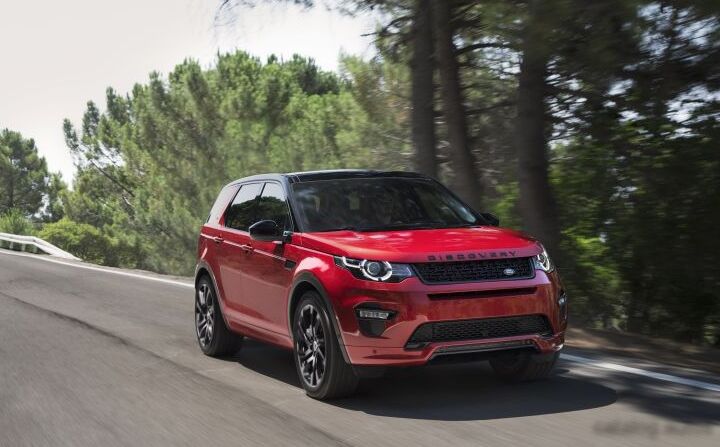
The Land Rover Discovery Sport 2.0 TD4, producing 150 horsepower, with all-wheel drive and an automatic transmission, was a key variant in the first generation (L550) of the Discovery Sport model line, produced primarily for the 2018 and 2019 model years. Positioned as an entry-level offering within the range, it aimed to provide access to the Discovery Sport’s premium features and capability at a more attainable price point. This model played a significant role in establishing the Discovery Sport as a popular choice in the compact luxury SUV segment, particularly in European and Asian markets, and increasingly in North America as the brand expanded its presence.
Technical Specifications
| Brand | Land Rover |
| Model | Discovery Sport |
| Generation | Discovery Sport |
| Type (Engine) | 2.0 TD4 (150 Hp) AWD Automatic |
| Start of production | 2018 |
| End of production | 2019 |
| Powertrain Architecture | Internal Combustion engine |
| Body type | SUV |
| Seats | 5-7 |
| Doors | 5 |
| Fuel consumption (combined) | 6.4-6.6 l/100 km (36.8 – 35.6 US mpg, 44.1 – 42.8 UK mpg, 15.6 – 15.2 km/l) |
| CO2 emissions | 169-174 g/km |
| Fuel Type | Diesel |
| Acceleration 0 – 100 km/h | 10.9 sec |
| Acceleration 0 – 62 mph | 10.9 sec |
| Acceleration 0 – 60 mph | 10.4 sec |
| Maximum speed | 180 km/h (111.85 mph) |
| Weight-to-power ratio | 11.9 kg/Hp, 84 Hp/tonne |
| Weight-to-torque ratio | 4.7 kg/Nm, 212.9 Nm/tonne |
| Power | 150 Hp |
| Power per litre | 75 Hp/l |
| Torque | 380 Nm @ 1750 rpm (280.27 lb.-ft. @ 1750 rpm) |
| Engine layout | Front, Transverse |
| Engine Model/Code | Ingenium / 204DTD |
| Engine displacement | 1999 cm3 (121.99 cu. in.) |
| Number of cylinders | 4 |
| Engine configuration | Inline |
| Cylinder Bore | 83 mm (3.27 in.) |
| Piston Stroke | 92.35 mm (3.64 in.) |
| Compression ratio | 15.5:1 |
| Number of valves per cylinder | 4 |
| Fuel injection system | Diesel Commonrail |
| Engine aspiration | Turbocharger, Intercooler |
| Engine oil capacity | 6.5 l (6.87 US qt | 5.72 UK qt) |
| Coolant | 7.4 l (7.82 US qt | 6.51 UK qt) |
| Kerb Weight | 1785-1884 kg (3935.25 – 4153.51 lbs.) |
| Max. weight | 2505-2660 kg (5522.58 – 5864.3 lbs.) |
| Max load | 720-776 kg (1587.33 – 1710.79 lbs.) |
| Trunk (boot) space – maximum | 981 l (34.64 cu. ft.) |
| Fuel tank capacity | 54 l (14.27 US gal | 11.88 UK gal) |
| Max. roof load | 75 kg (165.35 lbs.) |
| Permitted trailer load with brakes (12%) | 2200 kg (4850.17 lbs.) |
| Permitted trailer load without brakes | 750 kg (1653.47 lbs.) |
| Permitted towbar download | 100 kg (220.46 lbs.) |
| Length | 4599 mm (181.06 in.) |
| Width with mirrors folded | 2069 mm (81.46 in.) |
| Width including mirrors | 2173 mm (85.55 in.) |
| Height | 1724 mm (67.87 in.) |
| Wheelbase | 2741 mm (107.91 in.) |
| Front track | 1621 mm (63.82 in.) |
| Rear (Back) track | 1630 mm (64.17 in.) |
| Ride height (ground clearance) | 211 mm (8.31 in.) |
| Minimum turning circle | 11.86 m (38.91 ft.) |
| Approach angle | 23.4° |
| Departure angle | 31° |
| Ramp-over angle | 20° |
| Wading depth | 600 mm (23.62 in.) |
| Drive wheel | All wheel drive (4×4) |
| Number of gears and type of gearbox | 9 gears, automatic transmission |
| Rear suspension | Independent multi-link suspension |
| Front brakes | Disc, 325 mm |
| Rear brakes | Disc, 300 mm |
| Assisting systems | ABS (Anti-lock braking system) |
| Steering type | Steering rack and pinion |
| Power steering | Electric Steering |
| Wheel rims size | 17; 18; 19 |
INTRODUCTION
The Land Rover Discovery Sport 2.0 TD4 (150 hp) AWD Automatic, introduced in 2018 and continuing through 2019, represents a crucial entry point into the Discovery Sport range. Built on the Land Rover-Geely jointly developed L550 platform (also underpinning the Range Rover Evoque), it aimed to deliver a blend of Land Rover’s off-road capability, premium interior, and modern technology in a more accessible package. This variant was particularly important in markets where diesel engines were favored, offering a balance of fuel efficiency and torque. It served as a stepping stone to the more powerful engine options, attracting buyers who prioritized value and practicality.
Powertrain & Engine Architecture
At the heart of the 2.0 TD4 lies Land Rover’s Ingenium engine family. Specifically, the 204DTD engine is a 2.0-liter inline-four cylinder diesel engine. This engine utilizes a sophisticated common-rail direct injection system, delivering fuel at extremely high pressures for optimized combustion. A single turbocharger, coupled with an intercooler, provides forced induction, boosting power and torque. The engine boasts a relatively high compression ratio of 15.5:1, contributing to its efficiency. The 9-speed automatic transmission, sourced from ZF, is a key component of this powertrain. This transmission offers a wide range of gear ratios, optimizing both fuel economy and performance. It features a torque converter for smooth low-speed operation and a sophisticated electronic control system for precise gear changes. The transmission is designed to work seamlessly with Land Rover’s Terrain Response system, adapting gear selection to suit various driving conditions.
Driving Characteristics
The 150 hp output and 380 Nm (280 lb-ft) of torque provide adequate, though not exhilarating, performance. Acceleration from 0-60 mph takes around 10.4 seconds, and the top speed is limited to 111.85 mph. The 9-speed automatic transmission plays a crucial role in managing the engine’s power delivery. While the wide gear spread aids fuel economy, some drivers have noted occasional hesitancy during downshifts. Compared to the higher-output 180 hp version of the 2.0 TD4, or the petrol-powered variants, this model feels less responsive, particularly during overtaking maneuvers. However, the abundance of low-end torque makes it well-suited for everyday driving and towing. The all-wheel-drive system provides excellent traction in various conditions, enhancing confidence on slippery surfaces.
Equipment & Trim Levels
The 2.0 TD4 Automatic typically came equipped with a respectable level of standard features. These included climate control, a touchscreen infotainment system with navigation, Bluetooth connectivity, and a suite of safety features such as ABS, stability control, and multiple airbags. Interior upholstery was generally cloth, with leather options available as an upgrade. Common trim levels included ‘SE’ and ‘HSE’, with the HSE offering additional features like leather seats, upgraded audio systems, and parking sensors. Optional extras included a panoramic sunroof, heated seats, and advanced driver-assistance systems like adaptive cruise control and lane departure warning.
Chassis & Braking
The Discovery Sport features a robust chassis designed to handle both on-road and off-road driving. The suspension consists of MacPherson struts at the front and a multi-link setup at the rear. The 2.0 TD4 models typically featured disc brakes on all four wheels, with front discs measuring 325mm and rear discs measuring 300mm. The braking system is assisted by ABS and electronic brakeforce distribution. Stabilizer bars are fitted to both the front and rear axles to reduce body roll during cornering. The ride height provides adequate ground clearance for moderate off-road excursions.
Market Reception & Comparison
The 2.0 TD4 Automatic was generally well-received by automotive critics as a practical and capable entry-level option. Fuel economy was a strong point, with combined figures ranging from 35.6 to 36.8 US mpg. However, some reviewers noted that the engine could feel strained when fully loaded or tackling steep inclines. Compared to the more powerful 180 hp diesel, the 150 hp version offered a noticeable trade-off in performance for a lower price. The petrol-powered variants provided quicker acceleration but typically suffered from lower fuel economy. Reliability reports have been generally positive, with the Ingenium engine proving to be relatively robust, although some owners have reported issues with the infotainment system.
Legacy
The Land Rover Discovery Sport 2.0 TD4 (150 hp) AWD Automatic remains a popular choice in the used car market. Its blend of practicality, capability, and relatively affordable running costs makes it an attractive option for buyers seeking a compact luxury SUV. The Ingenium engine has proven to be durable, and parts availability is generally good. While the infotainment system can be a source of occasional issues, these are typically addressable with software updates. This variant helped establish the Discovery Sport as a successful model for Land Rover, paving the way for future iterations and cementing its position in the competitive SUV segment.