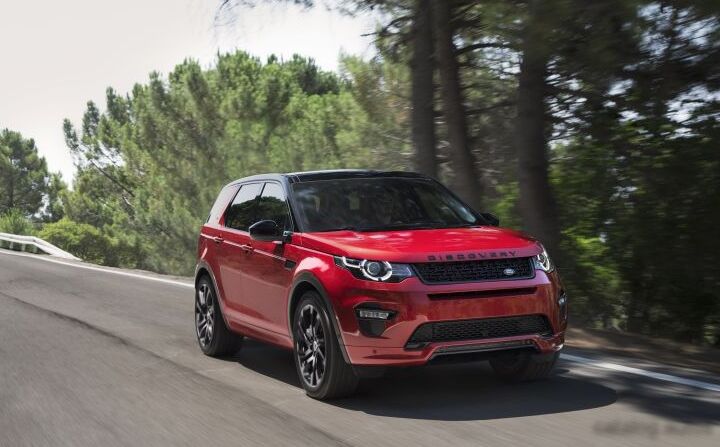
The Land Rover Discovery Sport 2.0 TD4, producing 180 horsepower, with all-wheel drive (AWD) was a key variant in the first generation (2015-2019) of the Discovery Sport lineup. Introduced in 2018, this model aimed to balance fuel efficiency with respectable performance, appealing to buyers seeking a premium compact SUV experience. It occupied a mid-range position within the Discovery Sport family, slotting between the lower-powered diesel options and the more potent gasoline variants. This version was primarily marketed in Europe and other international markets where diesel engines remained popular, though limited numbers were available in North America.
Technical Specifications
| Brand | Land Rover |
| Model | Discovery Sport |
| Generation | Discovery Sport |
| Type (Engine) | 2.0 TD4 (180 Hp) AWD |
| Start of production | 2018 |
| End of production | 2019 |
| Powertrain Architecture | Internal Combustion engine |
| Body type | SUV |
| Seats | 5 |
| Doors | 5 |
| Fuel consumption (combined) | 6.4 l/100 km (36.8 US mpg, 44.1 UK mpg, 15.6 km/l) |
| CO2 emissions | 168 g/km |
| Fuel Type | Diesel |
| Acceleration 0 – 100 km/h | 9.9 sec |
| Acceleration 0 – 62 mph | 9.9 sec |
| Acceleration 0 – 60 mph | 9.4 sec |
| Maximum speed | 188 km/h (116.82 mph) |
| Weight-to-power ratio | 9.9 kg/Hp, 101.4 Hp/tonne |
| Weight-to-torque ratio | 4.1 kg/Nm, 242.3 Nm/tonne |
| Power | 180 Hp |
| Power per litre | 90 Hp/l |
| Torque | 430 Nm @ 1750 rpm (317.15 lb.-ft. @ 1750 rpm) |
| Engine layout | Front, Transverse |
| Engine Model/Code | Ingenium / 204DTD |
| Engine displacement | 1999 cm3 (121.99 cu. in.) |
| Number of cylinders | 4 |
| Engine configuration | Inline |
| Cylinder Bore | 83 mm (3.27 in.) |
| Piston Stroke | 92.35 mm (3.64 in.) |
| Compression ratio | 15.5:1 |
| Number of valves per cylinder | 4 |
| Fuel injection system | Diesel Commonrail |
| Engine aspiration | Turbocharger, Intercooler |
| Engine oil capacity | 6.5 l (6.87 US qt | 5.72 UK qt) |
| Coolant | 7.4 l (7.82 US qt | 6.51 UK qt) |
| Kerb Weight | 1775 kg (3913.21 lbs.) |
| Max. weight | 2505 kg (5522.58 lbs.) |
| Max load | 730 kg (1609.37 lbs.) |
| Trunk (boot) space – maximum | 1698 l (59.96 cu. ft.) |
| Fuel tank capacity | 54 l (14.27 US gal | 11.88 UK gal) |
| Max. roof load | 75 kg (165.35 lbs.) |
| Permitted trailer load with brakes (12%) | 2000 kg (4409.25 lbs.) |
| Permitted trailer load without brakes | 750 kg (1653.47 lbs.) |
| Permitted towbar download | 100 kg (220.46 lbs.) |
| Length | 4599 mm (181.06 in.) |
| Width with mirrors folded | 2069 mm (81.46 in.) |
| Width including mirrors | 2173 mm (85.55 in.) |
| Height | 1724 mm (67.87 in.) |
| Wheelbase | 2741 mm (107.91 in.) |
| Front track | 1621 mm (63.82 in.) |
| Rear (Back) track | 1630 mm (64.17 in.) |
| Ride height (ground clearance) | 211 mm (8.31 in.) |
| Minimum turning circle | 11.86 m (38.91 ft.) |
| Approach angle | 23.4° |
| Departure angle | 31° |
| Ramp-over angle | 20° |
| Wading depth | 600 mm (23.62 in.) |
| Drive wheel | All wheel drive (4×4) |
| Number of gears and type of gearbox | 6 gears, manual transmission |
| Rear suspension | Independent multi-link suspension |
| Front brakes | Disc, 325 mm |
| Rear brakes | Disc, 300 mm |
| Assisting systems | ABS (Anti-lock braking system) |
| Steering type | Steering rack and pinion |
| Power steering | Electric Steering |
| Wheel rims size | 17; 18; 19 |
INTRODUCTION
The Land Rover Discovery Sport 2.0 TD4 (180 Hp) AWD, produced from 2018 to 2019, represents a significant step in Land Rover’s expansion into the compact SUV segment. Built on the LR-MS (Land Rover Modular System) platform – also known as the 1HX0/A3 platform – it aimed to deliver the brand’s renowned off-road capability and premium interior in a more accessible package. This particular variant, powered by the Ingenium engine family, was designed to offer a balance between performance, fuel economy, and refinement, making it a popular choice for families and individuals alike. It was positioned as a practical and versatile vehicle, capable of handling both daily commutes and weekend adventures.
Powertrain & Engine Architecture
At the heart of the 2.0 TD4 lies Land Rover’s Ingenium engine family. Specifically, this variant utilizes the 204DTD engine code, a 2.0-liter inline-four cylinder diesel engine. This engine features a sophisticated diesel commonrail fuel injection system, delivering precise fuel metering for optimized combustion. The engine also incorporates a turbocharger with an intercooler, boosting power output and improving efficiency. The 15.5:1 compression ratio contributes to the engine’s thermal efficiency. The engine produces 430 Nm (317.15 lb-ft) of torque at 1750 rpm, providing strong low-end pulling power. The engine is transversely mounted in the front of the vehicle. The 6-speed manual transmission was standard, offering a balance between fuel efficiency and driver engagement.
Driving Characteristics
The 180 horsepower and 430 Nm of torque provide adequate performance for everyday driving. Acceleration from 0-60 mph takes approximately 9.4 seconds, and the top speed is 116.82 mph. While not a sports car, the 2.0 TD4 offers sufficient power for overtaking and merging onto highways. The manual transmission allows for greater driver control, but the gear ratios are tuned for fuel efficiency rather than outright performance. Compared to the higher-output diesel variants or the gasoline-powered models, the 2.0 TD4 feels less urgent in its acceleration. However, the strong low-end torque makes it a capable performer in real-world driving conditions, particularly when fully loaded or towing. The all-wheel-drive system provides excellent traction in various conditions, enhancing stability and confidence.
Equipment & Trim Levels
The Discovery Sport 2.0 TD4 typically came equipped with a respectable level of standard features. These included climate control, a touchscreen infotainment system, Bluetooth connectivity, and a suite of safety features such as ABS, traction control, and multiple airbags. Interior upholstery was typically cloth, with leather options available as an upgrade. Higher trim levels offered additional features such as heated seats, a panoramic sunroof, and a premium sound system. Optional extras included navigation, parking sensors, and advanced driver-assistance systems. The dashboard layout was modern and functional, with a focus on user-friendliness.
Chassis & Braking
The Discovery Sport features a robust chassis designed to handle both on-road and off-road driving. The suspension consists of independent multi-link suspension at the rear, providing a comfortable ride and good handling characteristics. Front suspension is MacPherson strut. The braking system utilizes disc brakes on all four wheels, with 325mm discs at the front and 300mm discs at the rear. ABS (Anti-lock Braking System) is standard, enhancing braking performance and stability. The electric power steering provides precise and responsive steering feel. The vehicle’s relatively high ground clearance (211 mm) and approach/departure angles contribute to its off-road capability.
Market Reception & Comparison
The Land Rover Discovery Sport 2.0 TD4 was generally well-received by critics, who praised its stylish design, spacious interior, and capable all-wheel-drive system. The 180 horsepower diesel engine was considered a good compromise between performance and fuel economy. Compared to the more powerful diesel variants, the 2.0 TD4 offered a lower price point, making it more accessible to a wider range of buyers. However, some critics noted that the manual transmission could feel a bit notchy, and the overall driving experience was not as engaging as some of its competitors. Fuel economy was competitive, averaging around 36.8 US mpg in combined driving. Reliability was generally good, although some owners reported minor issues with the infotainment system.
Legacy
The Land Rover Discovery Sport 2.0 TD4 (180 Hp) AWD remains a popular choice in the used car market. The Ingenium engine has proven to be relatively reliable, although regular maintenance is essential. The vehicle’s combination of practicality, style, and off-road capability continues to appeal to buyers seeking a versatile and premium compact SUV. While newer models have introduced updated technology and improved performance, the first-generation Discovery Sport 2.0 TD4 represents a solid and well-rounded package that offers good value for money.