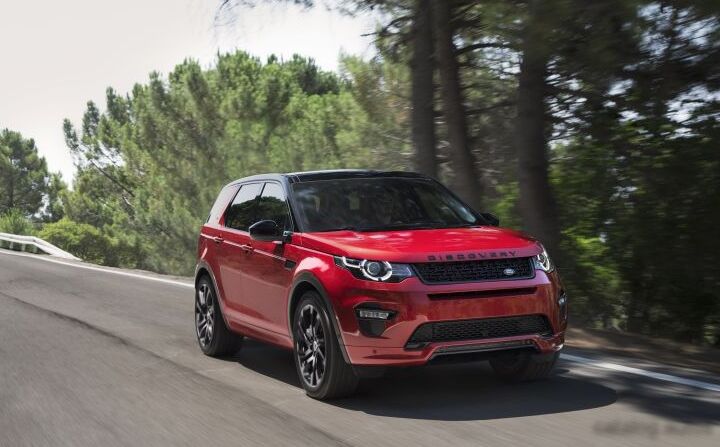
The Land Rover Discovery Sport 2.2 SD4 AWD Automatic, produced from 2014 to 2015, represents the initial offering of the first-generation Discovery Sport (internally designated L550). This model played a crucial role in establishing the Discovery Sport as a premium compact SUV, bridging the gap between the larger Range Rover Evoque and the traditional Land Rover Discovery. Positioned as a mid-range trim, the SD4 offered a balance of performance, capability, and luxury within the Discovery Sport lineup. It was primarily marketed towards buyers seeking a versatile vehicle capable of both on-road comfort and moderate off-road excursions, appealing to families and individuals with active lifestyles.
Technical Specifications
| Brand | Land Rover |
| Model | Discovery Sport |
| Type (Engine) | 2.2 SD4 (190 Hp) AWD Automatic |
| Start of production | 2014 |
| End of production | 2015 |
| Powertrain Architecture | Internal Combustion engine |
| Body type | SUV |
| Seats | 5 |
| Doors | 5 |
| Fuel consumption (combined) | 6.1 l/100 km (38.6 US mpg, 46.3 UK mpg, 16.4 km/l) |
| CO2 emissions | 161 g/km |
| Fuel Type | Diesel |
| Acceleration 0 – 100 km/h | 8.9 sec |
| Acceleration 0 – 62 mph | 8.9 sec |
| Acceleration 0 – 60 mph | 8.5 sec |
| Maximum speed | 188 km/h (116.82 mph) |
| Emission standard | Euro 5 |
| Weight-to-power ratio | 9.3 kg/Hp, 107 Hp/tonne |
| Weight-to-torque ratio | 4.2 kg/Nm, 236.6 Nm/tonne |
| Power | 190 Hp @ 3500 rpm |
| Power per litre | 87.2 Hp/l |
| Torque | 420 Nm @ 1750 rpm (309.78 lb.-ft. @ 1750 rpm) |
| Engine layout | Front, Transverse |
| Engine Model/Code | Duratorq / 224DT |
| Engine displacement | 2179 cm3 (132.97 cu. in.) |
| Number of cylinders | 4 |
| Engine configuration | Inline |
| Cylinder Bore | 85 mm (3.35 in.) |
| Piston Stroke | 96 mm (3.78 in.) |
| Compression ratio | 15.8:1 |
| Number of valves per cylinder | 4 |
| Fuel injection system | Diesel Commonrail |
| Engine aspiration | Turbocharger, Intercooler |
| Valvetrain | DOHC |
| Engine oil capacity | 5.9 l (6.23 US qt | 5.19 UK qt) |
| Coolant | 5.7 l (6.02 US qt | 5.02 UK qt) |
| Kerb Weight | 1775 kg (3913.21 lbs.) |
| Max. weight | 2505 kg (5522.58 lbs.) |
| Max load | 730 kg (1609.37 lbs.) |
| Trunk (boot) space – maximum | 1698 l (59.96 cu. ft.) |
| Fuel tank capacity | 65 l (17.17 US gal | 14.3 UK gal) |
| Max. roof load | 75 kg (165.35 lbs.) |
| Permitted trailer load with brakes (12%) | 2500 kg (5511.56 lbs.) |
| Permitted trailer load without brakes | 750 kg (1653.47 lbs.) |
| Permitted towbar download | 150 kg (330.69 lbs.) |
| Length | 4599 mm (181.06 in.) |
| Width with mirrors folded | 2069 mm (81.46 in.) |
| Width including mirrors | 2173 mm (85.55 in.) |
| Height | 1724 mm (67.87 in.) |
| Wheelbase | 2741 mm (107.91 in.) |
| Front track | 1621 mm (63.82 in.) |
| Rear (Back) track | 1630 mm (64.17 in.) |
| Ride height (ground clearance) | 212 mm (8.35 in.) |
| Drag coefficient (Cd) | 0.36 |
| Minimum turning circle | 11.6 m (38.06 ft.) |
| Approach angle | 25° |
| Departure angle | 31° |
| Ramp-over angle | 20° |
| Wading depth | 600 mm (23.62 in.) |
| Drive wheel | All wheel drive (4×4) |
| Number of gears and type of gearbox | 9 gears, automatic transmission |
| Front suspension | Independent coil spring |
| Rear suspension | Independent multi-link suspension |
| Front brakes | Ventilated discs, 325 mm |
| Rear brakes | Disc, 300 mm |
| Assisting systems | ABS (Anti-lock braking system) |
| Steering type | Steering rack and pinion |
| Power steering | Electric Steering |
Powertrain & Engine Architecture
The 2.2 SD4 variant utilizes Land Rover’s Duratorq engine, specifically the 224DT code. This is a four-cylinder diesel engine employing a common-rail direct injection system and a variable geometry turbocharger with intercooling. The engine benefits from double overhead camshafts (DOHC) and four valves per cylinder, contributing to its relatively high power output for its displacement. The 224DT engine is known for its robust construction and ability to handle increased power through tuning, though the factory specification of 190 horsepower was a compromise between performance and fuel efficiency. The engine is transversely mounted in the front of the vehicle. Paired with the engine is a ZF 9HP48 nine-speed automatic transmission. This transmission was a significant advancement, offering a wider gear ratio spread than traditional automatics, improving both fuel economy and acceleration. The transmission features a torque converter and is electronically controlled, adapting shift points based on driving conditions and driver input.
Driving Characteristics
The 190 hp and 420 Nm (309.78 lb-ft) of torque delivered by the 2.2 SD4 powertrain provide adequate performance for everyday driving. Acceleration from 0-60 mph takes approximately 8.5 seconds, which is respectable for a vehicle of this size and weight. The nine-speed automatic transmission helps to keep the engine in its optimal power band, providing smooth and relatively quick gear changes. Compared to the higher-output SD4 variants (typically 240 hp), the 190 hp version feels less urgent in acceleration, particularly when fully loaded or tackling steep inclines. However, the lower power output also contributes to improved fuel economy. The automatic transmission, while sophisticated, can sometimes exhibit slight hesitation during downshifts, a characteristic noted by some reviewers. The all-wheel-drive system provides good traction in various conditions, making it suitable for light off-road use.
Equipment & Trim Levels
The Discovery Sport 2.2 SD4 Automatic typically came equipped with a generous level of standard features. These included leather upholstery, automatic climate control, a touchscreen infotainment system with navigation, rear parking sensors, and alloy wheels. Optional extras included a panoramic sunroof, heated seats, upgraded sound system, and advanced driver-assistance systems such as adaptive cruise control and blind-spot monitoring. The interior design was modern and functional, with a focus on practicality and durability. The trim level sat in the middle of the range, offering a step up in luxury and features compared to the base models, but falling short of the top-spec HSE trims.
Chassis & Braking
The Discovery Sport utilizes a monocoque chassis construction, providing a good balance of rigidity and weight. The suspension consists of independent coil springs at the front and an independent multi-link setup at the rear. This configuration delivers a comfortable ride quality, absorbing bumps and imperfections in the road surface effectively. The braking system features ventilated discs at the front and solid discs at the rear. Anti-lock Braking System (ABS) is standard, enhancing braking performance and stability. The steering is electrically assisted, providing a light and precise feel.
Market Reception & Comparison
The Land Rover Discovery Sport 2.2 SD4 Automatic was generally well-received by automotive critics. It was praised for its stylish design, spacious interior, and capable all-wheel-drive system. The 190 hp engine was considered adequate for most drivers, although some reviewers noted that it could feel underpowered when the vehicle was fully loaded. Fuel economy was a strong point, with the SD4 achieving around 38.6 US mpg in combined driving. Compared to the higher-output SD4 variants, the 190 hp version offered a more affordable entry point into the Discovery Sport range, making it attractive to budget-conscious buyers. However, the 190 hp version was often seen as a compromise, lacking the outright performance of its more powerful siblings.
Legacy
The Duratorq engine, while generally reliable, can be prone to issues with the diesel particulate filter (DPF) if not properly maintained, particularly with frequent short journeys. The nine-speed automatic transmission has also been known to experience occasional software glitches, though these are often resolved with software updates. Despite these potential issues, the Discovery Sport 2.2 SD4 Automatic remains a popular choice in the used car market. Its combination of practicality, capability, and brand appeal continues to attract buyers seeking a premium compact SUV. Well-maintained examples can provide years of reliable service, making it a worthwhile investment for those seeking a versatile and stylish vehicle.