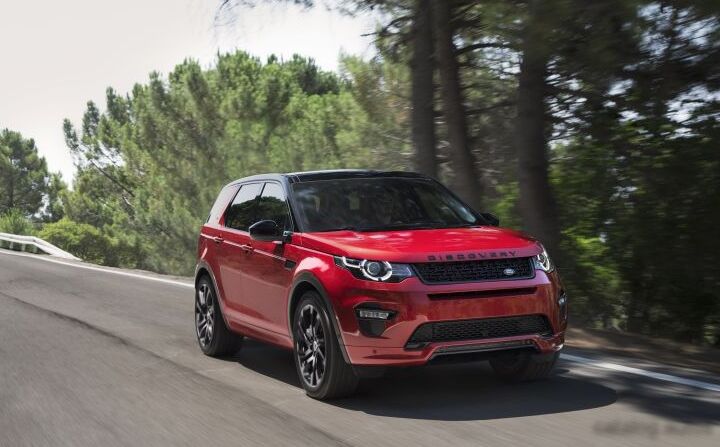
The Land Rover Discovery Sport 2.2 TD4, producing 150 horsepower, with all-wheel drive and a 9-speed automatic transmission, and offered with optional seven-seat configuration, was a key model in the initial launch of the Discovery Sport line. Introduced in 2014 and continuing through 2015, this variant represented an entry point into the Discovery Sport range, aiming to balance Land Rover’s off-road capability with reasonable fuel economy and a more accessible price point. It was built on the LR-MS platform, a monocoque chassis designed to provide a blend of rigidity and weight savings. This first generation Discovery Sport aimed to bridge the gap between the more luxurious Range Rover Evoque and the larger, more utilitarian Land Rover Discovery.
Technical Specifications
| Brand | Land Rover |
| Model | Discovery Sport |
| Type (Engine) | 2.2 TD4 (150 Hp) AWD Automatic 7 Seat |
| Start of production | 2014 |
| End of production | 2015 |
| Powertrain Architecture | Internal Combustion engine |
| Body type | SUV |
| Seats | 7 |
| Doors | 5 |
| Fuel consumption (combined) | 6.2 l/100 km (37.9 US mpg, 45.6 UK mpg, 16.1 km/l) |
| CO2 emissions | 164 g/km |
| Fuel Type | Diesel |
| Acceleration 0 – 100 km/h | 10.3 sec |
| Acceleration 0 – 62 mph | 10.3 sec |
| Acceleration 0 – 60 mph | 9.8 sec |
| Maximum speed | 180 km/h (111.85 mph) |
| Emission standard | Euro 5 |
| Weight-to-power ratio | 12.4 kg/Hp, 80.5 Hp/tonne |
| Weight-to-torque ratio | 4.7 kg/Nm, 214.7 Nm/tonne |
| Power | 150 Hp @ 3500 rpm |
| Power per litre | 68.8 Hp/l |
| Torque | 400 Nm @ 1750 rpm (295.02 lb.-ft. @ 1750 rpm) |
| Engine layout | Front, Transverse |
| Engine Model/Code | Duratorq / 224DT |
| Engine displacement | 2179 cm3 (132.97 cu. in.) |
| Number of cylinders | 4 |
| Engine configuration | Inline |
| Cylinder Bore | 85 mm (3.35 in.) |
| Piston Stroke | 96 mm (3.78 in.) |
| Compression ratio | 15.8:1 |
| Number of valves per cylinder | 4 |
| Fuel injection system | Diesel Commonrail |
| Engine aspiration | Turbocharger, Intercooler |
| Valvetrain | DOHC |
| Engine oil capacity | 5.9 l (6.23 US qt | 5.19 UK qt) |
| Coolant | 5.7 l (6.02 US qt | 5.02 UK qt) |
| Kerb Weight | 1863 kg (4107.21 lbs.) |
| Max. weight | 2600 kg (5732.02 lbs.) |
| Max load | 737 kg (1624.81 lbs.) |
| Fuel tank capacity | 65 l (17.17 US gal | 14.3 UK gal) |
| Max. roof load | 75 kg (165.35 lbs.) |
| Permitted trailer load with brakes (12%) | 2200 kg (4850.17 lbs.) |
| Permitted trailer load without brakes | 750 kg (1653.47 lbs.) |
| Permitted towbar download | 100 kg (220.46 lbs.) |
| Length | 4599 mm (181.06 in.) |
| Width with mirrors folded | 2069 mm (81.46 in.) |
| Width including mirrors | 2173 mm (85.55 in.) |
| Height | 1724 mm (67.87 in.) |
| Wheelbase | 2741 mm (107.91 in.) |
| Front track | 1621 mm (63.82 in.) |
| Rear (Back) track | 1630 mm (64.17 in.) |
| Ride height (ground clearance) | 212 mm (8.35 in.) |
| Drag coefficient (Cd) | 0.36 |
| Minimum turning circle | 11.6 m (38.06 ft.) |
| Approach angle | 25° |
| Departure angle | 31° |
| Ramp-over angle | 20° |
| Wading depth | 600 mm (23.62 in.) |
| Drive wheel | All wheel drive (4×4) |
| Number of gears and type of gearbox | 9 gears, automatic transmission |
| Front suspension | Independent coil spring |
| Rear suspension | Independent multi-link suspension |
| Front brakes | Ventilated discs, 325 mm |
| Rear brakes | Disc, 300 mm |
| Assisting systems | ABS (Anti-lock braking system) |
| Steering type | Steering rack and pinion |
| Power steering | Electric Steering |
Powertrain & Engine Architecture
The heart of the Discovery Sport 2.2 TD4 was the Duratorq 2.2-liter inline-four diesel engine, specifically the 224DT variant. This engine was part of the Ford/PSA joint venture engine family, known for its robustness and relatively good fuel efficiency. It featured a cast iron block and aluminum cylinder head, utilizing a common-rail direct injection system to deliver fuel at extremely high pressures for optimized combustion. The engine employed a variable geometry turbocharger (VGT) and an intercooler to boost power and torque while minimizing turbo lag. The DOHC valvetrain with four valves per cylinder further enhanced breathing and performance. The 9-speed automatic transmission, sourced from ZF, was a key feature. This transmission offered a wide range of gear ratios, contributing to both fuel economy and improved acceleration. It was designed to handle the engine’s torque output effectively and provide smooth shifts.
Driving Characteristics
The 150 horsepower and 400 Nm (295 lb-ft) of torque provided by the 2.2 TD4 engine delivered adequate, though not exhilarating, performance. Acceleration from 0-60 mph took around 9.8 seconds, making it competitive within its class but noticeably slower than higher-powered Discovery Sport variants. The 9-speed automatic transmission, while offering a wide range, could sometimes feel hesitant or ‘hunt’ for the right gear, particularly during quick acceleration. However, in steady-state cruising, it provided smooth and efficient operation. The all-wheel-drive system, featuring Terrain Response technology, allowed for confident handling on various surfaces, including gravel, snow, and mud. The emphasis was on usability and comfort rather than outright sportiness.
Equipment & Trim Levels
The 2.2 TD4 typically came with a respectable level of standard equipment. This included climate control, a touchscreen infotainment system (often with navigation as an option), alloy wheels, and a comprehensive suite of safety features like ABS, stability control, and multiple airbags. Interior upholstery was generally cloth, with leather options available as upgrades. Higher trim levels added features such as heated seats, a panoramic sunroof, and premium audio systems. The seven-seat option, while reducing cargo space, provided added versatility for families.
Chassis & Braking
The Discovery Sport’s chassis was designed to provide a balance between on-road comfort and off-road capability. It utilized independent suspension all around – coil springs at the front and a multi-link setup at the rear. The front brakes were ventilated discs measuring 325mm, while the rear brakes were solid discs measuring 300mm. The steering was electric power-assisted, providing a light and responsive feel. Stabilizer bars were fitted front and rear to reduce body roll during cornering. The suspension tuning was generally geared towards comfort, prioritizing ride quality over sharp handling.
Market Reception & Comparison
The Discovery Sport 2.2 TD4 was generally well-received by critics as a practical and capable family SUV. The 150 horsepower engine was considered adequate for most driving situations, but some reviewers noted that it could feel strained when fully loaded or tackling steep inclines. Fuel economy was a strong point, averaging around 38 mpg in combined driving. Compared to the higher-powered 2.0-liter petrol variants, the 2.2 TD4 offered better fuel efficiency and lower running costs, but at the expense of performance. Compared to the 2.2 SD4 (180 hp), the TD4 was positioned as the more affordable and economical option, targeting buyers who prioritized value and efficiency over outright power.
Legacy
The Duratorq engine, while robust, is known to require regular maintenance, particularly regarding the diesel particulate filter (DPF). Proper servicing and the use of quality diesel fuel are crucial to prevent DPF issues. The 9-speed automatic transmission, while generally reliable, has been known to experience occasional software glitches. Today, the Discovery Sport 2.2 TD4 represents a relatively affordable entry point into Land Rover ownership. Well-maintained examples continue to be sought after by buyers looking for a capable and practical SUV with a proven track record. Its blend of off-road ability, fuel efficiency, and practicality has ensured its continued relevance in the used car market.