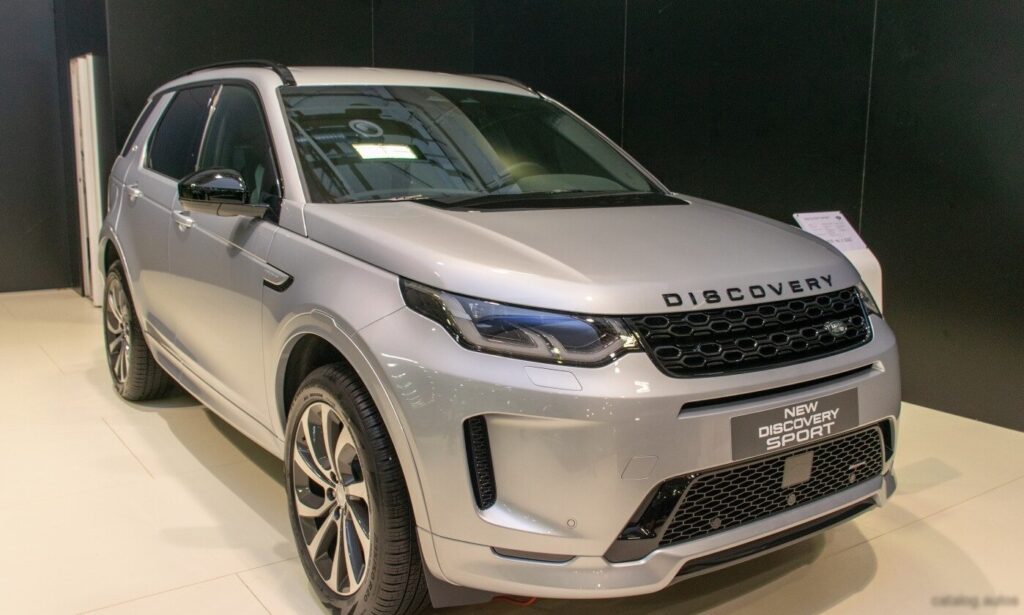
The Land Rover Discovery Sport 1.5 P300e, a plug-in hybrid variant, was introduced in April 2020 as part of the facelifted second-generation Discovery Sport (L550) model range. This version aimed to provide a more fuel-efficient and environmentally conscious option within the Discovery Sport lineup, appealing to buyers seeking reduced emissions and the benefits of electric driving. Positioned as a mid-to-high trim level, the P300e combined a 1.5-liter three-cylinder gasoline engine with an electric motor, delivering a combined system output of 309 horsepower. It played a key role in Land Rover’s strategy to electrify its range and meet increasingly stringent emissions regulations in Europe and other global markets.
Technical Specifications
| Brand | Land Rover |
| Model | Discovery Sport |
| Generation | Discovery Sport (facelift 2019) |
| Type (Engine) | 1.5 P300e (309 Hp) Plug-in Hybrid AWD Automatic |
| Start of production | April, 2020 |
| Powertrain Architecture | PHEV (Plug-in Hybrid Electric Vehicle) |
| Body type | SUV |
| Seats | 5 |
| Doors | 5 |
| Combined fuel consumption (WLTP) | 1.6-2 l/100 km (147 – 117.6 US mpg, 176.6 – 141.2 UK mpg, 62.5 – 50 km/l) |
| CO2 emissions (WLTP) | 36-44 g/km |
| Fuel consumption (NEDC, WLTP equivalent) | 2 l/100 km (117.6 US mpg, 141.2 UK mpg, 50 km/l) |
| CO2 emissions (NEDC, WLTP equivalent) | 46 g/km |
| Fuel Type | Petrol / electricity |
| Acceleration 0 – 100 km/h | 6.6 sec |
| Acceleration 0 – 62 mph | 6.6 sec |
| Acceleration 0 – 60 mph | 6.2 sec |
| Maximum speed | 209 km/h (129.87 mph) |
| Emission standard | Euro 6d |
| Weight-to-power ratio | 6.8 kg/Hp, 147.6 Hp/tonne |
| Weight-to-torque ratio | 3.9 kg/Nm, 258 Nm/tonne |
| All-electric range (WLTP) | 62 km (38.53 mi) |
| All-electric range (NEDC, WLTP equivalent) | 64 km (39.77 mi) |
| Electric motor power | 109 Hp |
| Electric motor Torque | 260 Nm (191.77 lb.-ft.) |
| Electric motor location | Rear axle, Transverse |
| System power | 309 Hp @ 5500 rpm |
| System torque | 540 Nm @ 2000-2500 rpm (398.28 lb.-ft. @ 2000-2500 rpm) |
| Power | 200 Hp |
| Power per litre | 133.6 Hp/l |
| Engine layout | Front, Transverse |
| Engine Model/Code | Ingenium / PT153 |
| Engine displacement | 1497 cm3 (91.35 cu. in.) |
| Number of cylinders | 3 |
| Engine configuration | Inline |
| Cylinder Bore | 83.01 mm (3.27 in.) |
| Piston Stroke | 92.35 mm (3.64 in.) |
| Compression ratio | 10.5:1 |
| Number of valves per cylinder | 4 |
| Fuel injection system | Direct injection |
| Engine aspiration | Turbocharger, Intercooler |
| Engine oil capacity | 5.9 l (6.23 US qt | 5.19 UK qt) |
| Coolant | 14.6 l (15.43 US qt | 12.85 UK qt) |
| Kerb Weight | 2093 kg (4614.28 lbs.) |
| Max. weight | 2750 kg (6062.71 lbs.) |
| Max load | 657 kg (1448.44 lbs.) |
| Trunk (boot) space – minimum | 1179 l (41.64 cu. ft.) |
| Trunk (boot) space – maximum | 1794 l (63.35 cu. ft.) |
| Fuel tank capacity | 57 l (15.06 US gal | 12.54 UK gal) |
| Max. roof load | 75 kg (165.35 lbs.) |
| Permitted trailer load with brakes (12%) | 1600 kg (3527.4 lbs.) |
| Permitted trailer load without brakes | 750 kg (1653.47 lbs.) |
| Permitted towbar download | 100 kg (220.46 lbs.) |
| Length | 4597 mm (180.98 in.) |
| Width with mirrors folded | 2069 mm (81.46 in.) |
| Width including mirrors | 2173 mm (85.55 in.) |
| Height | 1727 mm (67.99 in.) |
| Wheelbase | 2741 mm (107.91 in.) |
| Front track | 1626-1636 mm (64.02 – 64.41 in.) |
| Rear (Back) track | 1632-1642 mm (64.25 – 64.65 in.) |
| Front overhang | 901 mm (35.47 in.) |
| Rear overhang | 955 mm (37.6 in.) |
| Ride height (ground clearance) | 212 mm (8.35 in.) |
| Drag coefficient (Cd) | 0.33 |
| Minimum turning circle (turning diameter) | 12.14 m (39.83 ft.) |
| Approach angle | 22.8-25.0° |
| Departure angle | 28.2-30.2° |
| Ramp-over (brakeover) angle | 19.5° |
| Wading depth | 600 mm (23.62 in.) |
| Drivetrain Architecture | The Internal combustion engine (ICE) permanently drives the front wheels of the vehicle, the electric motor drives the rear wheels of the vehicle, capable of running in full electric mode, only by the Internal combustion engine (ICE) or in mixed mode. |
| Drive wheel | All wheel drive (4×4) |
| Number of gears and type of gearbox | 8 gears, automatic transmission |
| Front suspension | Independent type McPherson |
| Rear suspension | Independent multi-link suspension |
| Front brakes | Ventilated discs, 349 mm |
| Rear brakes | Ventilated discs, 325 mm |
| Assisting systems | ABS (Anti-lock braking system) |
| Steering type | Steering rack and pinion |
| Power steering | Electric Steering |
| Wheel rims size | 17; 18; 20 |
Powertrain & Engine Architecture
The 1.5 P300e utilizes Land Rover’s Ingenium engine family, specifically the PT153 three-cylinder turbocharged gasoline engine. This engine produces 200 horsepower and is paired with an 80 kW (109 hp) electric motor integrated into the rear axle. The combined system output is 309 horsepower and 540 Nm (398.28 lb-ft) of torque. The engine features direct fuel injection and a turbocharger with an intercooler to enhance performance. The 1.5-liter engine has a displacement of 1497 cc, a bore of 83.01 mm, and a stroke of 92.35 mm, operating with a compression ratio of 10.5:1. The electric motor draws power from a 15 kWh lithium-ion battery pack, enabling an all-electric range of up to 62 km (38.53 miles) under WLTP testing. The eight-speed automatic transmission, a staple of the Ingenium powertrain family, efficiently manages power delivery to all four wheels.
Driving Characteristics
The P300e offers a unique driving experience compared to other Discovery Sport variants. In electric mode, it provides near-silent and smooth acceleration, ideal for urban driving. When the gasoline engine engages, the transition is generally seamless. The combined power output delivers brisk acceleration, with a 0-60 mph time of around 6.2 seconds. The rear-mounted electric motor contributes to a balanced feel, particularly during cornering. While the 8-speed automatic transmission is responsive, it may exhibit occasional hesitation during kickdown maneuvers. Compared to the four-cylinder gasoline engines, the P300e offers a more refined and efficient driving experience, albeit with a slightly higher curb weight due to the battery pack.
Equipment & Trim Levels
The 1.5 P300e was typically offered in higher trim levels, such as HSE and R-Dynamic HSE. Standard features included leather upholstery, a touchscreen infotainment system with Apple CarPlay and Android Auto compatibility, navigation, climate control, and a suite of advanced driver-assistance systems (ADAS) like emergency braking and lane-keeping assist. Optional extras included a panoramic sunroof, premium audio systems, and adaptive cruise control. The interior design mirrored other Discovery Sport models, with a focus on practicality and comfort. Specific trim details, such as interior color schemes and exterior styling elements, varied depending on the chosen package.
Chassis & Braking
The Discovery Sport P300e utilizes an independent McPherson strut front suspension and an independent multi-link rear suspension. The suspension is tuned to provide a balance between ride comfort and handling. Ventilated disc brakes are fitted on all four wheels, providing ample stopping power. The braking system is enhanced by ABS (Anti-lock Braking System) and electronic brake-force distribution. Due to the added weight of the battery pack, the suspension components may be slightly reinforced compared to lower-weight variants. The vehicle’s all-wheel-drive system provides excellent traction in various conditions.
Market Reception & Comparison
The Discovery Sport P300e was generally well-received by automotive critics, who praised its fuel efficiency, electric range, and refined driving experience. However, some reviewers noted the slightly higher price compared to conventional gasoline models. Compared to the 2.0-liter four-cylinder gasoline variants, the P300e offered significantly better fuel economy and lower emissions, making it an attractive option for environmentally conscious buyers. Against competitors like the Volvo XC60 Recharge and BMW X3 xDrive30e, the Discovery Sport P300e offered a competitive blend of performance, practicality, and price.
Legacy
The Land Rover Discovery Sport 1.5 P300e represents an important step in Land Rover’s transition towards electrification. While long-term reliability data is still emerging, the Ingenium powertrain has proven to be generally robust. The P300e’s plug-in hybrid technology offers a compelling alternative to traditional gasoline engines, providing reduced running costs and environmental impact. On the used car market, these models are becoming increasingly sought after by buyers looking for a fuel-efficient and technologically advanced SUV. The P300e’s success paved the way for further electrification of the Discovery Sport range and Land Rover’s broader vehicle lineup.