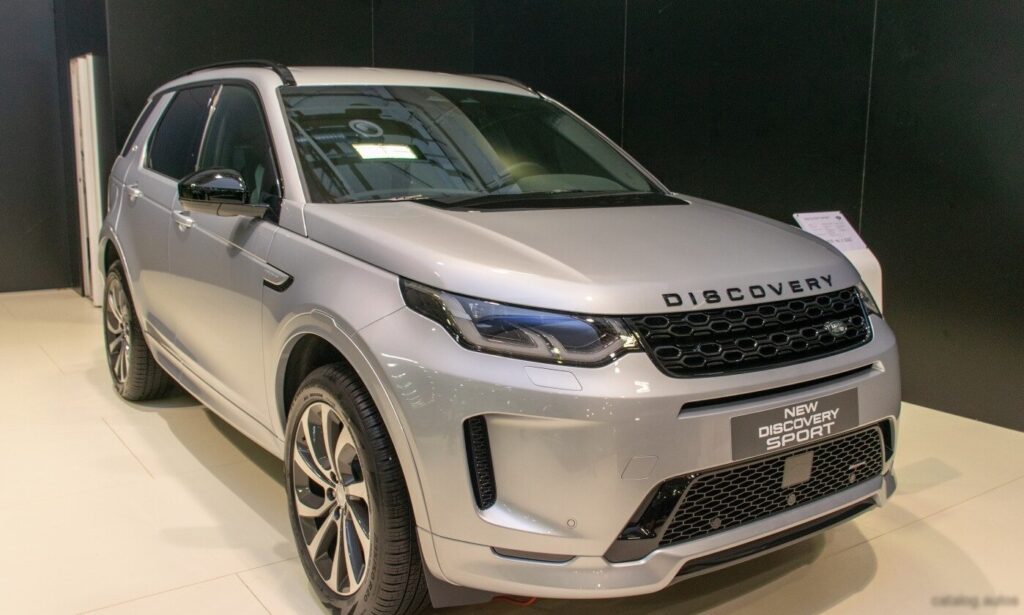
The Land Rover Discovery Sport 2.0 D165 (163 hp) represents a key variant within the facelifted first-generation Discovery Sport range, introduced in August 2020. Positioned as a mid-range offering, this model aimed to balance fuel efficiency with acceptable performance for everyday driving. It slots into the lineup below the more powerful diesel options (like the D200) and above the entry-level petrol variants. The facelift brought updated styling, improved technology, and refinements to the Ingenium engine family, making this version a significant evolution of the original Discovery Sport launched in 2014. This model is primarily aimed at the European and Asian markets, where diesel engines remain popular due to their fuel economy.
Technical Specifications
| Brand | Land Rover |
| Model | Discovery Sport |
| Generation | Discovery Sport (facelift 2019) |
| Type (Engine) | 2.0 D165 (163 Hp) |
| Start of production | August, 2020 |
| Powertrain Architecture | Internal Combustion engine |
| Body type | SUV |
| Seats | 5 |
| Doors | 5 |
| Combined fuel consumption (WLTP) | 6.3-6.7 l/100 km (37.3 – 35.1 US mpg, 44.8 – 42.2 UK mpg, 15.9 – 14.9 km/l) |
| CO2 emissions (WLTP) | 165-176 g/km |
| Fuel consumption (NEDC, WLTP equivalent) | 5.0 l/100 km (47 US mpg, 56.5 UK mpg, 20 km/l) |
| CO2 emissions (NEDC, WLTP equivalent) | 131 g/km |
| Fuel Type | Diesel |
| Acceleration 0 – 100 km/h | 10.4 sec |
| Acceleration 0 – 62 mph | 10.4 sec |
| Acceleration 0 – 60 mph | 9.8 sec |
| Maximum speed | 201 km/h (124.9 mph) |
| Emission standard | Euro 6 |
| Weight-to-power ratio | 10.9 kg/Hp, 92.1 Hp/tonne |
| Weight-to-torque ratio | 4.7 kg/Nm, 214.8 Nm/tonne |
| Power | 163 Hp @ 3750 rpm |
| Power per litre | 81.6 Hp/l |
| Torque | 380 Nm @ 1500-2500 rpm (280.27 lb.-ft. @ 1500-2500 rpm) |
| Engine layout | Front, Transverse |
| Engine Model/Code | Ingenium / 204DTD |
| Engine displacement | 1997 cm3 (121.86 cu. in.) |
| Number of cylinders | 4 |
| Engine configuration | Inline |
| Cylinder Bore | 83 mm (3.27 in.) |
| Piston Stroke | 92.31 mm (3.63 in.) |
| Compression ratio | 16.5:1 |
| Number of valves per cylinder | 4 |
| Fuel injection system | Diesel Commonrail |
| Engine aspiration | Turbocharger, Intercooler |
| Valvetrain | DOHC |
| Engine oil capacity | 6.5 l (6.87 US qt | 5.72 UK qt) |
| Kerb Weight | 1769 kg (3899.98 lbs.) |
| Trunk (boot) space – minimum | 897 l (31.68 cu. ft.) |
| Trunk (boot) space – maximum | 1794 l (63.35 cu. ft.) |
| Fuel tank capacity | 65 l (17.17 US gal | 14.3 UK gal) |
| AdBlue tank | 17.3 l (4.57 US gal | 3.81 UK gal) |
| Permitted trailer load with brakes (12%) | 1800 kg (3968.32 lbs.) |
| Permitted trailer load without brakes | 750 kg (1653.47 lbs.) |
| Length | 4597 mm (180.98 in.) |
| Width with mirrors folded | 2069 mm (81.46 in.) |
| Width including mirrors | 2173 mm (85.55 in.) |
| Height | 1727 mm (67.99 in.) |
| Wheelbase | 2741 mm (107.91 in.) |
| Front track | 1625-1636 mm (63.98 – 64.41 in.) |
| Rear (Back) track | 1631-1643 mm (64.21 – 64.69 in.) |
| Front overhang | 901 mm (35.47 in.) |
| Rear overhang | 955 mm (37.6 in.) |
| Ride height (ground clearance) | 212 mm (8.35 in.) |
| Drag coefficient (Cd) | 0.33 |
| Minimum turning circle (turning diameter) | 11.8 m (38.71 ft.) |
| Approach angle | 25° |
| Departure angle | 30.2° |
| Ramp-over (brakeover) angle | 20.6° |
| Wading depth | 600 mm (23.62 in.) |
| Drivetrain Architecture | The Internal combustion engine (ICE) drives the front wheels of the vehicle. |
| Drive wheel | Front wheel drive |
| Number of gears and type of gearbox | 6 gears, manual transmission |
| Front suspension | Independent type McPherson |
| Rear suspension | Independent multi-link suspension |
| Front brakes | Ventilated discs, 325-349 mm |
| Rear brakes | Disc, 300-325 mm |
| Assisting systems | ABS (Anti-lock braking system) |
| Steering type | Steering rack and pinion |
| Power steering | Electric Steering |
| Wheel rims size | 17; 18 |
INTRODUCTION
The Land Rover Discovery Sport 2.0 D165, introduced with the 2019 facelift, is a compact luxury SUV designed to appeal to buyers seeking a blend of practicality, style, and efficiency. Built on the Land Rover-Geely-developed 1HX0/A3 platform (shared with the Range Rover Evoque), the Discovery Sport aimed to fill a gap in Land Rover’s lineup – a more accessible and versatile option than the larger, more expensive Range Rover and Discovery models. The D165 variant, with its 2.0-liter Ingenium diesel engine, was positioned as a sensible choice for those prioritizing fuel economy and lower running costs. It was a popular choice in Europe, where diesel remained the dominant fuel type, and also found a niche market in Asia.
Powertrain & Engine Architecture
At the heart of the D165 is Land Rover’s Ingenium engine family. The 204DTD engine is a 2.0-liter inline-four cylinder diesel, utilizing a cast aluminum block and cylinder head. This engine features a sophisticated common-rail direct injection system, operating at pressures up to 2,500 bar, for optimized fuel atomization and combustion. The engine employs a single turbocharger with variable geometry turbine (VGT) technology, enhancing responsiveness and broadening the torque curve. The DOHC valvetrain, with four valves per cylinder, further contributes to the engine’s efficiency and power output. The 6-speed manual transmission was standard on this model, offering a balance between fuel economy and driver engagement. The transmission is a conventional design, known for its durability and relatively simple maintenance requirements.
Driving Characteristics
The 163 hp and 380 Nm (280 lb-ft) of torque delivered by the 2.0 D165 engine provide adequate performance for everyday driving. Acceleration from 0-60 mph takes around 9.8 seconds, and the top speed is 124.9 mph. While not particularly sporty, the engine offers a usable amount of power for overtaking and highway cruising. The manual transmission allows for greater driver control, but the gear ratios are tuned for fuel efficiency rather than outright performance. Compared to the higher-output D200 variant, the D165 feels noticeably less responsive, particularly at higher speeds. However, the lower power output also contributes to improved fuel economy, making it a more economical choice for those who prioritize running costs.
Equipment & Trim Levels
The Discovery Sport 2.0 D165 typically came equipped with a respectable level of standard features. These included climate control, a touchscreen infotainment system with navigation, Bluetooth connectivity, and a suite of safety features such as ABS, traction control, and multiple airbags. Interior upholstery was typically cloth, with leather options available as an upgrade. Common optional extras included a panoramic sunroof, heated seats, premium audio systems, and advanced driver-assistance systems like adaptive cruise control and park assist. Trim levels varied by market, but generally offered increasing levels of luxury and technology as you moved up the range.
Chassis & Braking
The Discovery Sport utilizes a robust chassis with independent suspension all around – McPherson struts at the front and a multi-link setup at the rear. This suspension configuration provides a comfortable ride quality, absorbing bumps and imperfections in the road effectively. Front brakes are ventilated discs, ranging from 325-349mm in diameter, while rear brakes are solid discs, typically measuring 300-325mm. The braking system is assisted by ABS and electronic brakeforce distribution (EBD) for enhanced safety. The D165 variant, being a front-wheel-drive model, generally features a smaller stabilizer bar compared to the all-wheel-drive versions.
Market Reception & Comparison
The Discovery Sport 2.0 D165 received generally positive reviews, with critics praising its stylish design, spacious interior, and comfortable ride. However, some reviewers noted that the 163 hp engine felt underpowered, particularly when fully loaded or tackling steep hills. Compared to the D200 variant, the D165 offered a more affordable entry point into the Discovery Sport range, but at the expense of performance. Fuel economy was a strong point, with the D165 achieving around 37.3-35.1 US mpg on the combined cycle. Reliability has been generally good, although some owners have reported minor issues with the infotainment system and electrical components.
Legacy
The Land Rover Discovery Sport 2.0 D165 remains a popular choice in the used car market, offering a compelling combination of practicality, style, and affordability. The Ingenium engine has proven to be relatively reliable, although regular maintenance is essential to ensure longevity. As with any diesel vehicle, it’s important to check for signs of wear and tear, particularly in the turbocharger and fuel injection system. The D165’s front-wheel-drive configuration makes it a more economical option than the all-wheel-drive variants, and its manual transmission appeals to drivers who prefer a more engaging driving experience. Overall, the Discovery Sport 2.0 D165 represents a well-rounded and capable compact SUV that continues to hold its value in the used car market.