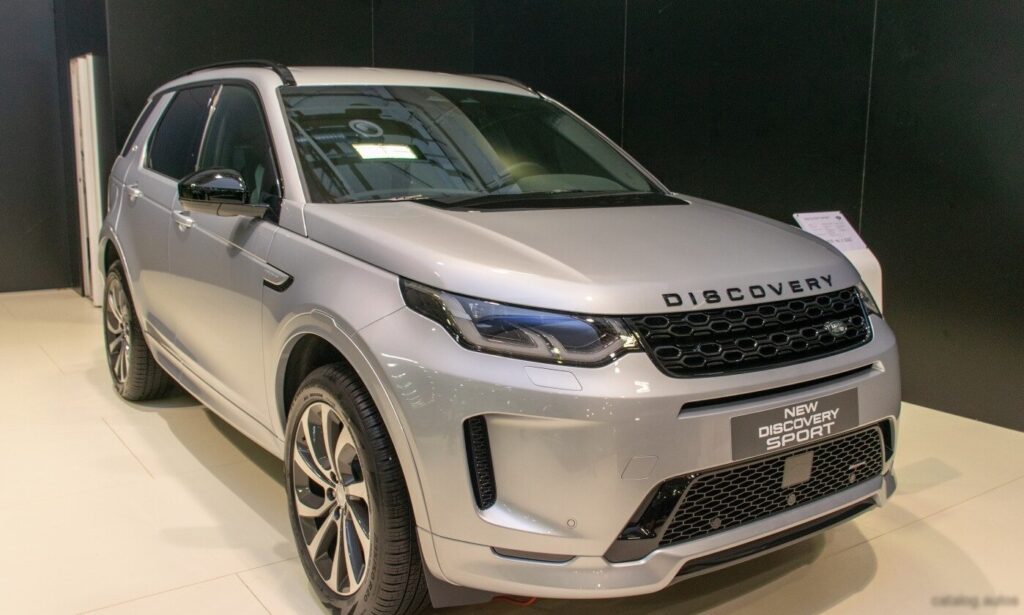
The Land Rover Discovery Sport 2.0 D165 (163 hp) 5+2 seating variant, introduced with the facelift in 2019 for the 2020 model year, represents a key entry point into the Discovery Sport lineup. Positioned as a more economical and accessible option, it offered the versatility of seven-passenger seating – a relatively uncommon feature in its compact luxury SUV segment – combined with a diesel engine focused on fuel efficiency. This model played a significant role in broadening the Discovery Sport’s appeal, particularly in European markets where diesel engines and smaller displacement options are highly favored. It builds upon the L550 Discovery Sport platform, first introduced in 2014, and benefits from the updates implemented during the 2019 facelift, including revised styling and enhanced technology.
Technical Specifications
| Brand | Land Rover |
| Model | Discovery Sport |
| Generation | Discovery Sport (facelift 2019) |
| Type (Engine) | 2.0 D165 (163 Hp) 5+2 Seating |
| Start of production | August, 2020 |
| Powertrain Architecture | Internal Combustion engine |
| Body type | SUV |
| Seats | 7 |
| Doors | 5 |
| Combined fuel consumption (WLTP) | 6.6-6.9 l/100 km (35.6 – 34.1 US mpg, 42.8 – 40.9 UK mpg, 15.2 – 14.5 km/l) |
| CO2 emissions (WLTP) | 172-180 g/km |
| Fuel consumption (NEDC, WLTP equivalent) | 5.1 l/100 km (46.1 US mpg, 55.4 UK mpg, 19.6 km/l) |
| CO2 emissions (NEDC, WLTP equivalent) | 134 g/km |
| Fuel Type | Diesel |
| Acceleration 0 – 100 km/h | 10.8 sec |
| Acceleration 0 – 62 mph | 10.8 sec |
| Acceleration 0 – 60 mph | 10.2 sec |
| Maximum speed | 200 km/h (124.27 mph) |
| Emission standard | Euro 6 |
| Weight-to-power ratio | 11.4 kg/Hp, 88.1 Hp/tonne |
| Weight-to-torque ratio | 4.9 kg/Nm, 205.3 Nm/tonne |
| Power | 163 Hp @ 3750 rpm |
| Power per litre | 81.6 Hp/l |
| Torque | 380 Nm @ 1500-2500 rpm (280.27 lb.-ft. @ 1500-2500 rpm) |
| Engine layout | Front, Transverse |
| Engine Model/Code | Ingenium / 204DTD |
| Engine displacement | 1997 cm3 (121.86 cu. in.) |
| Number of cylinders | 4 |
| Engine configuration | Inline |
| Cylinder Bore | 83 mm (3.27 in.) |
| Piston Stroke | 92.31 mm (3.63 in.) |
| Compression ratio | 16.5:1 |
| Number of valves per cylinder | 4 |
| Fuel injection system | Diesel Commonrail |
| Engine aspiration | Turbocharger, Intercooler |
| Valvetrain | DOHC |
| Engine oil capacity | 6.5 l (6.87 US qt | 5.72 UK qt) |
| Kerb Weight | 1851 kg (4080.76 lbs.) |
| Trunk (boot) space – minimum | 157 l (5.54 cu. ft.) |
| Trunk (boot) space – maximum | 1651 l (58.3 cu. ft.) |
| Fuel tank capacity | 65 l (17.17 US gal | 14.3 UK gal) |
| AdBlue tank | 17.3 l (4.57 US gal | 3.81 UK gal) |
| Permitted trailer load with brakes (12%) | 1800 kg (3968.32 lbs.) |
| Permitted trailer load without brakes | 750 kg (1653.47 lbs.) |
| Length | 4597 mm (180.98 in.) |
| Width with mirrors folded | 2069 mm (81.46 in.) |
| Width including mirrors | 2173 mm (85.55 in.) |
| Height | 1727 mm (67.99 in.) |
| Wheelbase | 2741 mm (107.91 in.) |
| Front track | 1625-1636 mm (63.98 – 64.41 in.) |
| Rear (Back) track | 1631-1643 mm (64.21 – 64.69 in.) |
| Front overhang | 901 mm (35.47 in.) |
| Rear overhang | 955 mm (37.6 in.) |
| Ride height (ground clearance) | 212 mm (8.35 in.) |
| Drag coefficient (Cd) | 0.33 |
| Minimum turning circle (turning diameter) | 11.8 m (38.71 ft.) |
| Approach angle | 25° |
| Departure angle | 30.2° |
| Ramp-over (brakeover) angle | 20.6° |
| Wading depth | 600 mm (23.62 in.) |
| Drivetrain Architecture | The Internal combustion engine (ICE) drives the front wheels of the vehicle. |
| Drive wheel | Front wheel drive |
| Number of gears and type of gearbox | 6 gears, manual transmission |
| Front suspension | Independent type McPherson |
| Rear suspension | Independent multi-link suspension |
| Front brakes | Ventilated discs, 325-349 mm |
| Rear brakes | Disc, 325 mm |
| Assisting systems | ABS (Anti-lock braking system) |
| Steering type | Steering rack and pinion |
| Power steering | Electric Steering |
| Wheel rims size | 17; 18 |
INTRODUCTION
The Land Rover Discovery Sport 2.0 D165 5+2, launched in 2020 as part of the facelifted first generation (L550), offered a compelling blend of practicality, luxury, and efficiency. It was designed to appeal to families needing occasional seven-passenger capability without the size and expense of larger SUVs. The “5+2” configuration features a pair of small, rear-facing seats suitable for children or short journeys. This variant utilized Land Rover’s Ingenium engine family, specifically the 2.0-liter four-cylinder diesel, tuned to produce 163 horsepower. It occupied the lower-mid range of the Discovery Sport lineup, sitting below the more powerful diesel options (like the D180 and D200) and the petrol variants.
Powertrain & Engine Architecture
At the heart of the 2.0 D165 is Land Rover’s Ingenium engine, specifically the 204DTD code. This engine is a turbocharged, four-cylinder diesel featuring direct injection and a double overhead camshaft (DOHC) valvetrain with four valves per cylinder. The turbocharger, coupled with an intercooler, helps to boost power and torque while maintaining reasonable fuel efficiency. The engine utilizes a common rail diesel injection system, delivering fuel at extremely high pressures for optimized combustion. The 163 hp output is achieved at 3750 rpm, while the peak torque of 380 Nm (280 lb-ft) is available from 1500-2500 rpm, providing good low-end grunt for everyday driving. This variant was typically paired with a 6-speed manual transmission, although an automatic transmission was also available as an option. The automatic transmission is a conventional torque converter type, prioritizing smooth shifts and ease of use over outright performance.
Driving Characteristics
The 2.0 D165, with its 163 hp and manual transmission, delivers a respectable, if not exhilarating, driving experience. Acceleration from 0-60 mph takes around 10.2 seconds, making it adequate for most driving situations but noticeably slower than the higher-powered variants. The engine’s strong low-end torque makes it feel more responsive in everyday driving than the horsepower figure might suggest. The manual gearbox is generally well-matched to the engine, with relatively short throws and a light clutch pedal. Compared to the automatic version, the manual offers more driver engagement and slightly improved fuel economy. However, the automatic provides greater convenience, particularly in urban traffic. The 5+2 seating configuration does impact cargo space when all seats are in use, but the rear seats can be folded flat to create a more generous luggage area.
Equipment & Trim Levels
The Discovery Sport 2.0 D165 5+2 typically came with a good level of standard equipment, including alloy wheels, automatic headlights, rain-sensing wipers, and a touchscreen infotainment system with Bluetooth connectivity. Higher trim levels, such as HSE, added features like leather upholstery, heated seats, a panoramic sunroof, and advanced driver-assistance systems like adaptive cruise control and lane departure warning. Optional extras included a premium sound system, navigation, and various styling enhancements. Interior upholstery was typically cloth on the base models, upgrading to leather on higher trims. The dashboard layout was consistent across the range, featuring a modern and minimalist design.
Chassis & Braking
The Discovery Sport utilizes a front-wheel-drive layout as standard, with all-wheel drive available as an option. The suspension consists of independent McPherson struts at the front and a multi-link setup at the rear, providing a comfortable ride quality. Front brakes are ventilated discs, ranging in size from 325-349mm depending on the trim level, while the rear brakes are solid discs. Anti-lock Braking System (ABS) is standard. The chassis is designed to balance on-road comfort with off-road capability, offering a reasonable degree of composure on both paved and unpaved surfaces. Stabilizer bars are fitted front and rear to reduce body roll during cornering.
Market Reception & Comparison
The Discovery Sport 2.0 D165 5+2 was generally well-received by critics as a practical and versatile family SUV. Its fuel economy, averaging around 35-40 mpg in real-world driving, was a key selling point. Compared to the more powerful diesel variants, the D165 offered a lower price point and slightly better fuel efficiency, but at the expense of performance. The 5+2 seating configuration was praised for its flexibility, although the rear seats were acknowledged to be best suited for children. Reliability reports have been mixed, with some owners reporting issues with the Ingenium engine’s diesel particulate filter (DPF) and electrical systems. However, many owners have reported trouble-free ownership experiences.
Legacy
The Land Rover Discovery Sport 2.0 D165 5+2 remains a popular choice in the used car market, offering a good balance of practicality, luxury, and affordability. The Ingenium engine, while not without its quirks, has proven to be generally durable when properly maintained. Regular servicing, including DPF regeneration and oil changes, is crucial for long-term reliability. The availability of parts and qualified mechanics is generally good, although specialist Land Rover technicians are recommended for more complex repairs. The 2.0 D165 represents a significant step forward in Land Rover’s efforts to offer a more efficient and accessible range of SUVs.